
Machine-translated by Google. Questions are authored in English.
Top

Electromagnetic Induction and Alternating Currents Questions and Answers

1.

Two circuits A and B are placed in close vicinity to each other. Circuit A comprises a galvanometer connected to two ends of the closed circuit. Circuit B comprises a battery and a key connected to two ends of the circuit. Initially the key is not inserted. Which of the following will be observed if the key is inserted and later removed ?

Exam Year(s)

CTET - 2026,

Answer: A

There are momentary galvanometer deflections in opposite directions that die out shortly.

This is electromagnetic induction. When the key is inserted, the current in circuit B rises from zero, so the magnetic field it produces through circuit A changes and induces a brief current in A, and the galvanometer deflects. Once the current in B is steady, the field stops changing and the deflection dies away.

When the key is removed, the current in B falls to zero, the field through A changes the other way, and the induced current flows in the opposite direction. So the deflections are in opposite directions, not the same direction, and there is an effect on removing the key as well as on inserting it.

Please log in or register to report this question.
2.

What is the value of induced EMF in a conductor of length 150 cm, moving at an angle of \(30^\circ\) to the direction of uniform magnetic field of flux density 1.2 wb/m\(^2\) with a velocity of 60 m/s?

Exam Year(s)

DSSSB AE - 2023,

Answer: A

The EMF induced in a conductor moving in a magnetic field is \(e = Blv\sin\theta\).


\[ \begin{aligned} e = 1.2 \times 1.5 \times 60 \times \sin 30^\circ \\ &= 108 \times 0.5 = 54\ \text{V} \end{aligned} \]


The length must be changed to 1.5 m. The value 60 V would result from taking \(\sin\theta = 0.555\), 45 V from a length of 1.25 m and 52 V has no basis. The answer is 54 V, option A.

Please log in or register to report this question.
3.

A 30 µF capacitor is connected to a 240 V, 50 Hz source. If the frequency of the source is changed from 50 Hz to 200 Hz, the capacitive reactance of the capacitor will

Exam Year(s)

IIT JAM - 2018,

Answer: C

The capacitive reactance will decrease by a factor of four.

Capacitive reactance is inversely proportional to frequency:

\[ \begin{aligned} X_C &= \frac{1}{2\pi f C} \\ \frac{X_{200}}{X_{50}} &= \frac{50}{200} = \frac{1}{4} \end{aligned} \]

The capacitance (30 µF) and supply voltage do not affect the ratio. 'Increase by four' would be true of an inductor, whose reactance \(X_L = 2\pi f L\) grows with frequency. The factor-of-two options would apply to a doubling of frequency, not a fourfold rise.

Please log in or register to report this question.
4.

A series LCR circuit contains \(L = 175\ mH\), \(C = 62.5\ \mu F\), and \(R = 40\ \Omega\) and is connected to a source of voltage amplitude \(E_{0} = 50\ V\) and angular frequency \(\omega = 400\ rad/s\).

Which of the following statements is correct?

Exam Year(s)

IIT JAM - 2026,

Answer: D

The correct statement is that the maximum voltage across the capacitor equals the maximum voltage across the resistor.

\[ \begin{aligned} X_L &= \omega L = 400 \times 0.175 = 70\ \Omega \\ X_C &= \frac{1}{\omega C} = \frac{1}{400 \times 62.5 \times 10^{-6}} = 40\ \Omega \\ Z &= \sqrt{40^{2} + (70 - 40)^{2}} = 50\ \Omega \end{aligned} \]

The current amplitude is \(I_0 = 50/50 = 1\) A, so the voltage amplitudes are \(V_R = 40\) V, \(V_L = 70\) V and \(V_C = 40\) V. The capacitor and resistor both carry 40 V.

The inductor's 70 V exceeds the 50 V source, which is possible because \(V_L\) and \(V_C\) are out of phase and partly cancel. The capacitor's 40 V is less than 60 V, and the resistor carries 40 V, not the full 50 V, because the circuit is not at resonance.

Please log in or register to report this question.

5.

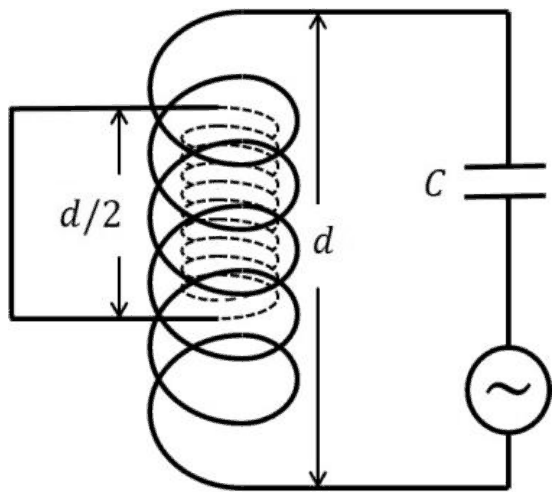
Consider a circuit consisting of a capacitor of capacitance \(C\) and a coil with \(N\) turns per unit length, cross sectional area \(S\) and length \(d\), where \(d^{2} \gg S\). There is another coil of length \(d/2\), cross sectional area \(S/2\) and \(2N\) turns per unit length completely inside the larger coil, as shown in the figure. The ends of this smaller coil are connected with each other by an insulated conducting wire. The self-inductance of the larger coil is \(L\). Neglecting edge effects and all the Ohmic resistances, the resonant frequency of the circuit is:

A coil of length d in a loop with a capacitor C and an AC source; a smaller coil of length d over 2 sits coaxially inside it with its two ends joined by a wire

Exam Year(s)

JEE Advanced - 2026,

Answer: C

The resonant frequency is \(\frac{2}{\sqrt{3\,LC}}\).

The smaller coil is a closed loop with no resistance, so the magnetic flux through it cannot change: it carries whatever current cancels the larger coil's field inside it. With the outer field \(\mu_{0}NI\) and the inner coil's field \(\mu_{0}(2N)i\), cancellation needs \(i = -\frac{I}{2}\), and the field inside the small coil's cross-section is zero.

Now count the flux linkage of the larger coil. Half its length (\(Nd/2\) turns) surrounds the small coil, where only the area \(S - \frac{S}{2}\) carries field; the other half sees the full area \(S\):

\[ \begin{aligned} \Phi &= \tfrac{Nd}{2}\,\mu_{0}NI\tfrac{S}{2} + \tfrac{Nd}{2}\,\mu_{0}NIS \\ &= \tfrac{3}{4}\,\mu_{0}N^{2}SdI = \tfrac{3}{4}LI \end{aligned} \]

So the effective inductance is \(\frac{3L}{4}\), and

\[ \begin{aligned} \omega_{0} &= \frac{1}{\sqrt{\frac{3}{4}LC}} \\ &= \frac{2}{\sqrt{3\,LC}} \end{aligned} \]

The other options would need an effective inductance of \(\frac{15L}{16}\), \(\frac{5L}{36}\) or \(\frac{3L}{2}\); none of these follows from the shorted coil, which can only reduce the inductance, and here by exactly a quarter.

Please log in or register to report this question.

6.

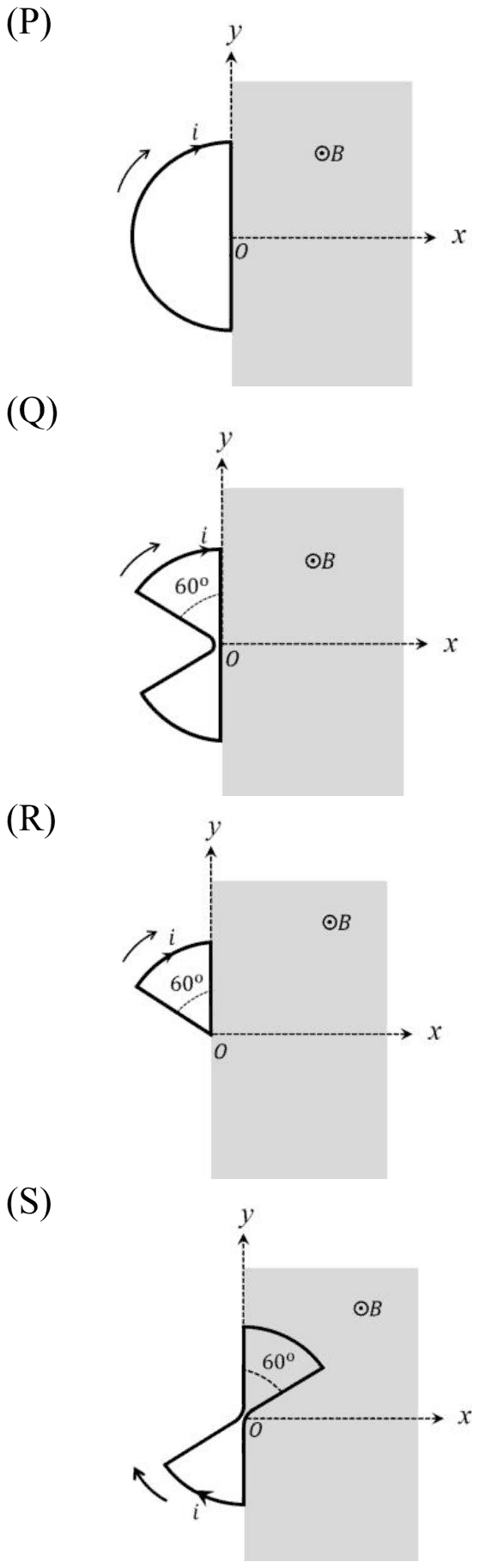
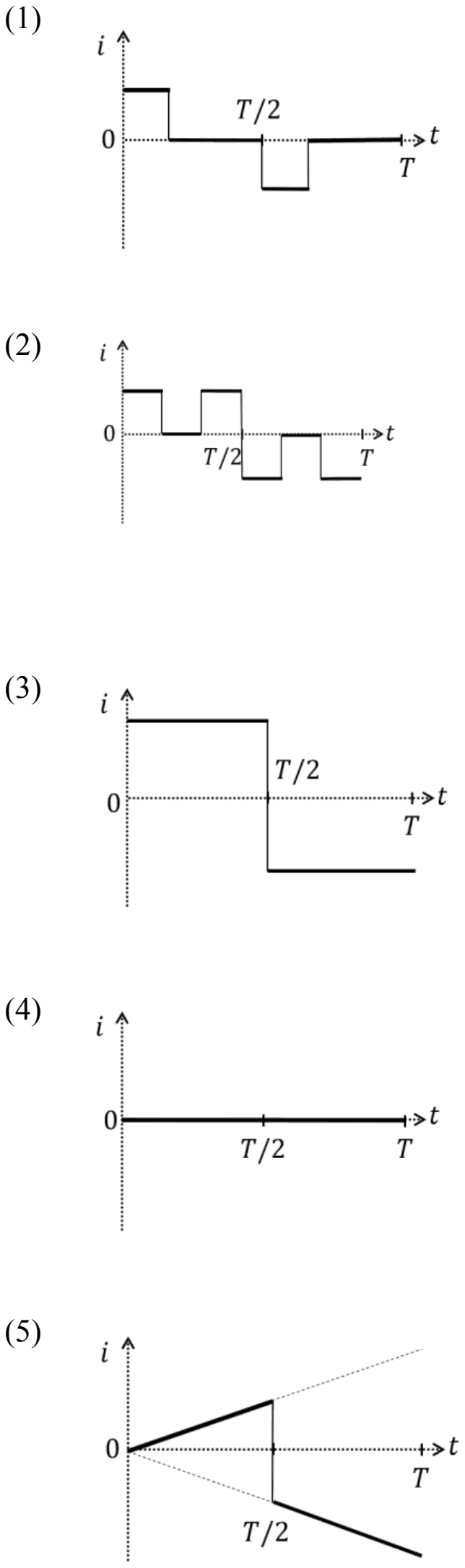
List-I contains four conducting loops lying in the \(XY\) plane, as shown in the figures. The loops are rotating about \(Z\) axis passing through the point \(O\) with time period \(T\) in clockwise direction. The region \(x \gt 0\) contains a uniform magnetic field \(B\) in the \(+z\) direction. List-II contains the qualitative variation of the induced current \(i(t)\) for each of these loops. Choose the option which describes the correct match between the entries in List-I to those in List-II.

List-I

List-I: four loops P, Q, R, S near the shaded field region x greater than 0

List-II

List-II: five graphs 1 to 5 of current against time over one period

Exam Year(s)

JEE Advanced - 2026,

Answer: C

The correct match is P → 3, Q → 2, R → 1, S → 4.

The emf is proportional to the rate of change of the flux through the part of the loop lying in \(x \gt 0\), and the current follows its sign. The loop turns clockwise through \(\omega t\).

(P) A half-disc moves into the field region at a steady rate: the field-filled area grows linearly during the first half period and shrinks linearly during the second. The emf is constant and reverses at \(\frac{T}{2}\): graph (3).

(R) A single 60° sector enters the field during the first sixth of the period, stays fully inside (constant flux, no current), then leaves between \(\frac{T}{2}\) and \(\frac{2T}{3}\): one positive pulse, a gap, then one negative pulse: graph (1).

(S) The two sectors lie opposite each other, so one leaves the field exactly as the other enters, and the total flux stays constant: no current, graph (4).

(Q) The two sectors enter and leave at different times, giving two pulses of each sign: graph (2), the only one left.

Please log in or register to report this question.

7.

The self-inductance of an air core solenoid is L. If the number of turns in the solenoid is doubled, keeping all other factors constant, then its self-inductance will be

Exam Year(s)

KEAM - 2025,

Answer: D

The self-inductance becomes \(4L\).

For a solenoid, \(L = \frac{\mu_{0}N^{2}A}{l}\). The field inside is proportional to \(N\), and the flux links all \(N\) turns, so \(L \propto N^{2}\). Doubling \(N\) with the same length and area multiplies \(L\) by \(2^{2} = 4\).

\(2L\) assumes \(L \propto N\), counting either the field or the linkage but not both. \(8L\) would be a cube law.

Please log in or register to report this question.

8.

An alternating current having the peak value \(10\sqrt{2}A\) is used to heat a metal wire. To produce the same heating effect, the constant current required is

Exam Year(s)

KEAM - 2025,

Answer: E

The constant current is 10A.

The heating effect of an alternating current equals that of a direct current equal to its rms value:

\[ \begin{aligned} I_{rms} &= \frac{I_{0}}{\sqrt{2}} \\ &= \frac{10\sqrt{2}}{\sqrt{2}} = 10\ \text{A} \end{aligned} \]

\(10\sqrt{2}\) A is the peak, which is reached only momentarily, so it would overheat the wire. 14 A is the peak rounded, and 5 A or 7 A halve the correct values.

Please log in or register to report this question.

9.

An iron ring is held horizontally and a bar magnet is dropped gently through the ring with its length coinciding with the axis of the ring. The acceleration of the freely falling magnet through the ring

(g = acceleration due to gravity)

Exam Year(s)

KEAM - 2025,

Answer: A

The acceleration of the magnet is less than g.

As the magnet falls through the ring, the magnetic flux through the ring changes, inducing currents (eddy currents) in the conducting iron ring. By Lenz's law these currents oppose the change that causes them: the ring repels the approaching magnet and attracts the receding one, so in both phases there is an upward force on the magnet and its acceleration is less than g.

It would equal g only if no current could be induced, and it cannot exceed g because the induced force always opposes the motion.

Please log in or register to report this question.

10.

The a.c circuit exhibiting the phenomenon of resonance has/have the circuit element(s)

Exam Year(s)

KEAM - 2025,

Answer: E

Resonance needs an inductor and capacitor.

Resonance in an a.c. circuit occurs at the frequency where the inductive reactance equals the capacitive reactance, \(X_{L} = X_{C}\), so that the two cancel: \(\omega_{0} = 1/\sqrt{LC}\). At that frequency the current in a series LCR circuit is a maximum. Both an inductor and a capacitor are needed, because the effect comes from energy passing back and forth between the magnetic field of one and the electric field of the other.

A circuit with only an inductor, only a capacitor, or either one with a resistor has a single kind of reactance and nothing to cancel it, so it cannot resonate. A resistor is not needed for resonance; it only limits the peak current and sets the sharpness of the resonance.

Please log in or register to report this question.

Loading…
Tags: Electromagnetic Induction and Alternating Currents Questions and Answers