
Machine-translated by Google. Questions are authored in English.
Top

Molecular Spectroscopy Questions and Answers

Direction for [ Question No: 1 To 2 ] :

A 20491 cm-1 laser line was used to excite oxygen molecules (made of 16O only) to obtain the rotational Raman spectrum. The resulting rotational Raman spectrum of oxygen molecule has the first Stokes line at 20479 cm-1.

1.

The rotational constant (usually denoted as B) for the oxygen molecule is

Exam Year(s)

GATE Chemistry - 2012,

Answer: A

The rotational constant is B = 1.2 cm-1.

The 16O nucleus has spin zero, and the ground state of O2 is 3Σg-. Nuclear spin statistics then allow only odd rotational levels (J = 1, 3, 5 ...). The first Stokes line is therefore J = 1 to J = 3, not J = 0 to J = 2. With rotational energies BJ(J + 1):

\[ \begin{aligned} \Delta\tilde{\nu} &= B(3 \cdot 4 - 1 \cdot 2) = 10B \\ 10B &= 20491 - 20479 = 12\ \text{cm}^{-1} \\ B &= 1.2\ \text{cm}^{-1} \end{aligned} \]

2.0 cm-1 is what the usual first-line shift of 6B (J = 0 to 2) would give, which is the trap here. 3.0 and 6.0 come from taking the shift as 4B or 2B.

Please log in or register to report this question.
2.

The next rotational Stokes line is expected at

Exam Year(s)

GATE Chemistry - 2012,

Answer: B

The next Stokes line is at 20469 cm-1.

The next allowed transition is J = 3 to J = 5, since only odd J levels are populated. Using B = 1.2 cm-1 from the previous question:

\[ \begin{aligned} \Delta\tilde{\nu} &= B(5 \cdot 6 - 3 \cdot 4) = 18B = 21.6\ \text{cm}^{-1} \\ \tilde{\nu} &= 20491 - 21.6 = 20469.4\ \text{cm}^{-1} \end{aligned} \]

Successive lines of 16O2 are 8B apart, about 9.6 cm-1, because every other level is missing. 20467 assumes the next line is a further 12 cm-1 away. 20471 and 20475 fit no allowed transition for B = 1.2 cm-1: the J = 3 to 5 line must lie 18B below the exciting line.

Please log in or register to report this question.

Answer: C

The allowed transition is \(^{1}\Sigma_{g}^{+} \rightarrow {}^{1}\Sigma_{u}^{+}\).

Electric dipole transitions in a diatomic molecule obey three rules that matter here:

  1. ΔS = 0: the spin multiplicity must not change;
  2. g ↔ u: parity must change (Laporte rule);
  3. for Σ to Σ transitions, + ↔ + and - ↔ -, never + ↔ -.

\(^{1}\Sigma_{g}^{+} \rightarrow {}^{1}\Sigma_{u}^{+}\) satisfies all three. The two transitions to \(^{3}\Sigma_{u}\) states change the multiplicity from singlet to triplet, so they are spin-forbidden. \(^{1}\Sigma_{g}^{+} \rightarrow {}^{1}\Sigma_{u}^{-}\) keeps the spin and changes parity, but goes from + to -, which is forbidden.

Please log in or register to report this question.

4.

The bond that gives the most intense band in the infrared spectrum for its stretching vibration is

Exam Year(s)

GATE Chemistry - 2012,

Answer: C

The most intense stretching band comes from O-H.

An infrared band's intensity is proportional to the square of the change in dipole moment during the vibration, (dμ/dr)2. The larger the electronegativity difference across the bond, the larger that change. Oxygen is the most electronegative of the four atoms bonded to hydrogen here, so the O-H stretch, near 3200-3600 cm-1, is strong and broad.

N-H is less polar and gives a weaker band. C-H is only slightly polar, and S-H, with sulfur's electronegativity close to that of carbon, gives one of the weakest bands, near 2550 cm-1.

Please log in or register to report this question.

5.

The pure vibrational spectrum of a hypothetical diatomic molecule shows three peaks with the following intensity at three different temperatures.

PeakIntensity (arbitrary unit)
300 K600 K900 K
I1.01.01.0
II0.10.10.1
III0.020.040.06

The CORRECT statement is

Exam Year(s)

GATE Chemistry - 2022,

Answer: C

Peak III appears at the lowest energy.

Peak I is the strongest and does not change with temperature: it is the fundamental, v = 0 to 1, from the ground level that holds almost all molecules. Peak II is ten times weaker and also temperature-independent: it is the first overtone, v = 0 to 2, which lies at almost twice the energy of the fundamental.

Peak III grows as the temperature rises, so it starts from a level whose population increases with temperature: it is a hot band, v = 1 to 2. Because of anharmonicity the vibrational levels get closer together as v increases, so the 1 to 2 gap is smaller than the 0 to 1 gap and the hot band lies just below the fundamental.

So in energy, peak III lies just below peak I and peak II lies highest. That makes 'peak I at the highest energy' wrong, and neither I nor II is the lowest.

Please log in or register to report this question.

6.

In the following table, the left column represents the rigid-rotor type and the right column shows a set of molecules.

P. Symmetric rotor (oblate)1. SiH4
Q. Symmetric rotor (prolate)2. CH3Cl
R. Spherical rotor3. C6H6
S. Asymmetric rotor4. CH3OH
5. CO2

The CORRECT match is

Exam Year(s)

GATE Chemistry - 2022,

Answer: B

The correct match is P-3, Q-2, R-1, S-4.

  • Benzene, C6H6, is a flat symmetric top: the two in-plane moments are equal and the moment about the six-fold axis is the largest, so it is an oblate symmetric rotor.
  • CH3Cl has a three-fold axis along C-Cl; the moment about that axis is the smallest and the other two are equal and larger, a prolate symmetric rotor.
  • SiH4 is tetrahedral, with all three moments equal: a spherical rotor.
  • CH3OH has no axis of three-fold or higher symmetry, so all three moments differ: an asymmetric rotor.

CO2 is linear and is the extra item. Options that call SiH4 oblate, benzene spherical, or CO2 or CH3OH prolate misclassify at least one molecule.

Please log in or register to report this question.

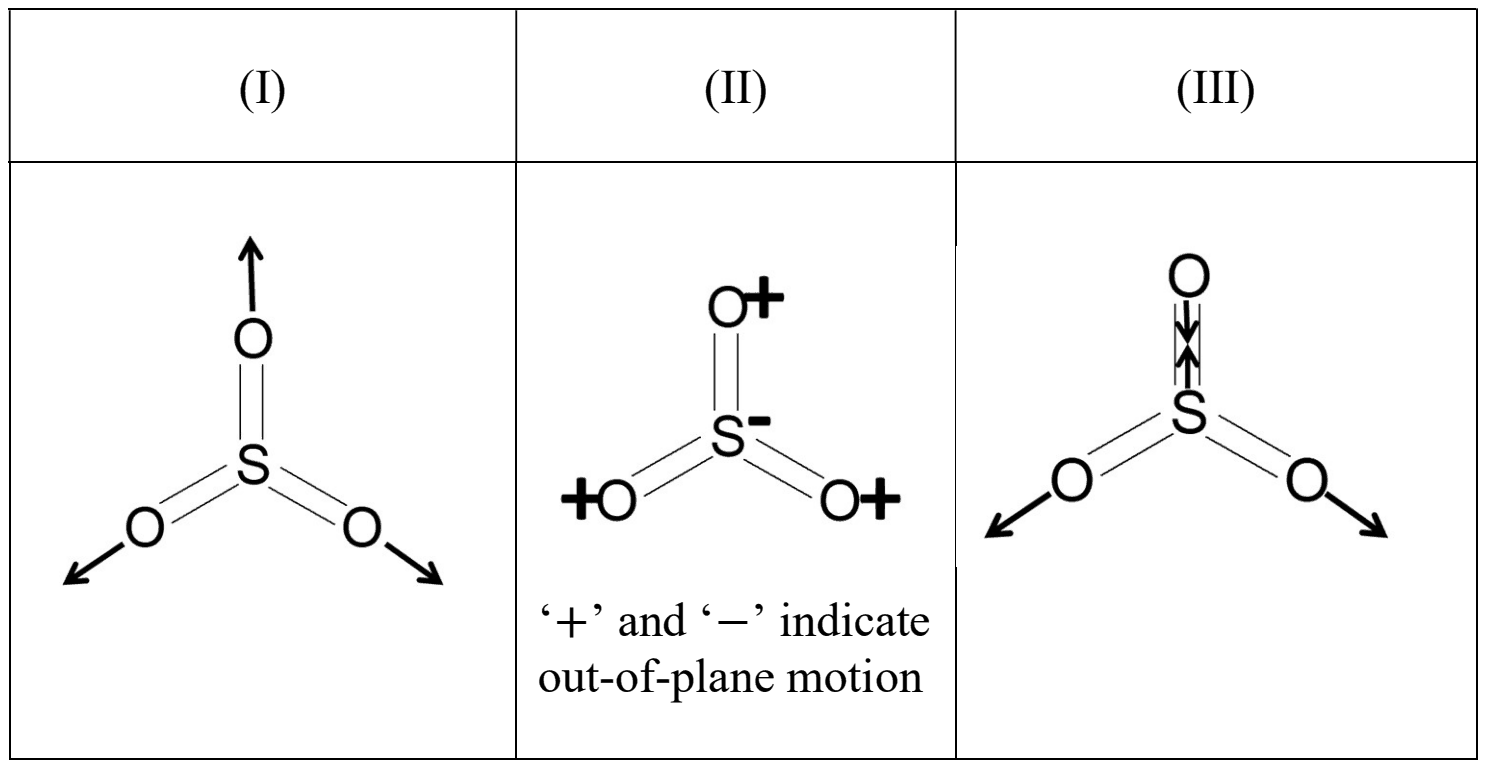
Answer: B

The correct statement is (I) is infrared inactive while (II) and (III) are infrared active.

A mode is IR active only if it changes the dipole moment. SO3 is trigonal planar (D3h).

  • (I): all three S-O bonds stretch in phase (the symmetric stretch, A1'). The molecule keeps its full symmetry and its dipole stays zero, so this mode is IR inactive (it is Raman active).
  • (II): S moves out of the plane one way and the three O atoms the other (A2''). This creates a dipole along the three-fold axis, so it is IR active.
  • (III): one S-O bond shortens while the other two lengthen, an asymmetric stretch (E'). The in-plane dipole changes, so it is IR active.

A zero permanent dipole does not make every mode inactive: what matters is whether the vibration makes the dipole oscillate, so the 'none of the modes' option is wrong, and the options calling (III) inactive or (I) active are wrong too.

Please log in or register to report this question.

8.

The molecule XY2 is microwave active and its vibration-rotation spectrum shows only P and R transitions. In the correct structure,

Exam Year(s)

GATE Chemistry - 2024,

Answer: C

The structure is Y as the central atom in linear XY2, that is X-Y-Y.

A vibration-rotation spectrum with only P and R branches and no Q branch is characteristic of a linear molecule (parallel bands). Being microwave active, the molecule must also have a permanent dipole moment.

A linear molecule with X in the middle, Y-X-Y, would be centrosymmetric and have no dipole, so it would be microwave inactive (like CO2). The unsymmetrical linear arrangement X-Y-Y has a dipole, as N2O (NNO) does. Bent molecules show a Q branch in their vibration-rotation bands, which rules out both bent options.

Please log in or register to report this question.

9.

Consider the following six vibrational modes:

symmetric stretching of CO2, O-H symmetric stretching of H2O, stretching of HCl, stretching of H2, N-H symmetric stretching of NH3, and bending of CO2.

Among these modes, if k number of modes are IR active but Raman inactive, l number of modes are IR inactive but Raman active, and m number of modes are both IR and Raman active.

k, l, and m, respectively, are

Exam Year(s)

GATE Chemistry - 2024,

Answer: C

k, l and m are 1, 2 and 3.

  • Symmetric stretch of CO2: no dipole change, polarisability changes: Raman only.
  • Stretch of H2: homonuclear, no dipole: Raman only.
  • Bend of CO2: dipole changes but, by the mutual exclusion rule for a centrosymmetric molecule, Raman inactive: IR only.
  • O-H symmetric stretch of H2O, the HCl stretch and the N-H symmetric stretch of NH3: molecules without a centre of symmetry, both IR and Raman active.

That gives k = 1 (IR only), l = 2 (Raman only) and m = 3 (both). The other options swap these counts.

Please log in or register to report this question.

10.

Among the following, the one for which the infrared active vibrational modes are Raman inactive and vice versa is

Exam Year(s)

GATE Chemistry - 2026,

Answer: B

The molecule is the trans-planar conformer of H2O2.

The question describes the rule of mutual exclusion: in a molecule with a centre of inversion, vibrations that are IR active (odd, u) are Raman inactive, and Raman-active (even, g) ones are IR inactive. Planar trans H-O-O-H belongs to \(C_{2h}\), which contains i, so the rule applies.

None of the others has a centre of inversion. H2O is \(C_{2v}\), and all three of its modes are both IR and Raman active. Eclipsed ethane is \(D_{3h}\) (it is the staggered form, \(D_{3d}\), that is centrosymmetric). CH4 is \(T_{d}\), and its t2 modes are active in both spectra.

Please log in or register to report this question.

Loading…
Tags: Molecular Spectroscopy Questions and Answers