
Machine-translated by Google. Questions are authored in English.
Top

Trigonometric Functions and Equations Questions and Answers

Direction for [ Question No: 1 To 1 ] :

Match each entry in List-I to the correct entry in List-II and choose the correct option.

1.

List-IList-II
(P) The number of elements in the set \(\{x \in [-\pi, \pi] : \sin^{6}x + \cos^{4}x = 1\}\)(1) is 1
(Q) The number of elements in the set \(\{x \in [-\frac{\pi}{2}, \frac{\pi}{2}] : \sin^{2}x + \cos^{6}x = 1\}\)(2) is 2
(R) The number of elements in the set \(\{x \in [-\pi, \pi] : \cos^{2}(\frac{x}{2}) - \sin^{2}x = \frac{1}{2}\}\)(3) is 3
(S) The number of elements in the set \(\{x \in [-2\pi, 2\pi] : 6\sin^{2}(\frac{x}{2}) - \cos 3x = 3\}\)(4) is 4
(5) is 5

Exam Year(s)

JEE Advanced - 2026,

Answer: B

The correct match is (P) → (5), (Q) → (3), (R) → (2), (S) → (4).

(P) Put \(s = \sin^{2}x\): \(s^{3} + (1 - s)^{2} = 1\) reduces to \(s(s + 2)(s - 1) = 0\), so \(s = 0\) or \(s = 1\). In \([-\pi, \pi]\), \(\sin x = 0\) at \(-\pi, 0, \pi\) and \(\sin^{2}x = 1\) at \(\pm\frac{\pi}{2}\): 5 elements.

(Q) Put \(c = \cos^{2}x\): \(1 - c + c^{3} = 1\) gives \(c(c - 1)(c + 1) = 0\), so \(c = 0\) or \(1\). In \([-\frac{\pi}{2}, \frac{\pi}{2}]\) that is \(x = \pm\frac{\pi}{2}\) and \(x = 0\): 3 elements.

(R) Using \(\cos^{2}\frac{x}{2} = \frac{1 + \cos x}{2}\) and \(\sin^{2}x = 1 - \cos^{2}x\):

\[ \begin{aligned} 2\cos^{2}x + \cos x - 2 &= 0 \\ \cos x &= \frac{-1 \pm \sqrt{17}}{4} \end{aligned} \]

Only \(\frac{-1 + \sqrt{17}}{4} \approx 0.78\) lies in \([-1, 1]\), and it is taken once on each side of 0 in \([-\pi, \pi]\): 2 elements.

(S) \(6\sin^{2}\frac{x}{2} = 3 - 3\cos x\), so the equation becomes \(3\cos x + \cos 3x = 0\). With \(\cos 3x = 4\cos^{3}x - 3\cos x\) this is \(4\cos^{3}x = 0\), so \(\cos x = 0\): \(x = \pm\frac{\pi}{2}, \pm\frac{3\pi}{2}\), 4 elements.

Only the second option has 5, 3, 2, 4 in order.

Please log in or register to report this question.
2.

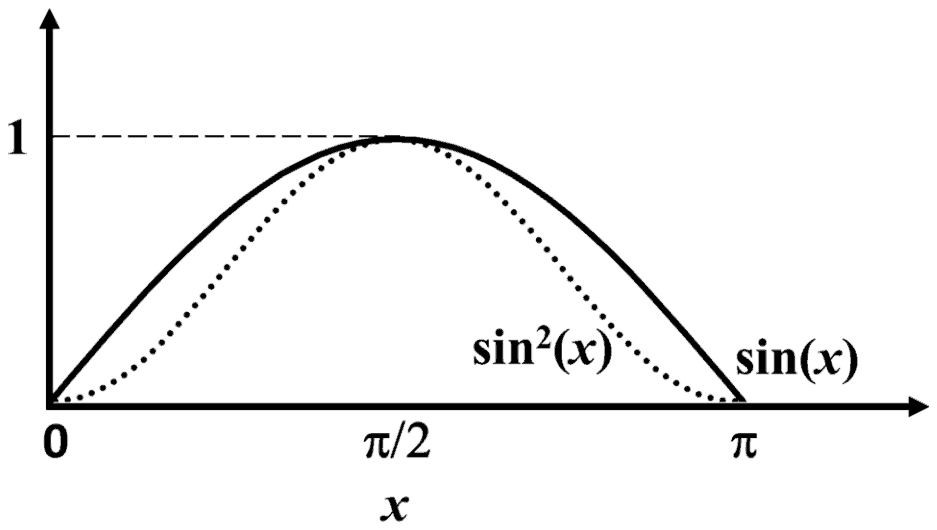
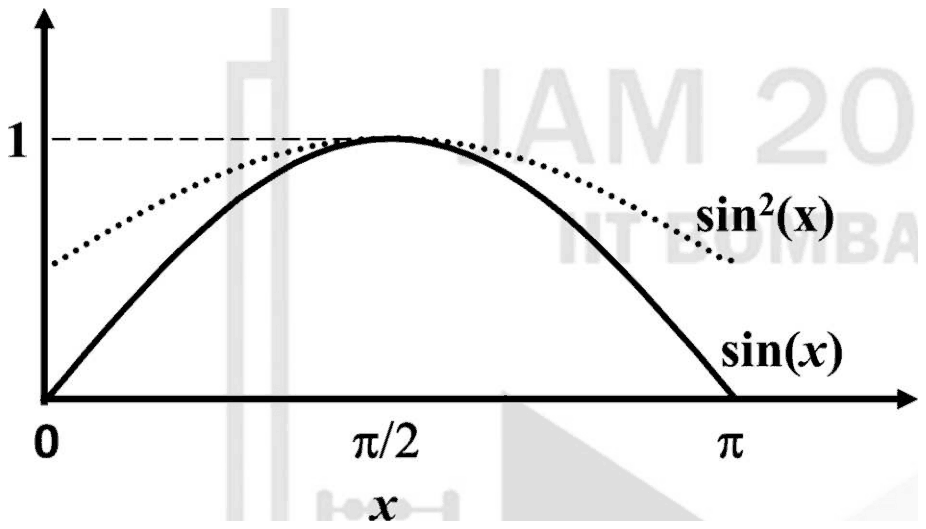
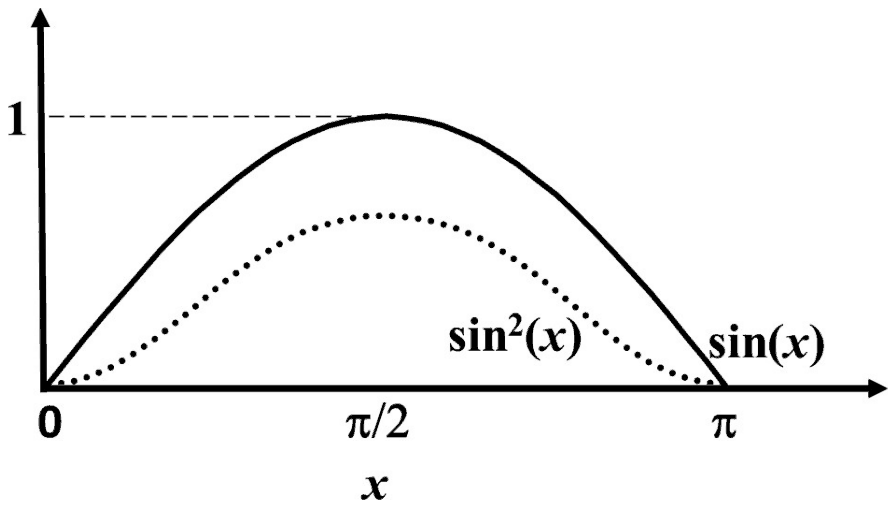
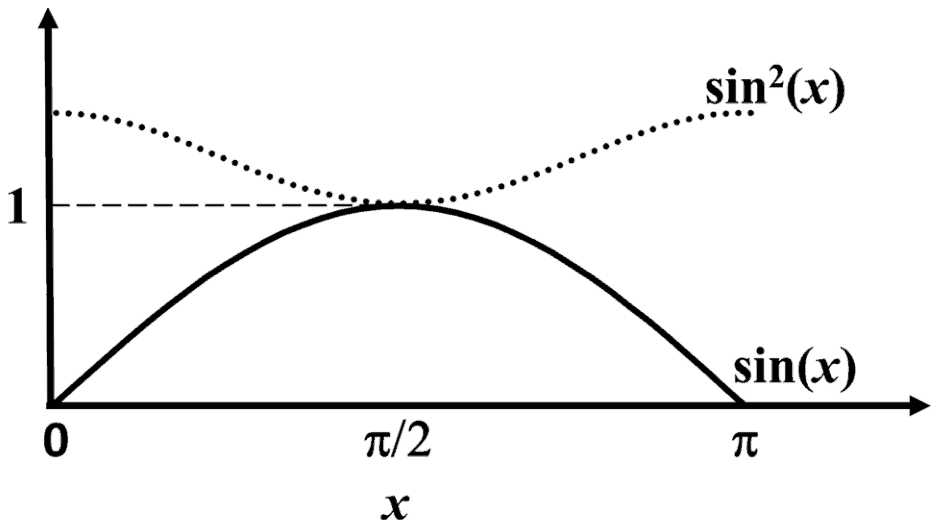
Which one of the following is the correct graphical representation for functions, sin(x) and sin2(x) for \(0 \le x \le \pi\)?

Exam Year(s)

IIT JAM - 2026,

Answer: A

The correct pair of graphs is the one in option (A).

On \(0 \le x \le \pi\) the sine is between 0 and 1, and squaring a number between 0 and 1 makes it smaller. So \(\sin^{2}x \le \sin x\) everywhere, the two curves meet only at \(x = 0\), \(\pi/2\) and \(\pi\), and both reach exactly 1 at \(\pi/2\). Near 0 and \(\pi\) the square is much flatter, because \(\sin^{2}x \approx x^{2}\) there.

Option (B) shows \(\sin^{2}x\) starting above zero at \(x = 0\), but \(\sin^{2}0 = 0\). Option (C) has the square peaking below 1, but \(\sin^{2}(\pi/2) = 1\). Option (D) puts \(\sin^{2}x\) above \(\sin x\) and above 1, which can never happen.

Please log in or register to report this question.
3.

Considering only the principal values of the inverse trigonometric functions, the value of

\(\cot^{-1}(\cot(-11)) + 10\sin(2\cos^{-1}(\frac{1}{\sqrt{2}}))\)
\(+\, 10\sin(2\tan^{-1}(2))\)

is

Exam Year(s)

JEE Advanced - 2026,

Answer: C

The value is \(4\pi + 7\).

The principal value of \(\cot^{-1}\) lies in \((0, \pi)\), and cot has period \(\pi\), so add multiples of \(\pi\) to \(-11\) until it lands in that interval: \(-11 + 4\pi \approx 1.566\), which lies in \((0, \pi)\). So \(\cot^{-1}(\cot(-11)) = 4\pi - 11\).

\[ \begin{aligned} 10\sin\left(2 \cdot \tfrac{\pi}{4}\right) &= 10 \\ \sin(2\tan^{-1} 2) &= \frac{2 \cdot 2}{1 + 2^{2}} = \frac{4}{5} \\ \text{total} &= (4\pi - 11) + 10 + 8 = 4\pi + 7 \end{aligned} \]

The answer 7 comes from writing \(\cot^{-1}(\cot(-11)) = -11\), forgetting the principal range. \(3\pi + 7\) uses \(3\pi - 11\), which is negative and so also outside \((0, \pi)\).

Please log in or register to report this question.
4.

Let \(f(x) = cosx\). Then the value of \(\frac{1}{2}[f(x + y) + f(y - x)] - f(x)f(y)\) is equal to

Exam Year(s)

KEAM - 2025,

Answer: E

The value is 0.

Use the sum formula \(\cos C + \cos D = 2\cos\frac{C + D}{2}\cos\frac{C - D}{2}\) with \(C = x + y\), \(D = y - x\):

\[ \begin{aligned} \cos(x + y) + \cos(y - x) &= 2\cos y \cos x \\ \tfrac{1}{2}[\ldots] &= \cos x \cos y \end{aligned} \]

Subtracting \(f(x)f(y) = \cos x \cos y\) leaves 0 for every \(x\) and \(y\). Since the expression is identically zero, the constants 2, -2, 1 and -1 cannot be right; for example \(x = y = 0\) gives \(\tfrac{1}{2}(1 + 1) - 1 = 0\).

Please log in or register to report this question.
5.

\(tan15^{\circ} + tan75^{\circ}\)=

Exam Year(s)

KEAM - 2025,

Answer: D

\(\tan 15^{\circ} + \tan 75^{\circ} = \) 4.

Since \(\tan 75^{\circ} = \cot 15^{\circ}\), write \(\theta = 15^{\circ}\):

\[ \begin{aligned} \tan\theta + \cot\theta &= \frac{\sin^{2}\theta + \cos^{2}\theta}{\sin\theta\cos\theta} \\ &= \frac{2}{\sin 2\theta} = \frac{2}{\sin 30^{\circ}} = 4 \end{aligned} \]

Directly: \(\tan 15^{\circ} = 2 - \sqrt{3}\) and \(\tan 75^{\circ} = 2 + \sqrt{3}\), which add to 4. Their product is 1, not their sum; 2 is what you get by taking each tangent as 1, and 0 would need the two angles to be negatives of each other.

Please log in or register to report this question.

6.

If \(x + z = 2y\) and \(y = \frac{\pi}{4}\) ,then tan \(x\) tan \(y\) tan \(z\)=

Exam Year(s)

KEAM - 2025,

Answer: A

\(\tan x \tan y \tan z = \) 1.

With \(y = \frac{\pi}{4}\), \(\tan y = 1\) and \(x + z = 2y = \frac{\pi}{2}\), so \(z = \frac{\pi}{2} - x\).

\[ \begin{aligned} \tan z &= \tan\left(\tfrac{\pi}{2} - x\right) = \cot x \\ \tan x \tan y \tan z &= \tan x \cdot 1 \cdot \cot x = 1 \end{aligned} \]

The product is the constant 1, so it cannot equal \(\tan(x - y)\) or \(\tan(z - y)\), which vary with \(x\); nor 0 or 1/2.

Please log in or register to report this question.

7.

If sin \(x\) + sin \(y = a\) ,cos \(x\) + cos \(y = b\) and \(x + y = \frac{2\pi}{3}\), then the value of \(\frac{a}{b}\) is equal to

Exam Year(s)

KEAM - 2025,

Answer: C

\(\frac{a}{b} = \) \(\sqrt{3}\).

Apply the sum-to-product formulas to both sums:

\[ \begin{aligned} a &= 2\sin\tfrac{x + y}{2}\cos\tfrac{x - y}{2} \\ b &= 2\cos\tfrac{x + y}{2}\cos\tfrac{x - y}{2} \\ \frac{a}{b} &= \tan\tfrac{x + y}{2} = \tan\tfrac{\pi}{3} = \sqrt{3} \end{aligned} \]

\(\frac{\sqrt{3}}{3}\) is \(\tan\frac{\pi}{6}\) or \(\cot\frac{\pi}{3}\), from inverting the ratio. Using \(\tan(x + y)\) instead of the half-angle gives \(-\sqrt{3}\), which is not offered.

Please log in or register to report this question.

8.

If sin \(\alpha = \frac{12}{13}\), where \(\frac{\pi}{2} \lt \alpha \lt \frac{3\pi}{2}\) then the value of tan \(\alpha\) is equal to

Exam Year(s)

KEAM - 2025,

Answer: C

\(\tan\alpha = \) \(\frac{-12}{5}\).

Between \(\frac{\pi}{2}\) and \(\frac{3\pi}{2}\) the sine is positive only in the second quadrant, so \(\alpha\) is there and \(\cos\alpha\) is negative:

\[ \begin{aligned} \cos\alpha &= -\sqrt{1 - \tfrac{144}{169}} = -\tfrac{5}{13} \\ \tan\alpha &= \frac{12/13}{-5/13} = -\frac{12}{5} \end{aligned} \]

\(\frac{5}{12}\) is the cotangent with the sign dropped; \(\frac{13}{5}\) and \(\frac{-13}{5}\) are \(\pm\sec\alpha\), not \(\tan\alpha\).

Please log in or register to report this question.

9.

If \(f(x) = \tan^{-1}\left(\dfrac{2x}{1 - x^{2}}\right)\), then \(f\left(\dfrac{1}{\sqrt{3}}\right)\) is equal to

Exam Year(s)

KEAM - 2025,

Answer: C

\(f\left(\frac{1}{\sqrt{3}}\right) = \) \(\frac{\pi}{3}\).

Substitute directly:

\[ \begin{aligned} \frac{2x}{1 - x^{2}} &= \frac{2/\sqrt{3}}{1 - 1/3} = \frac{2/\sqrt{3}}{2/3} = \sqrt{3} \\ f &= \tan^{-1}\sqrt{3} = \frac{\pi}{3} \end{aligned} \]

This agrees with the identity \(\tan^{-1}\frac{2x}{1 - x^{2}} = 2\tan^{-1}x\) for \(|x| \lt 1\): \(2 \cdot \frac{\pi}{6} = \frac{\pi}{3}\). \(\frac{\pi}{6}\) forgets the factor 2; \(\frac{2\pi}{3}\) and \(\frac{4\pi}{3}\) lie outside the principal range \(\left(-\frac{\pi}{2}, \frac{\pi}{2}\right)\).

Please log in or register to report this question.

10.

if 5 \(sin^{-1}\alpha + 3cos^{-1}\alpha = \pi\) ,then \(\alpha\) is equal to

Exam Year(s)

KEAM - 2025,

Answer: C

\(\alpha = \) \(\frac{-1}{\sqrt{2}}\).

Use \(\cos^{-1}\alpha = \frac{\pi}{2} - \sin^{-1}\alpha\):

\[ \begin{aligned} 5\sin^{-1}\alpha + \tfrac{3\pi}{2} - 3\sin^{-1}\alpha &= \pi \\ 2\sin^{-1}\alpha &= -\tfrac{\pi}{2} \\ \sin^{-1}\alpha &= -\tfrac{\pi}{4} \end{aligned} \]

So \(\alpha = \sin\left(-\frac{\pi}{4}\right) = -\frac{1}{\sqrt{2}}\). Check: \(5(-\frac{\pi}{4}) + 3(\frac{3\pi}{4}) = \pi\). \(\frac{1}{\sqrt{2}}\) loses the sign; 1 and -1 give \(\frac{5\pi}{2}\) and \(\frac{\pi}{2}\) instead.

Please log in or register to report this question.

Loading…
Tags: Trigonometric Functions and Equations Questions and Answers