
Machine-translated by Google. Questions are authored in English.
Top

Organic Evolution Questions and Answers

1.

Match the following evolutionary biologists with their respective theory

I) August Weismani) Neutral theory of molecular evolution
II) Jean-Baptiste Lamarkii) Handicap principle
III) Amotz Zahaviiii) Germ plasm theory
IV) Motoo Kimuraiv) Inheritance of acquired characteristics

Exam Year(s)

GATE Life Sciences - 2012,

Answer: B

The correct match is I-iii, II-iv, III-ii, IV-i.

  • August Weismann proposed the germ plasm theory: hereditary material passes through the germ line, unaffected by the body (I-iii).
  • Jean-Baptiste Lamarck is known for the inheritance of acquired characteristics (II-iv).
  • Amotz Zahavi proposed the handicap principle: costly signals such as a peacock's tail are honest because only fit individuals can afford them (III-ii).
  • Motoo Kimura developed the neutral theory of molecular evolution (IV-i).

The other options swap Zahavi and Kimura or misplace Weismann and Lamarck.

Please log in or register to report this question.
2.

Consider a large population of a finch species, where both small and big beak sizes are advantageous, and an intermediate beak size is maladaptive. Over a period of 10 years, which one of the following evolutionary processes is most likely to operate on the beak size of this finch population?

Exam Year(s)

GATE Life Sciences - 2024,

Answer: B

The process most likely to act is disruptive selection.

When both extremes of a trait are favoured and the intermediate is selected against, selection pushes the population towards two peaks. That is disruptive (diversifying) selection, and given enough time it can split the population into two beak-size types.

Directional selection favours one extreme only. Stabilizing selection is the opposite case, favouring the intermediate. Genetic drift is random change, most important in small populations, while this population is described as large and under clear selection.

Please log in or register to report this question.

3.

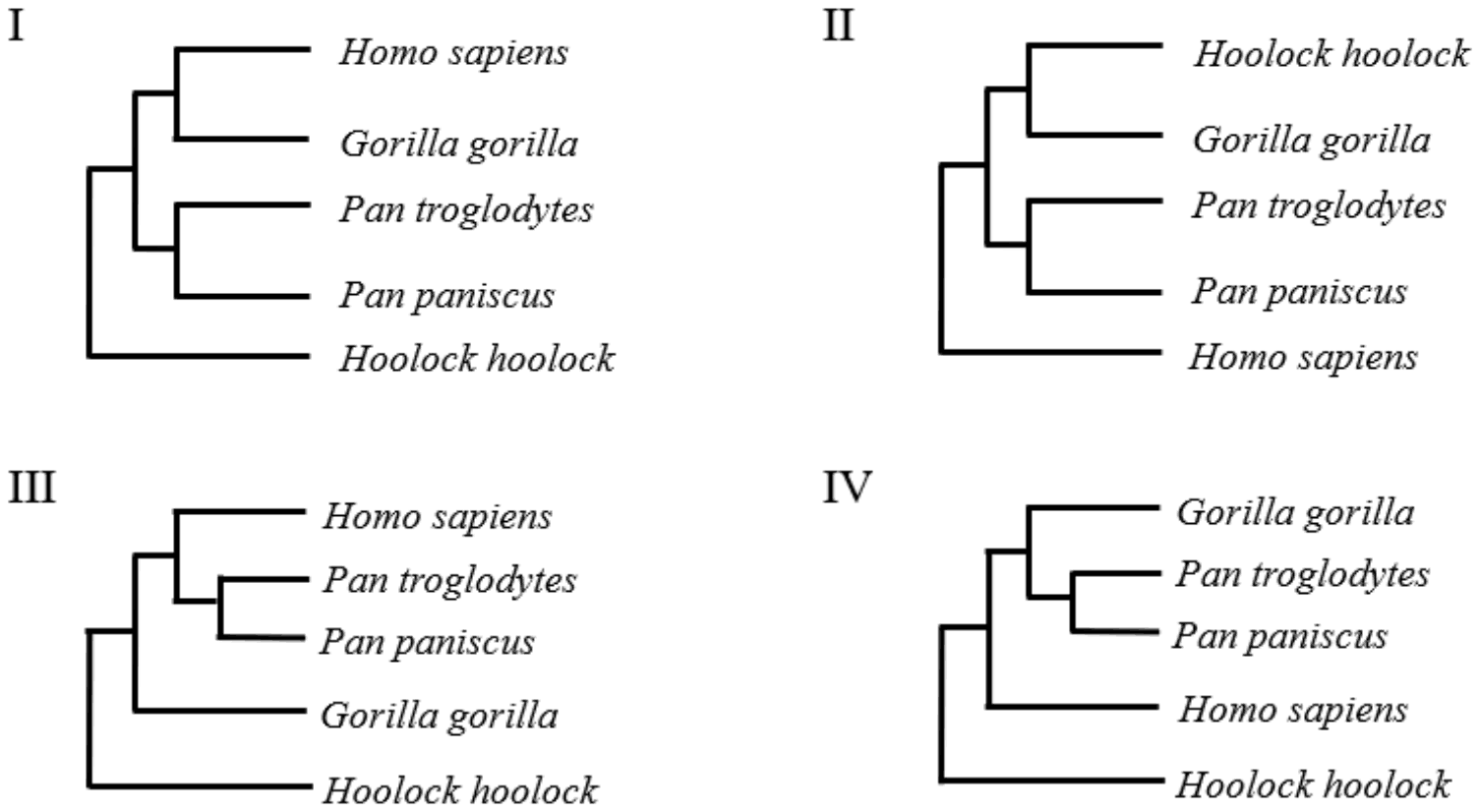
Which one of the following rooted tree topologies best describes the primate phylogeny?

Four rooted trees I to IV of Homo sapiens, Pan troglodytes, Pan paniscus, Gorilla gorilla and Hoolock hoolock. III groups Homo with the two Pan species, then Gorilla, with Hoolock outermost; I pairs Homo with Gorilla; II roots on Homo; IV pairs Gorilla with Pan.

Exam Year(s)

GATE Life Sciences - 2024,

Answer: C

The best tree is III.

Molecular evidence places humans and the two chimpanzee species, Pan troglodytes and Pan paniscus (bonobo), as each other's closest relatives. The two Pan species are sisters, the human lineage joins them, the gorilla branches off before that, and the gibbon (Hoolock hoolock) is the outgroup to all the great apes. Tree III shows exactly this order.

Tree I pairs humans with gorillas, tree II makes humans the outgroup with the gibbon nested among apes, and tree IV puts gorillas closer to Pan than humans are.

Please log in or register to report this question.

4.

Which one of the following is a "post-zygotic" isolating mechanism of speciation?

Exam Year(s)

GATE Life Sciences - 2025,

Answer: C

The post-zygotic mechanism is hybrid sterility.

Reproductive isolating barriers are classed by whether they act before or after a zygote forms. Hybrid sterility acts after: the zygote forms and the hybrid develops, often vigorously, but cannot reproduce. The mule, a sterile horse-donkey hybrid, is the usual example; hybrid inviability and hybrid breakdown are the other post-zygotic barriers.

Behavioral isolation (different courtship) and seasonal isolation (breeding at different times) prevent mating altogether, and fertilization failure (gametic isolation) prevents the zygote from forming. All three are pre-zygotic.

Please log in or register to report this question.

5.

First vertebrates appear in :

Exam Year(s)

MPPSC Forest Service - 2022,

Answer: C

The first vertebrates appeared in the Paleozoic era.

The earliest vertebrates were jawless fishes, the ostracoderms, which appeared in the Cambrian and Ordovician periods of the Paleozoic era, around 500 million years ago.

The Archaeozoic era predates complex animal life. The Mesozoic is the age of reptiles and the Coenozoic the age of mammals, both much later than the first fishes.

Please log in or register to report this question.

6.

The technique of radiocarbon dating has been used to estimate the age of fossilized life forms. What is the approximate half-life of carbon-14 ?

Exam Year(s)

MH SET - 2018, SET Exam - 2018,

Answer: B

The half-life of carbon-14 is about 5,500 years.

The accepted value is 5,730 years (Libby's original figure was 5,568), and 5,500 is the option closest to it. After each half-life, half the carbon-14 in a dead organism has decayed to nitrogen-14, so comparing the remaining 14C with that of living matter gives the time since death; the method is useful back to about 50,000 years.

550 years is ten times too short, while 55,000 and 5,50,000 (550,000) years are ten and a hundred times too long; after 55,000 years almost no carbon-14 would be left to measure.

Please log in or register to report this question.

7.

Lamarck's theory of organic evolution is popularly known as :

Exam Year(s)

MH SET - 2018, SET Exam - 2018,

Answer: A

Lamarck's theory is popularly known as the inheritance of acquired characters.

In his Philosophie Zoologique (1809) Lamarck proposed that organs develop with use and shrink with disuse, and that such changes acquired during an animal's life are passed on to its offspring; the giraffe's long neck is the textbook example.

'Descent with modification' is Darwin's phrase, natural selection is Darwin's mechanism, and the continuity of germplasm is Weismann's theory, which in fact argued against Lamarck by showing that changes to body cells are not inherited.

Please log in or register to report this question.

8.

The Sewall Wright effect occurs because of :

Exam Year(s)

MH SET - 2018, SET Exam - 2018,

Answer: B

The Sewall Wright effect occurs because of a decline in population.

The Sewall Wright effect is another name for genetic drift: random changes in allele frequencies from one generation to the next because only a sample of the gene pool is passed on. Its effect is strongest in small populations, so a decline in population size, as in a bottleneck or a founder event, makes drift important and can fix or eliminate alleles by chance alone.

Mutation creates new alleles but is not what drift means, a large or increasing population weakens drift, and variation is the raw material on which drift acts, not its cause.

Please log in or register to report this question.

9.

All the seemingly similar ancestors who are on the direct line of evolution of man are grouped into a single family Hominidae. All of the following belong to Hominidae, except :

Exam Year(s)

MH SET - 2018, SET Exam - 2018,

Answer: D

The one that does not belong is Therapsids.

Therapsids are the 'mammal-like reptiles' of the Permian and Triassic, from which the mammals arose some 200 million years ago. They are ancestors of all mammals, not members of the human family.

The other three are primates that the textbook account places on the line leading to man: Proconsul (an early Miocene ape), Ramapithecus (once regarded as an early hominid) and Australopithecus (the southern ape-man). Modern classification places Proconsul in a family of its own and treats Ramapithecus as part of Sivapithecus, but under either view therapsids are the clear exception.

Please log in or register to report this question.

10.

A species inhabiting different geographical regions is known as :

Exam Year(s)

MH SET - 2018, SET Exam - 2018,

Answer: B

Such a species is allopatric.

Allopatric (Greek allos, other, and patra, homeland) populations or species live in separate geographical areas. Geographical isolation of this kind is the basis of allopatric speciation, the commonest route to new species.

Sympatric species share the same area. Sibling species are near-identical in appearance but reproductively isolated, wherever they live. 'Biospecies' refers to the biological species concept of interbreeding populations and says nothing about geography.

Please log in or register to report this question.

Loading…

Other Subjects

Tags: Organic Evolution Questions and Answers