
Machine-translated by Google. Questions are authored in English.
Top

Partial Differential Equations Questions and Answers

41.

Consider a function u which depends on position x and time t. The partial differential equation

\(\dfrac{\partial u}{\partial t}=\dfrac{\partial^2 u}{\partial x^2}\)

is known as the

Exam Year(s)

GATE ME - 2018,

Answer: B

It is the heat equation.

The one-dimensional heat (diffusion) equation is \(u_t=\alpha\,u_{xx}\) (subscripts denoting partial derivatives): the first time derivative equals a constant times the second space derivative. Here the constant is 1.

The wave equation has the second time derivative, \(u_{tt}=c^2u_{xx}\). Laplace's equation has no time derivative at all, \(\nabla^{2}u = 0\). There is no standard 'elasticity equation' of this form.

Please log in or register to report this question.
42.

For the differential equation given below, which one of the following options is correct?

\(\frac{\partial^{2}u}{\partial x^{2}} + \frac{\partial^{2}u}{\partial y^{2}} = 0\) \(\quad 0 \le x \le 1,\ 0 \le y \le 1\)

Exam Year(s)

GATE ME - 2025,

Answer: B

The solution is \(u = e^{x}\sin y\).

Check Laplace's equation term by term: \(u_{xx} = e^{x}\sin y\) and \(u_{yy} = -e^{x}\sin y\), so \(u_{xx} + u_{yy} = 0\) everywhere.

For \(e^{x+y}\) the sum is \(2e^{x+y}\); for \(\sin x\sin y\) it is \(-2\sin x\sin y\); for \(\cos x\cos y\) it is \(-2\cos x\cos y\). None of these vanishes for all \(x\) and \(y\), so none is a solution.

Please log in or register to report this question.

43.

The order and degree of the following differential equation are \(m\) and \(n\), respectively.

\[ \begin{aligned} &\frac{\partial^{3}\varphi}{\partial x^{3}} + \frac{\partial^{2}\varphi}{\partial y^{2}}\frac{\partial\varphi}{\partial x} \\ &+ \left(\frac{\partial^{2}\varphi}{\partial x^{2}}\right)^{2} + \frac{\partial\varphi}{\partial y} = 0 \end{aligned} \]

The value of \((m - n)\) is

Exam Year(s)

GATE ME - 2026,

Answer: A

The value of \(m - n\) is 2.

The order is the highest derivative present, \(\partial^{3}\varphi/\partial x^{3}\), so \(m = 3\). The degree is the power of that highest-order derivative once the equation is polynomial in its derivatives; \(\partial^{3}\varphi/\partial x^{3}\) appears to the first power, so \(n = 1\).

Hence \(m - n = 2\). The square on \(\partial^{2}\varphi/\partial x^{2}\) is a trap: it is not the highest-order term, so it does not set the degree. Taking the degree as 2 gives 1, and taking the order as 2 gives 0 or 1.

Please log in or register to report this question.

44.

Consider the following differential equation

\(\frac{\partial y}{\partial x} = 3\frac{\partial y}{\partial t} + y\)

If \(y(x, 0) = 10e^{-2x}\), then the solution of the differential equation is

Exam Year(s)

GATE ME - 2026,

Answer: A

The solution is \(y(x,t) = 10e^{-2x-t}\).

Try \(y = 10e^{-2x + kt}\), which matches the initial condition at \(t = 0\). Substituting:

\[ \begin{aligned} -2y &= 3ky + y \\ 3k &= -3,\quad k = -1 \end{aligned} \]

So \(y = 10e^{-2x-t}\). Check: \(\partial y/\partial x = -2y\), and \(3\,\partial y/\partial t + y = -3y + y = -2y\). With \(k = +1\) the right side is \(4y\), and with \(k = \pm 2\) it is \(-5y\) or \(7y\); none equals \(-2y\).

Please log in or register to report this question.

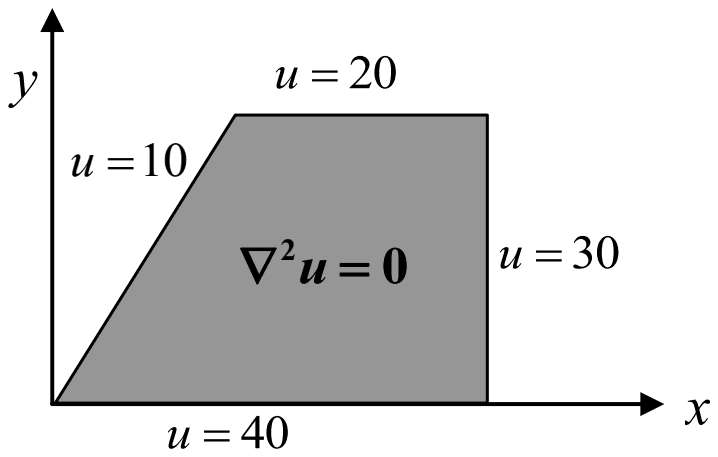
Answer: C

The true statement is that the solution cannot be obtained using separation of variables because not all the boundaries are along constant coordinate lines.

Separation of variables in Cartesian coordinates needs a domain whose sides are lines of constant x or constant y, so that each boundary condition can be imposed on one factor of the product solution. Here the left side is a slanted line through the origin, which is neither, so the method fails for this domain.

Laplace's equation itself is separable, so the first option is wrong. Non-zero boundary values are handled by superposing several separated solutions, so the second is wrong. And the slanted edge means the fourth option is wrong as posed.

Please log in or register to report this question.

46.

If the partial differential equation

\[ \begin{aligned} &(x + 2)\frac{\partial^{2}u}{\partial x^{2}} + 2(x + y)\frac{\partial^{2}u}{\partial x\,\partial y} \\ &+ 2(y - 1)\frac{\partial^{2}u}{\partial y^{2}} - 3y^{2}\frac{\partial u}{\partial y} = 0 \end{aligned} \]

is parabolic on the circle \((x - a)^{2} + (y - b)^{2} = r^{2}\), then the values of \(a\), \(b\) and \(r\) are given by

Exam Year(s)

GATE XE - 2022,

Answer: B

\(a = -1,\ b = 2,\ r = 1\).

A second-order equation \(Au_{xx} + 2Bu_{xy} + Cu_{yy} + \ldots = 0\) is parabolic where \(B^{2} - AC = 0\). Here \(A = x + 2\), \(2B = 2(x + y)\) so \(B = x + y\), and \(C = 2(y - 1)\):

\[ \begin{aligned} (x + y)^{2} - 2(x + 2)(y - 1) &= 0 \\ x^{2} + y^{2} + 2x - 4y + 4 &= 0 \\ (x + 1)^{2} + (y - 2)^{2} &= 1 \end{aligned} \]

The circle has centre \((-1, 2)\) and radius 1. The other options flip the sign of a or b, which is what happens if the completed squares are read as \((x - 1)\) or \((y + 2)\).

Please log in or register to report this question.

47.

Consider the second order Partial Differential Equation (PDE)

\[ \begin{aligned} &4x^{2}\frac{\partial^{2}u}{\partial x^{2}} + 4(x + y)\frac{\partial^{2}u}{\partial x \partial y} \\ &+ (x^{2} + y^{2})\frac{\partial^{2}u}{\partial y^{2}} - u = 0. \end{aligned} \]

Then which one of the following statements is correct ?

Exam Year(s)

GATE XE - 2025,

Answer: A

The correct statement is The PDE is hyperbolic in the region -1 < x < 0, y < 0.

For \(Au_{xx} + Bu_{xy} + Cu_{yy} + \dots = 0\) the type is set by the discriminant \(B^{2} - 4AC\). Here A = 4x2, B = 4(x + y), C = x2 + y2:

\[ B^{2}-4AC = 16\left[(x+y)^{2} - x^{2}(x^{2}+y^{2})\right] \]

In the region -1 < x < 0, y < 0, both x and y are negative, so 2xy > 0 and \((x+y)^{2} \gt x^{2}+y^{2}\), while \(x^{2} \lt 1\) gives \(x^{2}+y^{2} \ge x^{2}(x^{2}+y^{2})\). The discriminant is positive everywhere there: hyperbolic.

For x > 1 and y < 0 the bracket is negative at, for example, x = 2, y = -0.1 (3.61 - 16.04), so the PDE is not hyperbolic throughout that region, and it is not parabolic there either, which would need the discriminant to be zero. For 0 < x < 1, y > 0 the discriminant is positive, so the PDE is hyperbolic there, not elliptic.

Please log in or register to report this question.

Loading…
Tags: Partial Differential Equations Questions and Answers || Partial Differential Equations MCQ Questions and Answers || Partial Differential Equations GK Questions and Answers || Partial Differential Equations GK MCQ Questions || Partial Differential Equations Multiple Choice Questions and Answers || Partial Differential Equations GK || GK on Partial Differential Equations || Engineering Mathematics Questions and Answers || Engineering Mathematics MCQ Questions and Answers || Engineering Mathematics GK Questions and Answers || GK on Engineering Mathematics