
Machine-translated by Google. Questions are authored in English.
Top

Lagrangian Formulation Questions and Answers

1.

A particle of mass m is constrained to move on a circle with radius a which itself is rotating about its vertical diameter with a constant angular velocity \(\omega\). Assume that the initial angular velocity is zero and \(g\) is the acceleration due to gravity. If \(\theta\) be the inclination of the radius vector of the particle with the axis of rotation and \(\dot{\theta}\) denotes the derivative of \(\theta\) with respect to \(t\), then the Lagrangian of this system is

Exam Year(s)

GATE Mathematics - 2012,

Answer: A

The Lagrangian is \(\frac{1}{2}ma^{2}(\dot{\theta}^{2} + \omega^{2}\sin^{2}\theta) + mga\cos\theta\).

The particle has two velocity components. Along the circle it moves with speed \(a\dot{\theta}\). The circle's rotation carries it round the vertical axis on a horizontal circle of radius \(a\sin\theta\), with speed \(a\omega\sin\theta\). These are perpendicular, so

\[ \begin{aligned} T &= \tfrac{1}{2}m(a\dot{\theta})^{2} + \tfrac{1}{2}m(a\omega\sin\theta)^{2} \\ &= \tfrac{1}{2}ma^{2}(\dot{\theta}^{2} + \omega^{2}\sin^{2}\theta). \end{aligned} \]

With \(\theta\) measured from the downward vertical, the height below the centre is \(a\cos\theta\), so \(V = -mga\cos\theta\) and \(L = T - V\) is the keyed expression.

The other options have the wrong kinetic energy: the rotational term must be \(\omega^{2}\sin^{2}\theta\), quadratic in \(\omega\), not \(2\omega\sin\theta\), \(2\omega^{2}\cos\theta\) or \(\omega\sin 2\theta\). They also use \(\sin\theta\) in the potential, which belongs to an angle measured from the horizontal.

Please log in or register to report this question.
2.

The Lagrangian of a system in terms of polar coordinates \((r, \theta)\) is given by

\[ \begin{aligned} L = {} &\frac{1}{2} m \dot{r}^{2} + \frac{1}{2} m (\dot{r}^{2} + r^{2}\dot{\theta}^{2}) \\ &- m g r (1 - \cos(\theta)), \end{aligned} \]

where \(m\) is the mass, \(g\) is the acceleration due to gravity and \(\dot{s}\) denotes the derivative of \(s\) with respect to time. Then the equations of motion are

Exam Year(s)

GATE Mathematics - 2015,

Answer: A

The equations of motion are \(2\ddot{r} = r\dot{\theta}^{2} - g(1 - \cos\theta)\) and \(\frac{d}{dt}(r^{2}\dot{\theta}) = -g r \sin\theta\).

First simplify: \(L = m\dot{r}^{2} + \frac{1}{2}m r^{2}\dot{\theta}^{2} - m g r (1 - \cos\theta)\). Apply Lagrange's equations \(\frac{d}{dt}\frac{\partial L}{\partial \dot{q}} = \frac{\partial L}{\partial q}\).

\[ \begin{aligned} r:\ \tfrac{d}{dt}(2m\dot{r}) &= m r \dot{\theta}^{2} - m g (1 - \cos\theta) \\ \theta:\ \tfrac{d}{dt}(m r^{2}\dot{\theta}) &= -m g r \sin\theta \end{aligned} \]

Dividing by \(m\) gives the first option. The other options change the sign of the gravity term in one equation or the other: the potential \(m g r(1 - \cos\theta)\) enters \(L\) with a minus sign, so both generalised forces carry a minus sign.

Please log in or register to report this question.

3.

A particle of mass 1 kg is released from a height of 1 m above the ground. When it reaches the ground, what is the value of Hamilton’s action for this motion in J s? (\(g\) is the acceleration due to gravity; take gravitation potential to be zero on the ground)

Exam Year(s)

GATE Physics - 2022,

Answer: D

The action is \(-\frac{1}{3}\sqrt{2g}\) J s.

Hamilton's action is \(S = \int (T - V)\,dt\). With \(m = 1\) kg, the particle falls 1 m in \(\tau = \sqrt{2/g}\), with \(v = gt\) and height \(h = 1 - \frac{1}{2}gt^{2}\):

\[ \begin{aligned} L &= \tfrac{1}{2}g^{2}t^{2} - g\left(1 - \tfrac{1}{2}gt^{2}\right) = g^{2}t^{2} - g \\ S &= \frac{g^{2}\tau^{3}}{3} - g\tau \end{aligned} \]

With \(\tau = \sqrt{2/g}\), \(g^{2}\tau^{3} = 2\sqrt{2g}\) and \(g\tau = \sqrt{2g}\), so

\[ S = \frac{2}{3}\sqrt{2g} - \sqrt{2g} = -\frac{1}{3}\sqrt{2g} \]

\(-\frac{2}{3}\sqrt{2g}\) is \(-\int V\,dt\) alone, dropping the kinetic part. The action is negative here because the potential energy outweighs the kinetic energy for most of the fall, which rules out the positive options.

Please log in or register to report this question.

4.

If \((\dot{x}\dot{y} + \alpha xy)\) is a constant of motion of a two-dimensional isotropic harmonic oscillator with Lagrangian

\[ \begin{aligned} L &= \frac{m(\dot{x}^{2} + \dot{y}^{2})}{2} \\ &- \frac{k(x^{2} + y^{2})}{2} \end{aligned} \]

then \(\alpha\) is

Exam Year(s)

GATE Physics - 2022,

Answer: A

The constant is \(\alpha = +\frac{k}{m}\).

The equations of motion are \(\ddot{x} = -\frac{k}{m}x\) and \(\ddot{y} = -\frac{k}{m}y\). Differentiate the candidate constant:

\[ \begin{aligned} \frac{d}{dt}(\dot{x}\dot{y} + \alpha xy) &= \ddot{x}\dot{y} + \dot{x}\ddot{y} + \alpha(\dot{x}y + x\dot{y}) \\ &= \left(\alpha - \frac{k}{m}\right)(x\dot{y} + \dot{x}y) \end{aligned} \]

This vanishes for every motion only if \(\alpha = k/m\). Physically, the isotropic oscillator conserves the energy of each Cartesian motion separately and also these cross terms, which is why it has more constants of motion than energy and angular momentum alone. \(-\frac{k}{m}\) and \(-\frac{2k}{m}\) have the wrong sign, and 0 leaves the \(-\frac{k}{m}(x\dot{y} + \dot{x}y)\) term.

Please log in or register to report this question.

5.

The Lagrangian

\[ L_{0}=\frac{1}{2}m\dot{q}^{2}-\frac{1}{2}m\omega^{2}q^{2} \]

with the generalized coordinate \(q\) is transformed to \(L = L_{0} + \alpha\frac{df(q)}{dt}\). Consider the following statements:

(i) Expression for the canonical momentum does not change.
(ii) The equation of the motion does not change.

Which of the following options is correct for the above statements?

Exam Year(s)

GATE Physics - 2026,

Answer: D

(i) is not correct and (ii) is correct.

Adding a total time derivative \(\alpha\,df(q)/dt = \alpha f'(q)\,\dot{q}\) changes the canonical momentum:

\[ \begin{aligned} p &= \frac{\partial L}{\partial \dot{q}} \\ &= m\dot{q} + \alpha f'(q) \end{aligned} \]

so statement (i) is false. But the extra term contributes nothing to the Euler-Lagrange equation:

\[ \tfrac{d}{dt}(\alpha f'(q)) - \alpha f''(q)\dot{q} = 0 \]

The equation of motion stays \(m\ddot{q} = -m\omega^{2}q\), so (ii) is true. Lagrangians differing by a total time derivative give the same action up to end-point terms and hence the same dynamics, while the canonical momentum is shifted by a gauge-like term.

Please log in or register to report this question.

6.

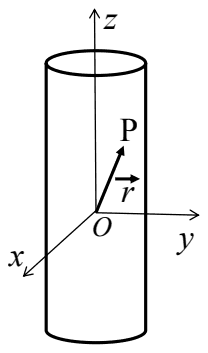
A particle P of mass m is constrained to move on the surface of a cylinder under a force \(-k\vec{r}\) as shown in figure (k is the positive constant). Which of the following statements is correct? (Neglect friction.)

A vertical cylinder with its axis along the z axis; the origin O is on the axis, the x and y axes are horizontal, and r is the position vector of P on the curved surface measured from O

Exam Year(s)

IIT JAM - 2018,

Answer: B

The answer is the motion along the z direction is simple harmonic.

Write \(\vec{r} = x\hat{\imath} + y\hat{\jmath} + z\hat{k}\). The constraint (the cylinder's surface, without friction) can only push perpendicular to the surface, that is horizontally, so it has no \(z\) component. Along \(z\) the only force is \(-kz\):

\[ m\ddot{z} = -kz \]

which is simple harmonic motion with \(\omega = \sqrt{k/m}\).

The force \(-k\vec{r}\) is conservative and the frictionless constraint does no work, so total energy is conserved. Linear momentum is not conserved, since a net force acts. The force \(-k\vec{r}\) exerts no torque about O, and the constraint force, which points towards the axis, has no torque about the axis, so the axial component of angular momentum is conserved; the other components only oscillate with \(z\). Nothing makes the angular momentum grow with time.

Please log in or register to report this question.

7.

If a particle of mass \(m\) moves in a plane under the influence of gravitational force of magnitude \(\dfrac{m}{r^{2}}\) directed towards origin. Then Lagrangian of the system is :

Exam Year(s)

MH SET - 2018, SET Exam - 2018,

Answer: B

The Lagrangian is \(\dfrac{m}{2}(\dot{r}^{2} + r^{2}\dot{\theta}^{2}) + \dfrac{m}{r}\).

In plane polar coordinates the kinetic energy is \(T = \tfrac{m}{2}(\dot{r}^{2} + r^{2}\dot{\theta}^{2})\). An attractive force of magnitude \(m/r^{2}\) towards the origin comes from the potential \(V = -m/r\), since \(-dV/dr = -m/r^{2}\), a pull inwards. So

\[ \begin{aligned} L &= T - V \\ &= \frac{m}{2}(\dot{r}^{2} + r^{2}\dot{\theta}^{2}) + \frac{m}{r} \end{aligned} \]

Option A has the sign of \(V\) wrong, which would make the force repulsive. Option C uses \(m/r^{2}\), the force, in place of the potential, and option D has \(r\dot{\theta}^{2}\) for \(r^{2}\dot{\theta}^{2}\).

Please log in or register to report this question.

8.

If the Lagrangian \(L(x, \dot{x})\) corresponding to Atwood's machine is given as :

\[ \begin{aligned} L(x, \dot{x}) &= \tfrac{1}{2}(m_{1} + m_{2})\dot{x}^{2} \\ &\quad + m_{1}gx + m_{2}g(l - x), \end{aligned} \]

where \(m_{1}\), \(m_{2}\), \(l\) and \(g\) are constants. Then the equation of motion is :

Exam Year(s)

MH SET - 2018, SET Exam - 2018,

Answer: C

The equation of motion is \(\ddot{x} = \dfrac{m_{1} - m_{2}}{m_{1} + m_{2}}g\).

Lagrange's equation is \(\tfrac{d}{dt}L_{\dot{x}} - L_{x} = 0\), where subscripts denote partial derivatives. Here \(\partial L/\partial \dot{x} = (m_{1} + m_{2})\dot{x}\) and \(\partial L/\partial x = m_{1}g - m_{2}g\), so

\[ (m_{1} + m_{2})\ddot{x} = (m_{1} - m_{2})g \]

The heavier mass accelerates down with this reduced gravity. An equation of motion gives the acceleration \(\ddot{x}\), so the two options with \(\dot{x}\) are wrong, and inverting the fraction would give an acceleration greater than \(g\), which is impossible.

Please log in or register to report this question.

Answer: B

The Lagrangian is \(\frac{1}{2} m_{1}\dot{x}_{1}^{2} + \frac{1}{2} m_{2}\dot{x}_{2}^{2}\) \(- q_{1}q_{2}/|x_{1} - x_{2}|\).

The Lagrangian is \(L = T - V\). The kinetic energy of the two particles moving along x is \(T = \frac{1}{2}m_{1}\dot{x}_{1}^{2} + \frac{1}{2}m_{2}\dot{x}_{2}^{2}\). In esu (Gaussian) units the Coulomb potential energy of the pair is \(V = q_{1}q_{2}/|x_{1} - x_{2}|\), with no \(4\pi\epsilon_{0}\) factor. So

\[ L = T - \frac{q_{1}q_{2}}{|x_{1} - x_{2}|} \]

The option with \(+q_{1}q_{2}/|x_{1}-x_{2}|\) is the total energy \(T + V\), the Hamiltonian, not the Lagrangian. The two options with negative kinetic terms correspond to \(V - T\) and \(-(T+V)\), neither of which is the Lagrangian.

Please log in or register to report this question.

10.

If a system of \(n\) particles with \(k\) non-holonomic constraints has \(r\) degrees of freedom, then :

Exam Year(s)

MH SET - 2019, SET Exam - 2019,

Answer: C

The keyed answer is \(r \gt 3n - k\).

For \(n\) free particles there are \(3n\) coordinates. A holonomic constraint is an equation among the coordinates, so it can be used to eliminate one of them: with \(k\) holonomic constraints the system needs exactly \(3n - k\) independent generalised coordinates.

A non-holonomic constraint restricts velocities (or is an inequality) and cannot be integrated into a relation among coordinates, so it cannot be used to eliminate one. The number \(r\) of independent coordinates the motion needs therefore stays larger than \(3n - k\); this is the textbook sense in which the paper uses 'degrees of freedom'.

\(r = 3n - k\) is the holonomic count, \(n - k\) forgets the three coordinates per particle, and \(r \lt 3n - k\) gets the direction wrong.

Please log in or register to report this question.

Loading…

Other Subjects

Tags: Lagrangian Formulation Questions and Answers