
Machine-translated by Google. Questions are authored in English.
Top

Partition Function Questions and Answers

1.

Consider a non-interacting gas of spin 1 particles, each with magnetic moment \(\mu\), placed in a weak magnetic field \(B\), such that \(\frac{\mu B}{k_{B}T} \ll 1\). The average magnetic moment of a particle is

Exam Year(s)

GATE Physics - 2022,

Answer: A

The average moment is \(\frac{2\mu}{3}\left(\frac{\mu B}{k_{B}T}\right)\).

A spin-1 particle has three orientations, \(m = +1, 0, -1\), with energies \(-\mu B\), 0 and \(+\mu B\). Writing \(x = \mu B/k_{B}T\), the Boltzmann average is

\[ \begin{aligned} \langle \mu_{z} \rangle &= \mu\frac{e^{x} - e^{-x}}{1 + e^{x} + e^{-x}} \\ &= \mu\frac{2\sinh x}{1 + 2\cosh x} \end{aligned} \]

For \(x \ll 1\), \(\sinh x \approx x\) and \(\cosh x \approx 1\), so \(\langle \mu_{z} \rangle \approx \mu\frac{2x}{3}\). The factor 2/3 is the Curie-law factor \(J(J+1)/3\) for \(J = 1\). The other coefficients, \(\frac{1}{2}\), \(\frac{1}{3}\) and \(\frac{3}{4}\), do not come from the three-level sum; a spin-1/2 particle, for comparison, would give \(\mu x\).

Please log in or register to report this question.
2.

A simple harmonic oscillator with an angular frequency \(\omega\) is in thermal equilibrium with a reservoir at absolute temperature \(T\), with \(\omega = \frac{2k_{B}T}{\hbar}\). Which one of the following is the partition function of the system?

Exam Year(s)

GATE Physics - 2023,

Answer: A

The partition function is \(\frac{e}{e^{2} - 1}\).

For a quantum oscillator with levels \(E_{n} = (n + \frac{1}{2})\hbar\omega\), the sum is geometric:

\[ \begin{aligned} Z &= \sum_{n=0}^{\infty} e^{-(n + 1/2)x} = \frac{e^{-x/2}}{1 - e^{-x}} \\ x &= \frac{\hbar\omega}{k_{B}T} = 2 \end{aligned} \]

So \(Z = e^{-1}/(1 - e^{-2})\); multiplying top and bottom by \(e^{2}\) gives \(e/(e^{2} - 1)\).

The \(+1\) in the denominator would come from an alternating series, which the oscillator does not have, and \(e/(e - 1)\) is what \(x = 1\) would give, forgetting the factor 2 in \(\omega = 2k_{B}T/\hbar\).

Please log in or register to report this question.
3.

Consider a two-level system with energy states \(+\varepsilon\) and \(-\varepsilon\). The number of particles at \(+\varepsilon\) level is \(N_{+}\) and the number of particles at \(-\varepsilon\) level is \(N_{-}\). The total energy of the system is \(E\) and the total number of particles is \(N = N_{+} + N_{-}\). In the thermodynamic limit, the inverse of the absolute temperature of the system is (Given: \(\mathrm{ln}\, N! \simeq N\mathrm{ln}\, N - N\))

Exam Year(s)

GATE Physics - 2025,

Answer: A

The answer is \(\frac{k_{B}}{2\varepsilon}\ln[\frac{N-E/\varepsilon}{N+E/\varepsilon}]\).

From \(N = N_{+} + N_{-}\) and \(E = \varepsilon(N_{+} - N_{-})\), \(N_{\pm} = \frac{1}{2}(N \pm \frac{E}{\varepsilon})\). The entropy, with Stirling's formula, is

\[ \begin{aligned} S = k_{B}[&N\ln N - N_{+}\ln N_{+} \\ &- N_{-}\ln N_{-}] \end{aligned} \]

Since \(\frac{dN_{\pm}}{dE} = \pm\frac{1}{2\varepsilon}\):

\[ \begin{aligned} \frac{1}{T} = \frac{\partial S}{\partial E} &= \frac{k_{B}}{2\varepsilon}(\ln N_{-} - \ln N_{+}) \\ &= \frac{k_{B}}{2\varepsilon}\ln\frac{N - E/\varepsilon}{N + E/\varepsilon} \end{aligned} \]

Option (D) misses the factor \(\frac{1}{2}\) from \(\frac{dN_{\pm}}{dE}\), and the \(\ln N\) options do not depend on \(E\), so they cannot give a temperature that changes with energy. For \(E \gt 0\) the result is negative, the familiar negative temperature of a population inversion.

Please log in or register to report this question.
4.

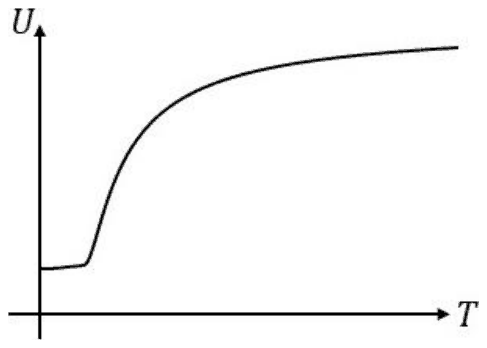
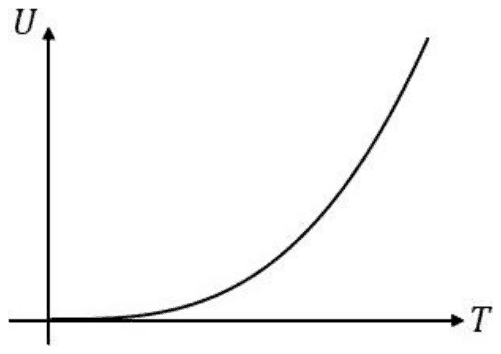
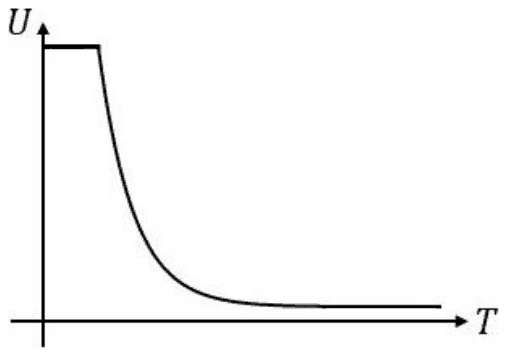
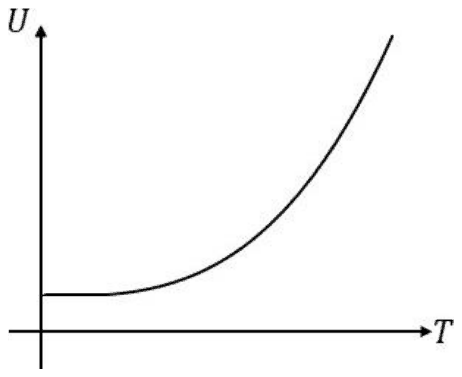
A gas of \(N\) classical particles that can occupy energy levels, \(\epsilon_{1}\) and \(\epsilon_{2} = \epsilon_{1} + \Delta\) is in equilibrium with a reservoir at temperature \(T\). From the schematics shown below, choose the correct dependence of the internal energy \(U\) on \(T\).

Exam Year(s)

GATE Physics - 2026,

Answer: A

The correct dependence is (A): U starts flat at a non-zero value, rises, and levels off.

For a classical two-level system the occupation follows the Boltzmann factor, so

\[ \begin{aligned} U &= N\epsilon_{1} + N\Delta\,p_{2} \\ p_{2} &= \frac{e^{-\Delta/k_{B}T}}{1 + e^{-\Delta/k_{B}T}} \end{aligned} \]

At low T almost every particle is in the lower level, so \(U \approx N\epsilon_{1}\), and the rise is exponentially slow until \(k_{B}T\) approaches \(\Delta\). At high T the two levels become equally occupied, so U saturates at \(N(\epsilon_{1} + \Delta/2)\) instead of growing without limit.

(B) and (D) keep rising ever more steeply, as for a system with unlimited levels. (C) has U falling as T rises, which would mean a negative heat capacity.

Please log in or register to report this question.
5.

Consider an ensemble of systems having only two energy levels having energies 0 and ε respectively. The average energy of the system at temperature T is :

Exam Year(s)

MH SET - 2018, SET Exam - 2018,

Answer: B

The average energy is \(\frac{\epsilon}{e^{\epsilon/kT} + 1}\).

With levels 0 and \(\epsilon\), the partition function is \(Z = 1 + e^{-\epsilon/kT}\). The mean energy is the Boltzmann-weighted average:

\[ \begin{aligned} \langle E\rangle &= \frac{0\cdot 1 + \epsilon\, e^{-\epsilon/kT}}{1 + e^{-\epsilon/kT}} \\ &= \frac{\epsilon}{e^{\epsilon/kT} + 1} \end{aligned} \]

Check the limits: at T = 0 it gives 0, and at high T it tends to \(\epsilon/2\), as both levels become equally occupied. The form with \(-1\) in the denominator is the mean energy of a harmonic oscillator mode (Planck's formula), which has infinitely many levels. The forms with \(e^{-\epsilon/kT}\) give the wrong limits, and the one with \(-1\) even becomes negative.

Please log in or register to report this question.

6.

The partition function of a two-dimensional oscillator whose energy \( E_{n_{x}n_{y}} = (n_{x} + n_{y} + 1)\hbar\omega \), \( n_{x} = 0, 1, 2, \ldots \); \( n_{y} = 0, 1, 2, \ldots \), is :

Exam Year(s)

MH SET - 2018, SET Exam - 2018,

Answer: C

The partition function is \( \frac{e^{\hbar\omega/k_{B}T}}{\left(e^{\hbar\omega/k_{B}T} - 1\right)^{2}} \).

The two quantum numbers are independent, so the sum factorises into two geometric series, with \( x = e^{-\hbar\omega/k_{B}T} \):

\[ \begin{aligned} Z &= x \sum_{n_{x}} x^{n_{x}} \sum_{n_{y}} x^{n_{y}} = \frac{x}{(1 - x)^{2}} \\ &= \frac{e^{\hbar\omega/k_{B}T}}{\left(e^{\hbar\omega/k_{B}T} - 1\right)^{2}} \end{aligned} \]

the last step multiplying top and bottom by \( x^{-2} \). The options with \( 2k_{B}T \) in the exponents halve the level spacing \( \hbar\omega \), and the option with \( +1 \) has the wrong sign in the denominator; none of them is the sum of these geometric series.

Please log in or register to report this question.

Loading…

Other Subjects

Tags: Partition Function Questions and Answers || Partition Function MCQ Questions and Answers || Partition Function GK Questions and Answers || Partition Function GK MCQ Questions || Partition Function Multiple Choice Questions and Answers || Partition Function GK || GK on Partition Function || Statistical Mechanics Questions and Answers || Statistical Mechanics MCQ Questions and Answers || Statistical Mechanics GK Questions and Answers || GK on Statistical Mechanics