Machine-translated by Google. Questions are authored in English.
Top

Schrodinger Equation Questions and Answers

1.

A particle is subjected to a potential

\[ V(x) = \begin{cases} \infty, & x \le 0 \\ V_{0}, & a \le x \le b \\ 0, & \text{elsewhere} \end{cases} \]

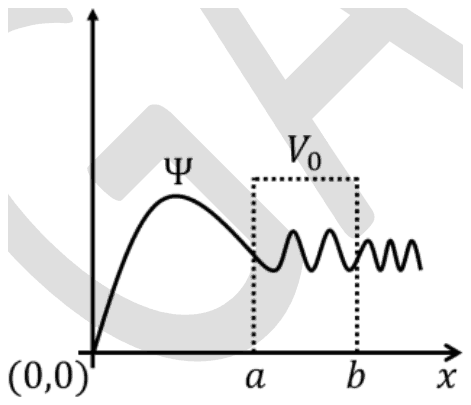
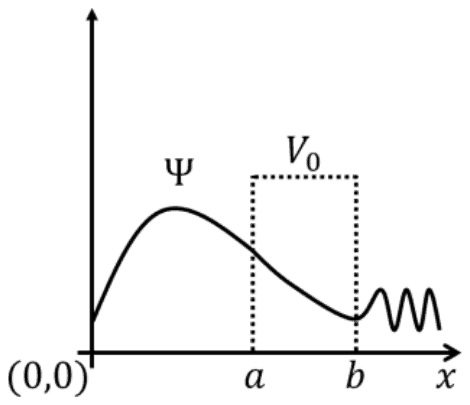
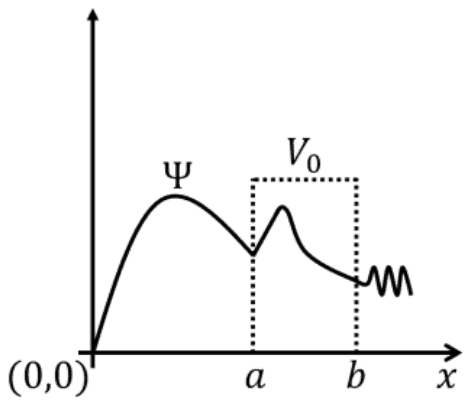
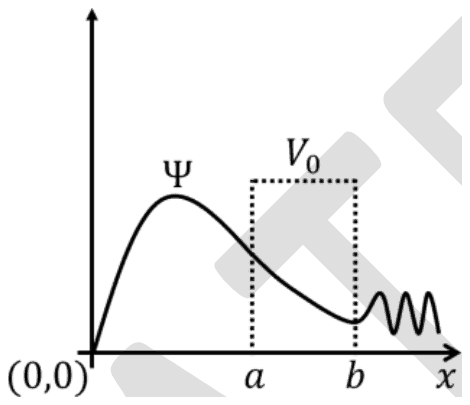
Here, \(a \gt 0\) and \(b \gt a\). If the energy of the particle \(E \lt V_{0}\), which one of the following schematics is a valid quantum mechanical wavefunction \((\Psi)\) for the system?
Exam Year(s)

GATE Physics - 2024,

Answer: B

The valid wavefunction is (B).

The requirements are:

  • Ψ = 0 at x = 0, because the potential is infinite for x ≤ 0;
  • between 0 and a, where E > V = 0, Ψ oscillates (here it rises from zero to a maximum);
  • inside the barrier, where E < V0, Ψ is a combination of rising and falling exponentials, so it cannot oscillate or develop a local peak;
  • beyond b, Ψ oscillates again; Ψ and its slope are continuous at a and b.

Sketch (B) meets all four. Sketch (A) has a bump inside the barrier, which an exponential cannot produce. Sketch (C) oscillates inside the barrier, as if E were above V0. Sketch (D) looks like (B) but is not zero at x = 0, violating the condition at the infinite wall.

Please log in or register to report this question.

2.

The wavefunction for a particle is given by the form \(e^{-(i\alpha x + \beta)}\), where \(\alpha\) and \(\beta\) are real constants. In which one of the following potentials \(V(x)\), the particle is moving?

Exam Year(s)

GATE Physics - 2024,

Answer: C

The particle moves in the potential V(x) = 0.

The wavefunction \(e^{-(i\alpha x + \beta)} = e^{-\beta}e^{-i\alpha x}\) is a plane wave with constant amplitude. Then \(\psi'' = -\alpha^{2}\psi\), and the time-independent Schrödinger equation gives

\[ \frac{\hbar^{2}\alpha^{2}}{2m}\psi + V(x)\psi = E\psi \]

For this to hold at every x, V must be the constant \(E - \hbar^{2}\alpha^{2}/2m\), which with the usual choice of zero is V = 0: a free particle with momentum \(\hbar\alpha\) moving in the -x direction.

A harmonic, exponential or sinusoidal potential would vary with x and force the amplitude or wavelength of ψ to change, which a pure plane wave never does.

Please log in or register to report this question.

3.

The Hamiltonian \(H = \frac{-\hbar^{2}}{2m}\frac{d^{2}}{dx^{2}} - \alpha\delta(x)\) is given for a particle. Using the trial wave function \(\psi_{trial}(x) = Ae^{-bx^{2}}\) (with b as the variational parameter), the bound on the ground state energy is :

(Given : \(\int_{-\infty}^{\infty} x^{2n}e^{-\alpha x^{2}}\,dx\) = \(\Gamma(n+1/2)/\alpha^{n+1/2}\))

Exam Year(s)

MH SET - 2019, SET Exam - 2019,

Answer: C

The bound is \(-m\alpha^{2}/\pi\hbar^{2}\).

Normalising the Gaussian gives \(|A|^{2} = \sqrt{2b/\pi}\). The kinetic and potential terms are:

\[ \begin{aligned} \langle T \rangle &= \frac{\hbar^{2}b}{2m} \\ \langle V \rangle &= -\alpha|\psi(0)|^{2} = -\alpha\sqrt{\frac{2b}{\pi}} \end{aligned} \]

Setting \(dE/db = 0\) gives \(\sqrt{b} = \frac{m\alpha}{\hbar^{2}}\sqrt{\frac{2}{\pi}}\), and then:

\[ \begin{aligned} E_{min} &= \frac{m\alpha^{2}}{\pi\hbar^{2}} - \frac{2m\alpha^{2}}{\pi\hbar^{2}} \\ &= -\frac{m\alpha^{2}}{\pi\hbar^{2}} \end{aligned} \]

The option \(-m\alpha^{2}/2\hbar^{2}\) is the exact ground-state energy of the delta well. The variational bound lies above it, as it must, since \(1/\pi \lt 1/2\). The positive option cannot describe a bound state.

Please log in or register to report this question.

4.

Which one of the following given below represents the bound state eigen function of the operator \(-\frac{d^{2}}{dx^{2}}\) in the region \(0 \le x \le \infty\) with eigen value -4 ?

Exam Year(s)

MH SET - 2020, SET Exam - 2020,

Answer: B

The bound state eigenfunction is \(A_{0}e^{-2x}\).

The eigenvalue equation is \(-\frac{d^{2}\psi}{dx^{2}} = -4\psi\), that is \(\psi'' = 4\psi\), whose solutions are combinations of \(e^{2x}\) and \(e^{-2x}\), or equivalently \(\cosh 2x\) and \(\sinh 2x\). All four options satisfy the equation.

A bound state must be normalisable on \(0 \le x \lt \infty\), so \(\psi\) must vanish as \(x \to \infty\). Only \(e^{-2x}\) does; \(e^{2x}\), \(\cosh 2x\) and \(\sinh 2x\) all grow without limit, so they cannot describe a bound state.

Please log in or register to report this question.

5.

In scattering theory of spherically symmetric potential, the incident particles on z-axis are represented by :

Exam Year(s)

MH SET - 2023, SET Exam - 2023,

Answer: A

The incident particles are represented by \(A\exp(ikz)\).

In scattering theory the wave function far from the target is written as an incoming plane wave plus an outgoing spherical wave:

\[ \begin{aligned} \psi &\approx Ae^{ikz} \\ &\quad + Af(\theta)\frac{e^{ikr}}{r} \end{aligned} \]

The plane wave \(Ae^{ikz}\) describes the beam of incident particles travelling along the z-axis with momentum \(\hbar k\), with uniform probability density.

A factor 1/r belongs to the spherical scattered wave, whose amplitude falls with distance so that probability flux is conserved through larger spheres; \(1/r^{2}\) and a factor r have no place in the incident beam.

Please log in or register to report this question.

6.

Using WKB approximation, the allowed energies \(E_{n}\), (n = 1, 2, 3...) for a one-dimensional harmonic oscillator are :

Exam Year(s)

MH SET - 2023, SET Exam - 2023,

Answer: A

With n = 1, 2, 3, ..., the WKB energies are \(\left(n - \frac{1}{2}\right)\hbar\omega\).

For a potential with two smooth turning points the WKB quantisation condition is

\[ \begin{aligned} \oint p\,dx &= 2\pi\hbar\left(n - \tfrac{1}{2}\right) \\ n &= 1, 2, 3, \ldots \end{aligned} \]

For the oscillator the phase-space orbit is an ellipse of area \(2\pi E/\omega\), so \(E = (n - \frac{1}{2})\hbar\omega\), the exact result.

The familiar form \((n + \frac{1}{2})\hbar\omega\) uses n = 0, 1, 2, ...; with n starting at 1, as the question specifies, it would miss the ground state \(\frac{1}{2}\hbar\omega\). The options with 2n give double the level spacing.

Please log in or register to report this question.

7.

A quantum particle is incident on a potential barrier. The particle has incident energy that is less than the height of the potential barrier. When the particle penetrates the barrier, its wave function is :

Exam Year(s)

MH SET - 2024, SET Exam - 2024,

Answer: B

Inside the barrier the wave function is exponentially decreasing.

Where \(E \lt V_{0}\), the Schrödinger equation becomes \(\psi'' = \kappa^{2}\psi\) with \(\kappa = \sqrt{2m(V_{0} - E)}/\hbar\), whose solutions are real exponentials \(e^{\pm\kappa x}\). For a wave entering from the left, the physical part decays as \(e^{-\kappa x}\) into the barrier; this is quantum tunnelling.

Oscillatory solutions occur only where \(E \gt V\). A growing exponential is not normalisable for a wide barrier, and a constant would need \(E = V_{0}\) exactly.

Please log in or register to report this question.

Answer: B

The transmission probability is the second option, \(T = e^{-\pi\sqrt{2mV_{0}a^{2}/\hbar^{2}}\,(1 - E/V_{0})}\).

The barrier is \(V_{0}(1 - x^{2}/a^{2})\) inside \(|x| \lt a\) and zero outside (the paper prints \(|x| \lt a\) for both regions; the second is meant to be the outside). WKB gives \(T = \exp(-2\int\kappa\,dx)\) between the turning points \(\pm x_{0}\), where \(x_{0}^{2} = a^{2}(1 - E/V_{0})\):

\[ \begin{aligned} \kappa &= \frac{\sqrt{2mV_{0}}}{\hbar a}\sqrt{x_{0}^{2} - x^{2}} \\ \int_{-x_{0}}^{x_{0}}\kappa\,dx &= \frac{\sqrt{2mV_{0}}}{\hbar a}\cdot\frac{\pi x_{0}^{2}}{2} \\ 2\int\kappa\,dx &= \pi\sqrt{\frac{2mV_{0}a^{2}}{\hbar^{2}}}\left(1 - \frac{E}{V_{0}}\right) \end{aligned} \]

The first option has a positive exponent, which gives \(T \gt 1\). The last two use \(\frac{E}{V_{0}} - 1\), which is negative below the barrier top and again makes \(T\) exceed 1.

Please log in or register to report this question.

9.

A particle with incoming wave vector k, after being scattered by the potential \(V(r) = \frac{c}{r^{2}}\), c real, goes out with wave vector k'. The differential scattering cross-section, calculated in the first Born approximation, depends on q = |k − k'|, as

Exam Year(s)

MH SET - 2025, SET Exam - 2025,

Answer: A

The cross-section goes as \(1/q^{2}\).

In the first Born approximation, for a central potential the scattering amplitude is

\[ \begin{aligned} f(q) &= -\frac{2m}{\hbar^{2}q}\int_{0}^{\infty} rV(r)\sin(qr)\,dr \\ &= -\frac{2mc}{\hbar^{2}q}\int_{0}^{\infty}\frac{\sin qr}{r}\,dr \\ &= -\frac{2mc}{\hbar^{2}q}\cdot\frac{\pi}{2} \end{aligned} \]

The remaining integral is \(\pi/2\) for any \(q \gt 0\), so \(f \propto 1/q\) and \(d\sigma/d\Omega = |f|^{2} \propto 1/q^{2}\).

\(1/q^{4}\) is the Rutherford dependence of the Coulomb potential \(1/r\), not of \(1/r^{2}\). \(1/q\) is the amplitude, not the cross-section, and \(1/q^{3/2}\) does not arise.

Please log in or register to report this question.

10.

A particle of mass m in three dimensions is subjected to a potential \(V(\vec{r})\) = A ln(r/ro) where \(r = |\vec{r}|\) and A and ro are constants. Then, in some normalized stationary state say \(\psi(\vec{r})\), the mean square velocity, \(\langle \vec{v}^{2} \rangle\), is equal to :

Exam Year(s)

MH SET - 2025, SET Exam - 2025,

Answer: D

The mean square velocity is \(A/m\).

In any stationary state the quantum virial theorem holds:

\[ \begin{aligned} 2\langle T \rangle &= \langle \vec{r}\cdot\vec{\nabla}V \rangle \\ \vec{r}\cdot\vec{\nabla}V &= r\frac{d}{dr}A\ln\frac{r}{r_{o}} = A \end{aligned} \]

so \(\langle T \rangle = A/2\). With \(\langle T \rangle = \frac{1}{2}m\langle v^{2} \rangle\), this gives \(\langle v^{2} \rangle = A/m\), the same in every bound state of the logarithmic potential.

\(2A/m\) and \(A/2m\) are off by a factor of 2 in one direction or the other (from dropping the 2 in the virial theorem or the 1/2 in the kinetic energy), and \(3A/m\) wrongly multiplies by the number of dimensions.

Please log in or register to report this question.

Loading…

Other Subjects

Tags: Schrodinger Equation Questions and Answers || Schrodinger Equation MCQ Questions and Answers || Schrodinger Equation GK Questions and Answers || Schrodinger Equation GK MCQ Questions || Schrodinger Equation Multiple Choice Questions and Answers || Schrodinger Equation GK || GK on Schrodinger Equation || Quantum Mechanics Questions and Answers || Quantum Mechanics MCQ Questions and Answers || Quantum Mechanics GK Questions and Answers || GK on Quantum Mechanics