Machine-translated by Google. Questions are authored in English.
Top

Superconductivity Questions and Answers

1.

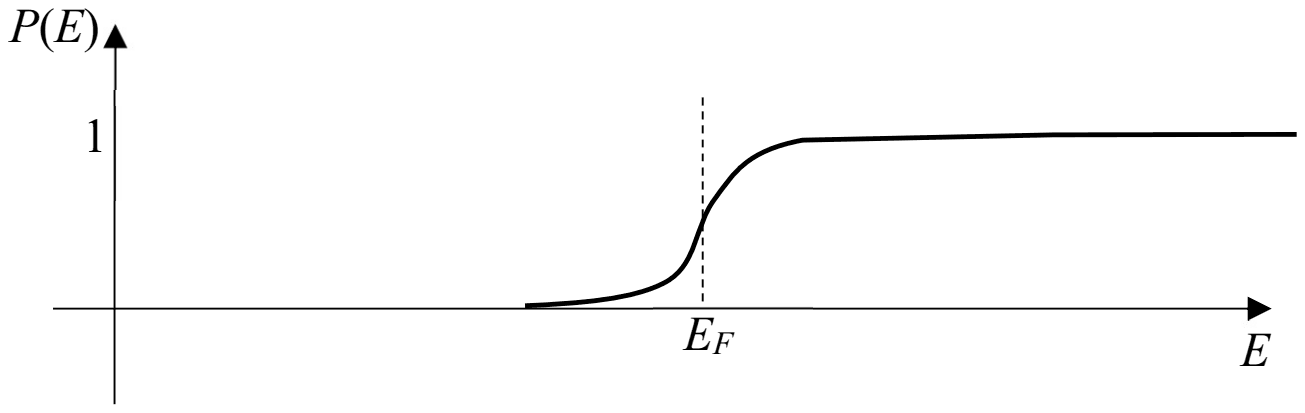
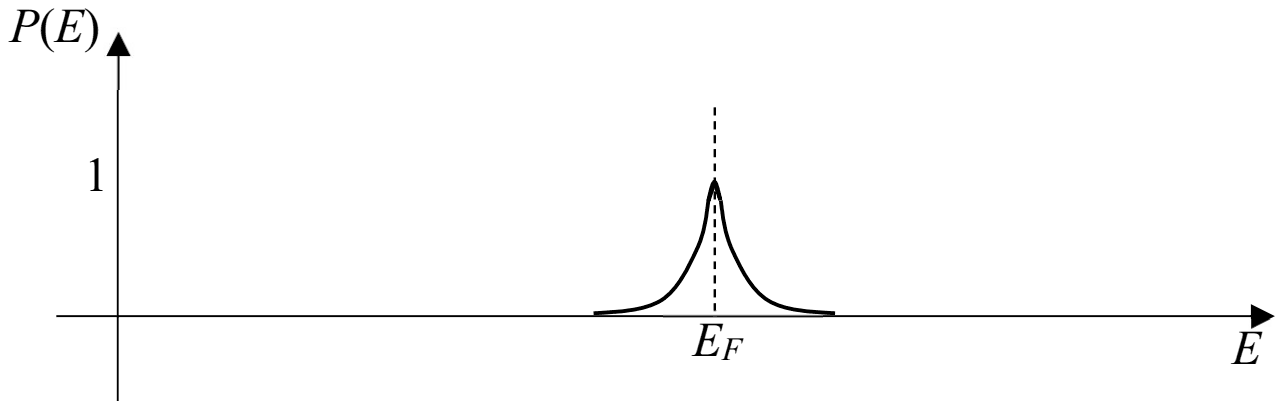
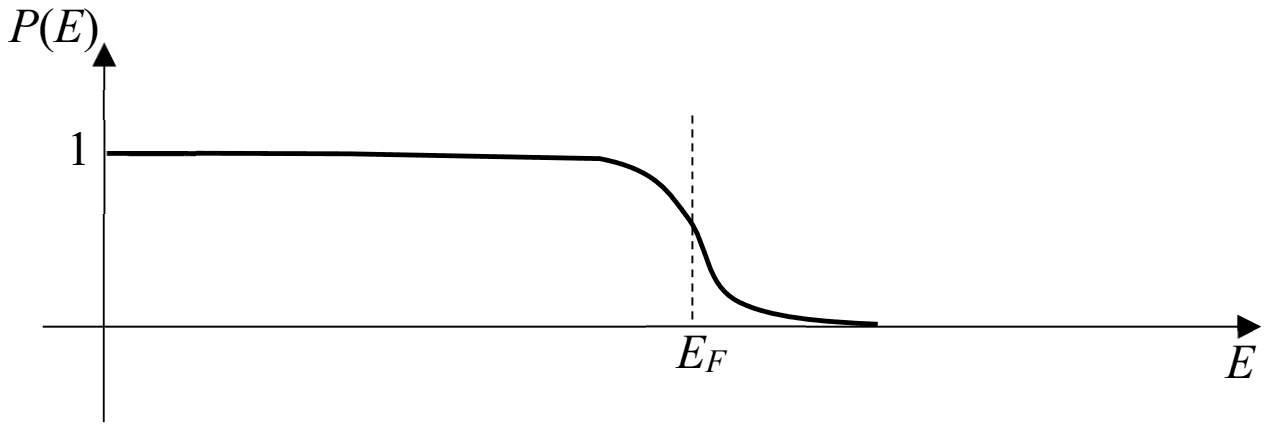
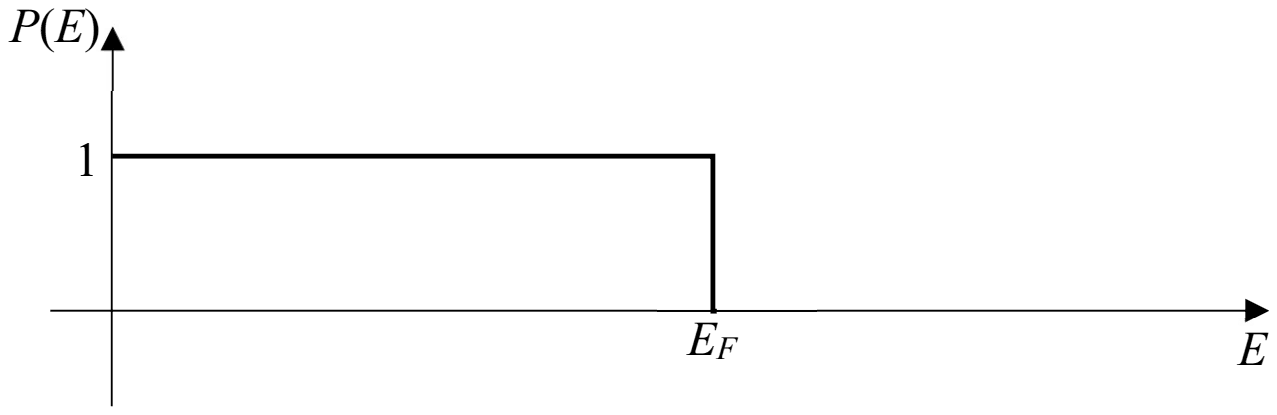
At \(T = 0\) K, which of the following diagram represents the occupation probability \(P(E)\) of energy states of electrons in a BCS type superconductor?
Exam Year(s)

GATE Physics - 2022,

Answer: A

The correct diagram is (A): \(P(E)\) is 1 well below \(E_{F}\) and falls smoothly to 0 across \(E_{F}\).

In the BCS ground state, electrons pair up and the occupation of a state of energy \(\xi\) measured from \(E_{F}\) is

\[ \begin{aligned} v_{k}^{2} &= \frac{1}{2}\left(1 - \frac{\xi}{E}\right), \\ E &= \sqrt{\xi^{2} + \Delta^{2}} \end{aligned} \]

Even at \(T = 0\) this goes smoothly from 1 to 0 over an energy range of order the gap \(\Delta\), passing through \(\frac{1}{2}\) at \(E_{F}\). It looks like a Fermi function at finite temperature, though its origin is pairing, not thermal excitation.

The sharp step (B) is a normal metal at \(T = 0\). The rising curve (C) is inverted, giving occupied states above \(E_{F}\) and empty ones below, and the peak (D) would leave deep states unoccupied.

Please log in or register to report this question.

2.

Superconductors are perfect diamagnets with susceptibility χ in CGS units to be :

Exam Year(s)

MH SET - 2018, SET Exam - 2018,

Answer: A

The susceptibility is \( -1/4\pi \) in CGS units.

The Meissner effect expels the field, so inside the superconductor \( B = 0 \). In CGS units \( B = H + 4\pi M \), so

\[ \begin{aligned} H + 4\pi M &= 0 \\ \chi = \frac{M}{H} &= -\frac{1}{4\pi} \end{aligned} \]

(In SI the same perfect diamagnetism is \( \chi = -1 \).) \( 10^{-6} \) and \( 10^{6} \) are positive, the sign of paramagnetic materials, and \( 4\pi \) has the wrong sign and size.

Please log in or register to report this question.

3.

A flux quantum (fluxoid) is approximately equal to 2 × 10\(^{-7}\) gauss-cm\(^{2}\). A type II superconductor is placed in a small magnetic field, which is then slowly increased till the field starts penetrating the superconductor. The strength of the field at this point is (2/\(\pi\)) × 10\(^{5}\) gauss. The penetration depth of this superconductor is :

Exam Year(s)

MH SET - 2019, MH SET - 2020, SET Exam - 2019, SET Exam - 2020,

Answer: B

The penetration depth is 100 Å.

The field at which flux first penetrates is the lower critical field, estimated in the question's model as one flux quantum spread over an area of about \(\pi\lambda^{2}\):

\[ \begin{aligned} H_{c1} &\approx \frac{\Phi_{0}}{\pi\lambda^{2}} \\ \lambda^{2} &= \frac{\Phi_{0}}{\pi H_{c1}} \end{aligned} \]

\[ \begin{aligned} \lambda^{2} &= \frac{2 \times 10^{-7}}{\pi \times (2/\pi) \times 10^{5}} \\ &= 10^{-12}\ \text{cm}^{2} \end{aligned} \]

so \(\lambda = 10^{-6}\) cm = 100 Å. The factor \(2/\pi\) in the field is chosen to cancel the \(\pi\), which shows this is the intended relation.

Please log in or register to report this question.

Answer: D

The incorrect statement is that flux is quantized in units of h/e.

In BCS theory the charge carriers are Cooper pairs of charge 2e, so the magnetic flux through a superconducting ring is quantized in units of

\[ \begin{aligned} \Phi_{0} &= \frac{h}{2e} \\ &\approx 2.07 \times 10^{-15}\ \text{Wb} \end{aligned} \]

The experiments of Deaver and Fairbank and of Doll and Nabauer (1961) confirmed the factor 2. The other statements are consistent with BCS theory: it predicts an energy gap below \(T_{c}\); the isotope effect, \(T_{c} \propto M^{-1/2}\), follows from electron-phonon pairing, so different isotopes have different \(T_{c}\); and the Meissner effect is observed and accounted for.

Please log in or register to report this question.

Answer: D

The superconductor expels its magnetic flux because the surface current induces a field opposite to the applied field.

This is the Meissner effect. When a type I superconductor is cooled below \(T_{c}\) in a field, persistent screening currents flow in a thin surface layer (the London penetration depth). Their field exactly cancels the applied field inside, so B = 0 in the bulk, even though the field was there before cooling. This is what distinguishes a superconductor from a merely perfect conductor, which would trap the flux.

The superconductor behaves as a perfect diamagnet, with susceptibility -1. A paramagnet would draw flux in, not expel it, and antiferromagnetism is an ordering of spins that has nothing to do with flux expulsion. Retaining the flux is the behaviour of a perfect conductor, not a superconductor.

Please log in or register to report this question.

6.

The wavelength of the photon which will be required to break a Cooper pair in a superconductor like aluminium whose critical temperature is 1.2 K is :

Exam Year(s)

MH SET - 2024, SET Exam - 2024,

Answer: B

The wavelength is about 3.4 × 10⁻³ m.

BCS theory gives the energy gap \(2\Delta \approx 3.5\,k_{B}T_{c}\); a photon must supply this to break a Cooper pair:

\[ \begin{aligned} 2\Delta &= 3.5 \times 1.38 \times 10^{-23} \times 1.2 \approx 5.8 \times 10^{-23}\ \text{J} \\ \lambda &= \frac{hc}{2\Delta} \\ &= \frac{1.99 \times 10^{-25}}{5.8 \times 10^{-23}} \approx 3.4 \times 10^{-3}\ \text{m} \end{aligned} \]

This is in the microwave or far-infrared region. Using \(\Delta\) instead of \(2\Delta\) would double the wavelength, to about 6.8 mm, which is not offered; 2.5, 4.4 and 5.4 mm do not follow from the BCS gap.

Please log in or register to report this question.

Loading…

Other Subjects

Tags: Superconductivity Questions and Answers || Superconductivity MCQ Questions and Answers || Superconductivity GK Questions and Answers || Superconductivity GK MCQ Questions || Superconductivity Multiple Choice Questions and Answers || Superconductivity GK || GK on Superconductivity || Solid State Physics Questions and Answers || Solid State Physics MCQ Questions and Answers || Solid State Physics GK Questions and Answers || GK on Solid State Physics