
Machine-translated by Google. Questions are authored in English.
Top

Darcy Law and Flow Nets Questions and Answers

Answer: D

A flow net is a graphical solution of the Laplace equation for the seepage of water through soil, so it is used to find the seepage quantity (for example beneath a dam or through an earthen dam), the exit gradient, the uplift (hydrostatic) pressure at points and the pore pressure. Passive earth pressure is the resistance of soil to a wall moving against it and is found from Rankine's or Coulomb's theories, not from a flow net, so it is not an application.

Please log in or register to report this question.
2.

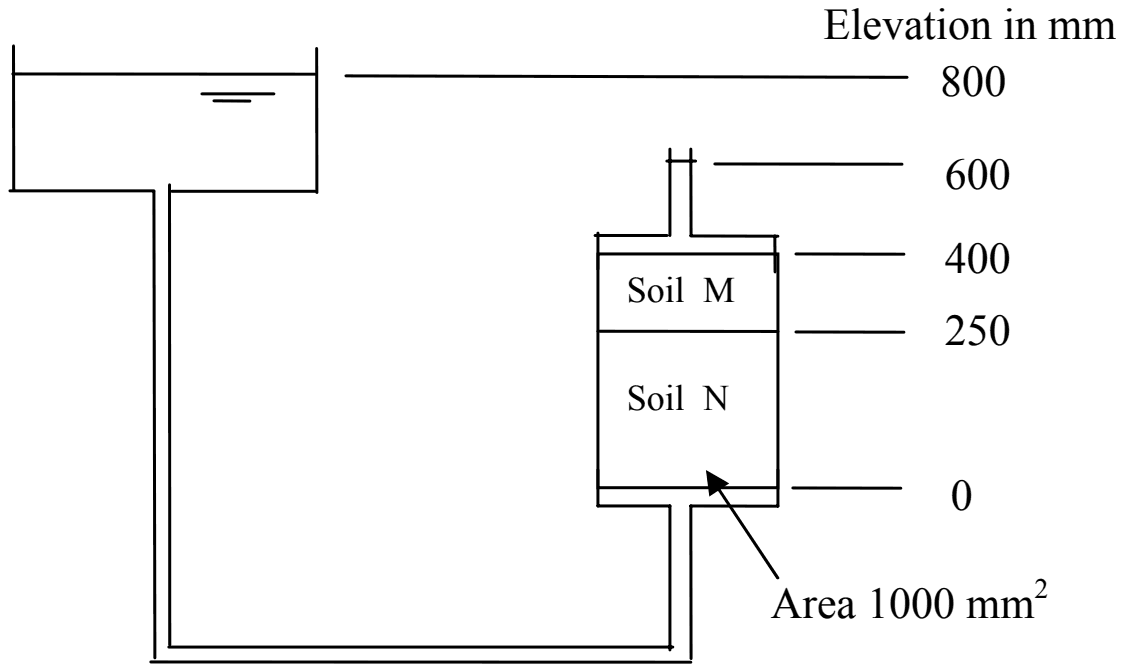
Flow is taking place through a layered soil system, having two homogeneous soils M and N, as shown in the figure. The head lost in soil N is 20 times the head lost in soil M.

Tank with water surface at elevation 800 mm feeding through a pipe the bottom of a vertical soil column of area 1000 mm2; soil N fills the column from elevation 0 to 250 mm and soil M from 250 to 400 mm, and the outflow pipe above the column rises to 600 mm

If the permeability of soil M is 3 × 10⁻⁴ mm s−1, the permeability of soil N, in mm s−1, will be

Exam Year(s)

GATE AG - 2012,

Answer: C

The permeability of soil N is \(2.5 \times 10^{-5}\) mm s−1.

The two soils are in series, so the same discharge passes through both and, with the same area, Darcy's law gives equal \(k\,h/L\) in each layer. From the elevations, soil M is 400 − 250 = 150 mm thick and soil N is 250 mm thick:

\[ \begin{aligned} k_{M}\frac{h_{M}}{L_{M}} &= k_{N}\frac{h_{N}}{L_{N}} \\ k_{N} &= k_{M}\frac{h_{M}}{h_{N}}\frac{L_{N}}{L_{M}} \\ &= 3 \times 10^{-4} \times \frac{1}{20} \times \frac{250}{150} \\ &= 2.5 \times 10^{-5} \end{aligned} \]

Ignoring the different thicknesses gives \(1.5 \times 10^{-5}\). Soil N, which loses twenty times the head, must be the less permeable layer, so values equal to or larger than \(k_{M}\) are impossible.

Please log in or register to report this question.

3.

Water is flowing under constant head of 40cm in a soil sample 20cm long and 10cm2 in sectional area. Quantity of flow in 4 minutes is 30cm3. Find K.

Exam Year(s)

RSMSSB JE - 2025, RSMSSB JE Agriculture - 2025, RSMSSB - 2025,

Answer: C

The coefficient of permeability is \(3.75 \times 10^{-1}\) cm/min.

For a constant head test, Darcy's law gives \(K = \frac{QL}{Aht}\).

\[ \begin{aligned} K &= \frac{30 \times 20}{10 \times 40 \times 4} \\ &= \frac{600}{1600} = 0.375\ \text{cm/min} \end{aligned} \]

That is \(3.75 \times 10^{-1}\) cm/min. The other options differ only in the leading digit and come from arithmetic slips in the same formula.

Please log in or register to report this question.

4.

According to Darcy's law, the rate of flow water through soil, for laminar flow condition in a saturated soil is:
(Where, Q = rate of flow, i = hydraulic gradient, k= Darcy's coefficient of permeability
A = total cross-sectional area of soil mass perpendicular to direction of flow.)

Exam Year(s)

RSMSSB JE - 2025, RSMSSB - 2025,

Answer: D

Darcy's law gives Q = kiA.

For laminar flow through saturated soil, the discharge velocity is proportional to the hydraulic gradient, v = ki, where k is the coefficient of permeability. Multiplying by the total cross-sectional area of the soil perpendicular to the flow gives the rate of flow Q = kiA.

The other options square one of the three quantities, which breaks the linear proportionality on which Darcy's law rests and gives the wrong dimensions for a flow rate.

Please log in or register to report this question.

Answer: A

A flow net is used for the determination of seepage, seepage pressure and hydrostatic pressure.

A flow net is the graphical solution of the Laplace equation for steady seepage: a grid of flow lines and equipotential lines. From the number of flow channels and potential drops it gives the quantity of seepage, and from the head at any point it gives the pore water pressure, the uplift pressure under a dam and the exit gradient that decides the risk of piping.

Liquid and plastic limits come from consistency tests on remoulded soil, particle size from sieve and hydrometer analysis, and buoyant force from the submerged unit weight. None of them needs a flow net.

Please log in or register to report this question.

Answer: A

Permeability is directly proportional to the square of grain size.

Allen Hazen's empirical relation for clean sands is \(k = C\,D_{10}^{2}\), where \(D_{10}\) is the effective size. The reason is physical: the size of the pore channels grows with the grain size, and flow through a channel grows with the square of its size, as in Poiseuille's law.

So doubling the effective size makes the soil about four times as permeable. That rules out the inverse relations, which would make clay more permeable than gravel, and the simple direct proportion, which understates the effect.

Please log in or register to report this question.

Loading…
Tags: Darcy Law and Flow Nets Questions and Answers || Darcy Law and Flow Nets MCQ Questions and Answers || Darcy Law and Flow Nets GK Questions and Answers || Darcy Law and Flow Nets GK MCQ Questions || Darcy Law and Flow Nets Multiple Choice Questions and Answers || Darcy Law and Flow Nets GK || GK on Darcy Law and Flow Nets || Soil Mechanics Questions and Answers || Soil Mechanics MCQ Questions and Answers || Soil Mechanics GK Questions and Answers || GK on Soil Mechanics