
Machine-translated by Google. Questions are authored in English.
Top

Equilibrium of Particles Questions and Answers

1.

The force (F) acting on the block, as shown in the figure is 2 N. The stiffness of the spring (k) is 100 N/m.

Assume that the block is in static equilibrium and its mass is negligible.

If the static deflection of the spring \((\Delta)\) is 0.01 m, which one of the following is the corresponding angle \((\theta)\) in radians?
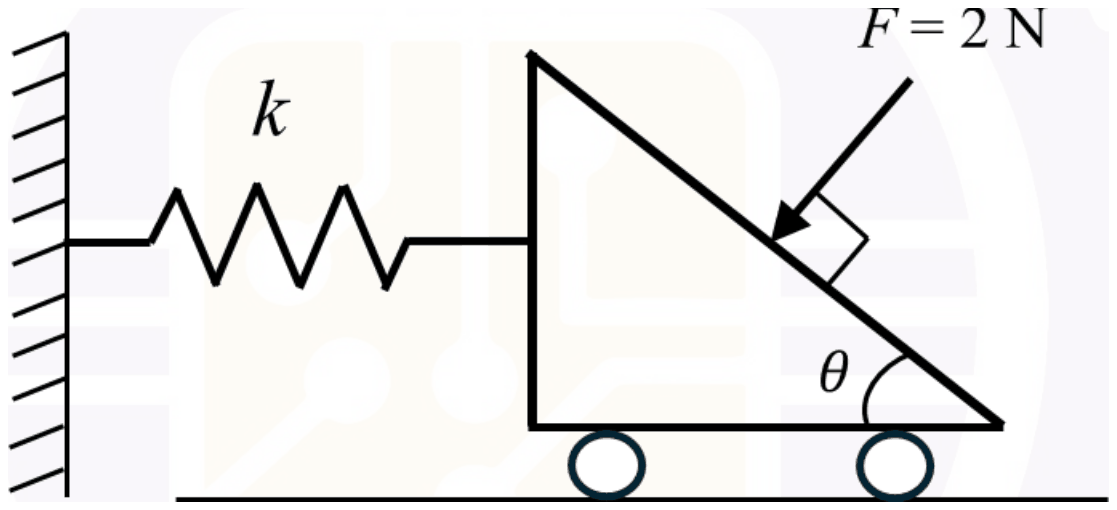
A right-angled wedge block on rollers is attached by a spring k to a wall on its left; its sloping face makes angle theta with the base, and the force F = 2 N presses on the sloping face at right angles to it

Exam Year(s)

GATE XE - 2026,

Answer: D

The angle is \(\theta = \frac{\pi}{6}\).

The force F is normal to the sloping face, which makes angle \(\theta\) with the horizontal base, so F makes the same angle \(\theta\) with the vertical. Its horizontal component pushes the block towards the wall and is resisted by the spring; the vertical component is taken by the floor.

\[ \begin{aligned} F\sin\theta &= k\Delta = 100 \times 0.01 = 1\ \text{N} \\ \sin\theta &= \frac{1}{2},\ \theta = \frac{\pi}{6} \end{aligned} \]

Using the cosine instead of the sine gives \(\pi/3\), the complementary angle. \(\pi/4\) and \(\pi/5\) give horizontal components of 1.41 N and 1.18 N, which do not match the spring force of 1 N.

Please log in or register to report this question.

2.

If a particle is subjected to a system of coplanar and concurrent forces in X-Y plane, the vector equation must satisfy :

Exam Year(s)

RSMSSB JE - 2025, RSMSSB - 2025,

Answer: D

The particle must satisfy both \(\Sigma f_{x} = 0\) and \(\Sigma f_{y} = 0\).

For a particle in equilibrium under coplanar concurrent forces, the vector sum of the forces must be zero, \(\Sigma \vec{F} = 0\). In the X-Y plane that one vector equation splits into two scalar equations, one along each axis.

If only \(\Sigma f_{x} = 0\) held, a resultant along Y would remain, and the particle would accelerate in that direction; the same is true the other way round. The first option, with \(\Sigma f_{y} \neq 0\), describes a particle that is not in equilibrium at all. No moment equation is needed, because concurrent forces all pass through one point.

Please log in or register to report this question.

Loading…
Tags: Equilibrium of Particles Questions and Answers || Equilibrium of Particles MCQ Questions and Answers || Equilibrium of Particles GK Questions and Answers || Equilibrium of Particles GK MCQ Questions || Equilibrium of Particles Multiple Choice Questions and Answers || Equilibrium of Particles GK || GK on Equilibrium of Particles || Engineering Mechanics Questions and Answers || Engineering Mechanics MCQ Questions and Answers || Engineering Mechanics GK Questions and Answers || GK on Engineering Mechanics