
Machine-translated by Google. Questions are authored in English.
Top

Boundary Layer Theory Questions and Answers

11.

For the laminar, incompressible flow over a flat plate with uniform free stream velocity, the axial pressure gradient within the boundary layer is

Exam Year(s)

GATE XE - 2024,

Answer: C

The axial pressure gradient is equal to zero.

Outside the boundary layer the free stream is uniform, so by Bernoulli's equation \(dp/dx = -\rho U\,dU/dx = 0\). Boundary-layer theory shows that the pressure does not vary across the thin layer (\(\partial p/\partial y \approx 0\)), so the layer feels the same zero gradient. This is the Blasius flat-plate problem.

A positive (adverse) or negative (favourable) gradient arises only when the outer velocity changes along the surface, as over a curved body. Pressure gradient and velocity gradient have different dimensions, so they cannot simply be equal.

Please log in or register to report this question.
12.

A sharp flat plate of length L and infinite width is immersed parallel to a fluid stream having velocity \(u_{\infty}\). At a point on the plate, far away from the leading edge and not near the trailing edge, the boundary layer thickness, the displacement thickness, and the momentum thickness are denoted as \(\delta\), \(\delta^{*}\), and \(\theta\), respectively.

Which one of the following options correctly represents the relation between these thicknesses?

Exam Year(s)

GATE XE - 2025,

Answer: A

The order is \(\delta \gt \delta^{*} \gt \theta\).

The boundary layer thickness \(\delta\) is where the velocity reaches 99% of the free stream. The displacement thickness \(\delta^{*} = \int_{0}^{\delta}(1 - u/U)\,dy\) and the momentum thickness \(\theta = \int_{0}^{\delta}(u/U)(1 - u/U)\,dy\) are integrals of deficits that are always smaller than 1 and shrink toward the edge, so both are less than \(\delta\). The extra factor \(u/U \le 1\) makes \(\theta\) smaller than \(\delta^{*}\).

For the laminar Blasius profile, for example, \(\delta^{*} \approx \delta/2.9\) and \(\theta \approx \delta/7.5\), and their ratio (the shape factor) is about 2.6. The other orders all put \(\theta\) above \(\delta^{*}\) or a thickness above \(\delta\).

Please log in or register to report this question.

13.

Consider a steady, and incompressible flow over a body with characteristic length L. The boundary layer thickness at a distance x from the leading edge is \(\delta\). Which one of the following assumptions is correct for deriving the Prandtl boundary layer equations?

Exam Year(s)

GATE XE - 2026,

Answer: D

The assumption is \(\delta \ll L\).

Prandtl's boundary layer equations come from an order-of-magnitude analysis of the Navier-Stokes equations in a thin layer next to the wall. Because the layer is thin compared with the body length, gradients across it (in y) are much larger than gradients along it (in x). This lets the streamwise diffusion term \(\partial^{2}u/\partial x^{2}\) be dropped and shows that the pressure is nearly constant across the layer, imposed by the outer flow.

If \(\delta\) were comparable to or larger than L, none of these simplifications would hold, which rules out the other three options.

Please log in or register to report this question.

14.

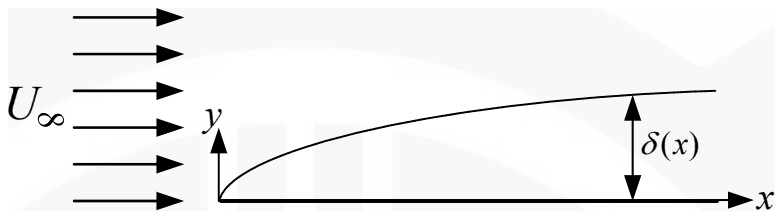
Consider a steady, laminar, and incompressible flow over a flat plate, as shown in the figure. With freestream velocity \(U_{\infty}\) and kinematic viscosity \(\nu_{1}\), the boundary layer thickness at a distance \(x_{1}\) from the leading edge is \(\delta_{1}\). If the kinematic viscosity of the fluid is increased by a factor of four \((\nu_{2} = 4\nu_{1})\), the boundary layer thickness \((\delta_{2})\) at \(x_{1}\) with same \(U_{\infty}\) will be equal to

A uniform stream U infinity approaching a flat plate along the x-axis, with the boundary layer thickness delta(x) growing from the leading edge

Exam Year(s)

GATE XE - 2026,

Answer: C

The new thickness is \(2\delta_{1}\).

For a laminar flat-plate boundary layer (Blasius):

\[ \begin{aligned} \delta &\approx \frac{5x}{\sqrt{Re_{x}}} = 5\sqrt{\frac{\nu x}{U_{\infty}}} \\ &\propto \sqrt{\nu} \end{aligned} \]

At the same x and U, multiplying the kinematic viscosity by 4 multiplies the thickness by \(\sqrt{4} = 2\).

\(4\delta_{1}\) assumes thickness proportional to viscosity, \(\delta_{1}/2\) has the dependence inverted, and \(\delta_{1}\) ignores viscosity altogether. A more viscous fluid diffuses momentum further from the wall, so the layer thickens.

Please log in or register to report this question.

Loading…
Tags: Boundary Layer Theory Questions and Answers || Boundary Layer Theory MCQ Questions and Answers || Boundary Layer Theory GK Questions and Answers || Boundary Layer Theory GK MCQ Questions || Boundary Layer Theory Multiple Choice Questions and Answers || Boundary Layer Theory GK || GK on Boundary Layer Theory || Fluid Mechanics Questions and Answers || Fluid Mechanics MCQ Questions and Answers || Fluid Mechanics GK Questions and Answers || GK on Fluid Mechanics