
Machine-translated by Google. Questions are authored in English.
Top

Entropy Questions and Answers

Direction for [ Question No: 1 To 2 ] :

Note: Usual notations have been used for thermodynamic variables.

Useful Data: Unless otherwise specified, the following data may be assumed. Universal gas constant, \(\bar{R}\) = 8.314 kJ/kmol.K; Acceleration due to gravity, g = 9.81 m/s2; Molecular mass of air, Mair = 29 kg/kmol; Specific heat of air at constant pressure, cp = 1.005 kJ/kg.K; Ratio of specific heats of air, γ = 1.4. Assume air to be a perfect gas unless specified otherwise.

Answer: C

The Clausius inequality is \(\oint \dfrac{\delta Q}{T} \le 0\).

For any closed cycle, the cyclic integral of heat transferred divided by the absolute temperature at the boundary where it crosses is zero for a reversible cycle and negative for an irreversible one. It is a statement of the second law, and leads directly to the definition of entropy, \(dS = (\delta Q/T)_{rev}\).

The cyclic integral of \(\delta Q\) alone equals the net work of the cycle by the first law and can be positive (an engine) or negative (a refrigerator), so the first two options are not the inequality. \(\oint \delta Q/T \gt 0\) would describe a cycle that violates the second law.

Please log in or register to report this question.
2.

32 kg of oxygen is mixed with 28 kg of nitrogen at the same temperature. The gases are at the same pressure of 103 kPa before and after mixing. If \(\bar{R}\) is the universal gas constant in kJ/kmol.K, the change in entropy of the mixture is

Exam Year(s)

GATE XE - 2012,

Answer: A

The entropy change is \(1.38\bar{R}\).

32 kg of O2 is 1 kmol and 28 kg of N2 is 1 kmol, so each mole fraction is 0.5. Mixing ideal gases at the same temperature and pressure gives

\[ \begin{aligned} \Delta S &= -\bar{R}\sum n_{i}\ln x_{i} = -\bar{R}\,[\ln 0.5 + \ln 0.5] \\ &= 2\bar{R}\ln 2 = 1.386\bar{R} \end{aligned} \]

The option \(0.69\bar{R}\) counts only one gas's contribution, \(\ln 2\). \(\bar{R}\) and \(0.34\bar{R}\) do not follow from the formula. The pressure value, 103 kPa, does not matter, since it is the same before and after.

Please log in or register to report this question.

3.

The equation for change of entropy per kg viz. \(R\log_{e}\dfrac{v_2}{v_1}\) is for the ______.

Exam Year(s)

DSSSB - 2023,

Answer: B

The expression \(R\log_e\frac{v_2}{v_1}\) is the change of entropy per kg for an isothermal process. For an ideal gas, \[ ds = c_v\frac{dT}{T} + R\frac{dv}{v} \] and at constant temperature the first term vanishes, which gives \[ s_2 - s_1 = R\log_e\frac{v_2}{v_1} \] In an adiabatic process the change of entropy is zero for the reversible case, and in a constant volume process only the temperature term is left, so the other options are wrong.

Please log in or register to report this question.

Answer: C

The characteristic of entropy named in the key is that it decreases when heat is removed, whether the temperature changes or not. Entropy of a system changes by \(\int \frac{dQ}{T}\) for a reversible process, so removing heat makes the integral negative and lowers the entropy of the system. The first statement is not what the key accepts, since entropy is unchanged in reversible adiabatic processes and increases in irreversible ones. The statement that it decreases when heat is supplied is the reverse of the truth, and the fourth statement about a throttling process is not the keyed statement.

Please log in or register to report this question.

5.

A substance experiences an entropy change of \(\Delta s \gt 0\) in a quasi-steady process. The rise in temperature (corresponding to the entropy change \(\Delta s\)) is highest for the following process:

Exam Year(s)

GATE AE - 2016,

Answer: C

The temperature rise is highest for the isochoric process.

For a reversible process \(T\,ds = \delta q\). At constant volume \(\delta q = c_{v}\,dT\), and at constant pressure \(\delta q = c_{p}\,dT\), so for the same entropy change

\[ \begin{aligned} dT_{v} &= \frac{T\,ds}{c_{v}} \\ dT_{p} &= \frac{T\,ds}{c_{p}} \end{aligned} \]

Since \(c_{v} \lt c_{p}\), the isochoric rise is larger, by the factor \(\gamma = c_{p}/c_{v}\). In an isothermal process the temperature does not rise at all, and an isenthalpic process of an ideal gas also keeps the temperature constant, since enthalpy depends only on temperature.

Please log in or register to report this question.

6.

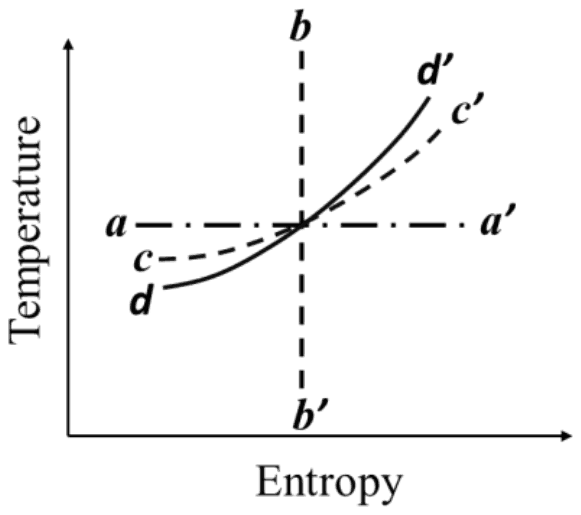
In the figure shown below, various thermodynamics processes for an ideal gas are represented. Match each curve with the process that it best represents.

Temperature against entropy: a horizontal line aa, a vertical line bb, and two rising curves cc and dd through the same point, dd being the steeper

Exam Year(s)

GATE AE - 2024,

Answer: C

The matching is aa' - Isothermal; bb' - Isentropic; cc' - Isobaric; dd' - Isochoric.

On a temperature-entropy diagram a horizontal line keeps the temperature fixed, so aa' is isothermal, and a vertical line keeps the entropy fixed, so bb' is isentropic.

Constant-volume and constant-pressure lines both rise to the right, with slopes

\[ \begin{aligned} \left(\frac{\partial T}{\partial s}\right)_{v} &= \frac{T}{c_{v}} \\ \left(\frac{\partial T}{\partial s}\right)_{p} &= \frac{T}{c_{p}} \end{aligned} \]

Since \(c_{p} \gt c_{v}\), the isochoric line is the steeper one. dd' is steeper than cc' through the common point, so dd' is isochoric and cc' isobaric.

The other options either swap the horizontal and vertical lines or swap the two sloping curves.

Please log in or register to report this question.

7.

For an ideal gas with constant properties undergoing a quasi-static process, which one of the following represents the change of entropy (Δs) from state 1 to 2?

Exam Year(s)

GATE ME - 2018,

Answer: A

The correct expression is \(\Delta s = C_{p}\ln\frac{T_{2}}{T_{1}} - R\ln\frac{P_{2}}{P_{1}}\).

From the Gibbs relation \(T\,ds = dh - v\,dP\), with \(dh = C_{p}\,dT\) and \(v = RT/P\) for an ideal gas:

\[ \begin{aligned} ds &= C_{p}\frac{dT}{T} - R\frac{dP}{P} \\ \Delta s &= C_{p}\ln\frac{T_{2}}{T_{1}} - R\ln\frac{P_{2}}{P_{1}} \end{aligned} \]

The volume form is \(\Delta s = C_{V}\ln\frac{T_{2}}{T_{1}} + R\ln\frac{V_{2}}{V_{1}}\). Option D has \(R\ln(V_{1}/V_{2})\), which reverses the sign of the volume term. Options B and C put a heat capacity where R belongs.

Please log in or register to report this question.

8.

Water at 300 K can be brought to 320 K using one of the following processes.

Process 1: Water is brought in equilibrium with a reservoir at 320 K directly.
Process 2: Water is first brought in equilibrium with a reservoir at 310 K and then with the reservoir at 320 K.
Process 3: Water is first brought in equilibrium with a reservoir at 350 K and then with the reservoir at 320 K.

The corresponding changes in the entropy of the universe for these processes are \(\Delta S_{1}\), \(\Delta S_{2}\) and \(\Delta S_{3}\), respectively. Then

Exam Year(s)

GATE Physics - 2022,

Answer: B

The order is \(\Delta S_{3} \gt \Delta S_{1} \gt \Delta S_{2}\).

When water of heat capacity \(C\) goes from \(T_{1}\) to \(T_{2}\) in contact with a reservoir at \(T_{r}\), the entropy of the universe changes by \(C\ln(T_{2}/T_{1}) - C(T_{2} - T_{1})/T_{r}\). In units of \(C\):

  • Process 1: \(\ln(320/300) - 20/320 = 0.0645 - 0.0625 = 0.0020\).
  • Process 2: \(\ln\frac{310}{300} - \frac{10}{310} \approx 0.0005\) for the first stage plus \(\ln\frac{320}{310} - \frac{10}{320} \approx 0.0005\) for the second, about 0.0010 in all.
  • Process 3: heating to 350 K gives \(0.1542 - 0.1429 = 0.0113\); cooling back to 320 K gives \(-0.0896 + 0.0938 = 0.0041\); total about 0.0154.

Smaller temperature steps make the heat transfer closer to reversible, so process 2 generates the least entropy. Overshooting to 350 K and coming back adds two irreversible transfers, so process 3 generates the most.

Please log in or register to report this question.

9.

A 5 kg metal block (\(c_{p}\) = 0.5 kJ/kg-K) at 373 K is submerged into 10 kg of water (\(c_{p}\) = 4.2 kJ/kg-K) at 293 K in an insulated rigid container without spilling. Assuming thermal equilibrium is reached, the approximate entropy change of the universe is

Exam Year(s)

GATE XE - 2023,

Answer: B

The entropy change of the universe is about 0.073 kJ/K.

The container is insulated and rigid, so the heat lost by the block equals the heat gained by the water:

\[ \begin{aligned} 5(0.5)(373 - T) &= 10(4.2)(T - 293) \\ T &= \frac{932.5 + 12306}{44.5} = 297.5\ \text{K} \end{aligned} \]

Each body's entropy change is \(mc\ln(T_{2}/T_{1})\):

\[ \begin{aligned} \Delta S_{block} &= 2.5\ln\tfrac{297.5}{373} = -0.565 \\ \Delta S_{water} &= 42\ln\tfrac{297.5}{293} = +0.639 \\ \Delta S_{univ} &\approx 0.073\ \text{kJ/K} \end{aligned} \]

No heat leaves the container, so the surroundings' entropy does not change. \(-0.565\) kJ/K is the block's change alone, and 0.642 kJ/K is close to the water's alone; the universe's total must be positive for this irreversible process.

Please log in or register to report this question.

10.

10 kg of water at 300 K is poured into a bucket containing 10 kg of water at 350 K. Heat capacity of water is 4.2 kJ/kg.K. Neglecting any heat losses to the surroundings, the change in the entropy (in kJ/K) of the system during this process (rounded off to two decimal places) is

Exam Year(s)

GATE XE - 2024,

Answer: B

The entropy change is 0.25 kJ/K.

Equal masses of water mix to the mean temperature, 325 K. The entropy change of each mass is \(mc\ln(T_f/T_i)\):

\[ \begin{aligned} \Delta S &= 42\left[\ln\tfrac{325}{300} + \ln\tfrac{325}{350}\right] \\ &= 42(0.08004 - 0.07411) \\ &= 0.249 \approx 0.25\ \text{kJ/K} \end{aligned} \]

with \(mc = 10 \times 4.2 = 42\) kJ/K. The cold water gains more entropy than the hot water loses, so the total is positive, as it must be for an irreversible mixing. 0.00 would describe a reversible process, and 0.50 and 0.75 overstate the result.

Please log in or register to report this question.

Loading…
Tags: Entropy Questions and Answers || Entropy MCQ Questions and Answers || Entropy GK Questions and Answers || Entropy GK MCQ Questions || Entropy Multiple Choice Questions and Answers || Entropy GK || GK on Entropy || Thermodynamics Questions and Answers || Thermodynamics MCQ Questions and Answers || Thermodynamics GK Questions and Answers || GK on Thermodynamics