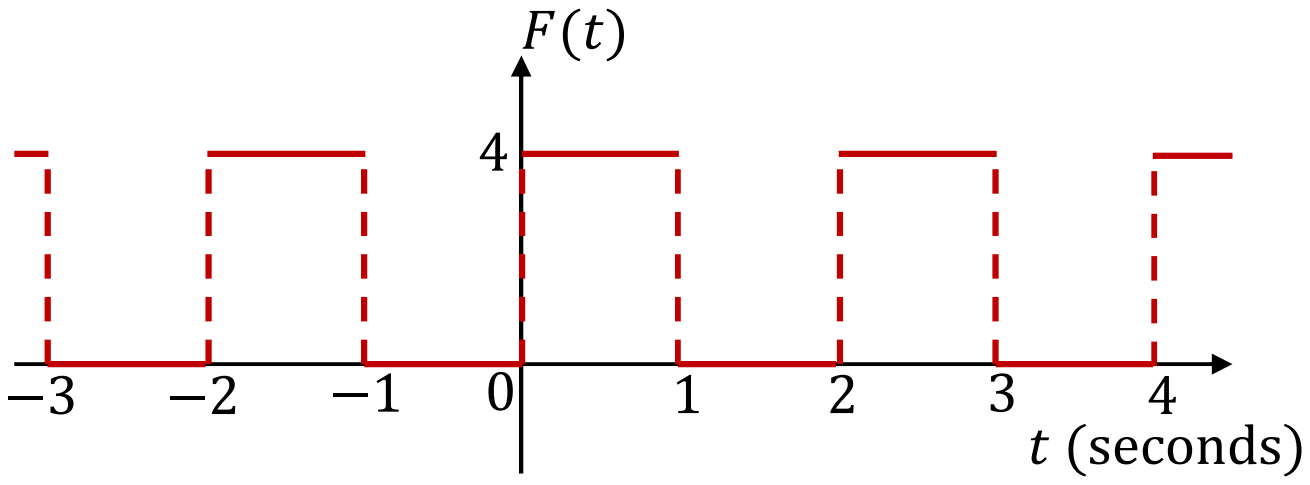
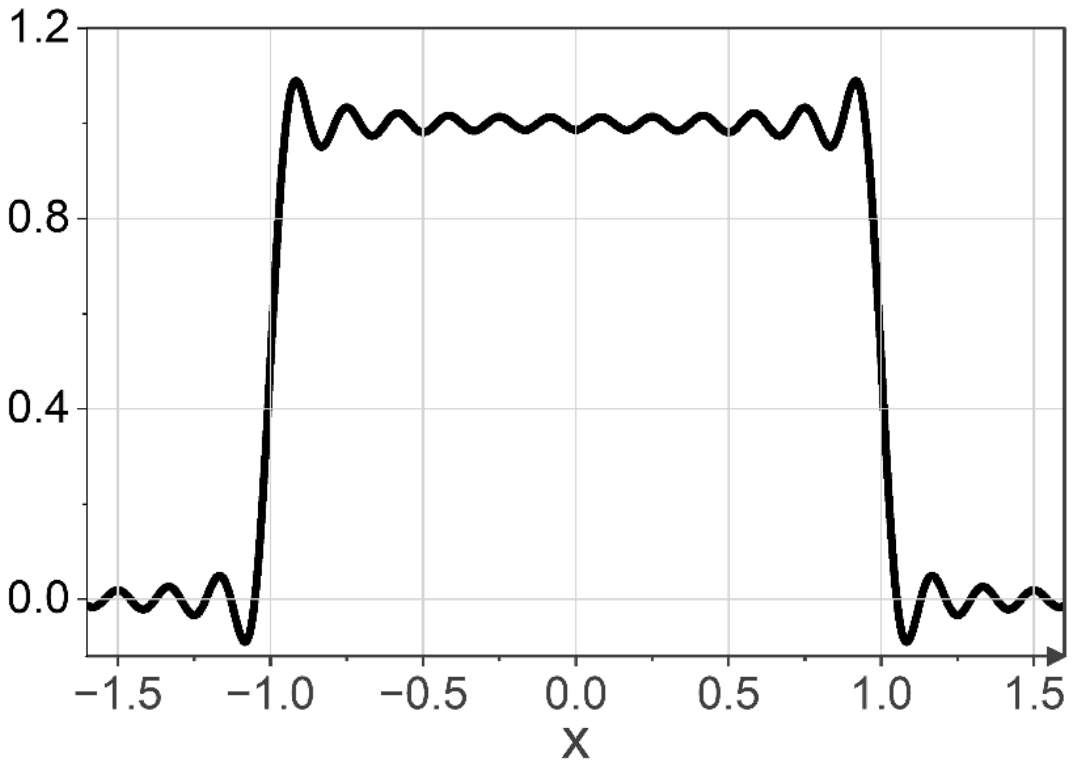
The Fourier series representation of a square wave is shown in the figure below. The fluctuations seen near x = ±1 are named after which one of the following scientists?
GATE AE - 2026,
Answer: C
The fluctuations are the Gibbs phenomenon.
When a function with a jump discontinuity, such as a square wave, is represented by a truncated Fourier series, the partial sums overshoot and ring near the jump. Adding more terms squeezes the ripples closer to the discontinuity but does not reduce the peak overshoot, which stays near 9% of the jump. J. Willard Gibbs explained this in 1899, and it is named after him.
Fourier gave the series itself, not the overshoot. Cauchy and Laplace are associated with other results (Cauchy's integral theorem, the Laplace transform and equation) and not with this effect.
Please log in or register to report this question.