
Machine-translated by Google. Questions are authored in English.
Top

Atmospheric Waves Questions and Answers

1.

Analysis of an atmospheric variable shows prominent modes at 5, 40 and 1460 days. These modes correspond respectively to

Exam Year(s)

GATE XE - 2018,

Answer: B

The modes are synoptic, MJO and ENSO.

A period of about 5 days is typical of synoptic weather systems, the passage of mid-latitude cyclones and anticyclones. About 40 days falls in the 30 to 60 day band of the Madden-Julian Oscillation. 1460 days is 4 years, within the 2 to 7 year period of El Nino-Southern Oscillation.

Tides have periods of about half a day and a day, not 5 days. Milankovitch cycles last tens of thousands of years, and decadal variability means about 10 years or more, far longer than 4 years.

Please log in or register to report this question.
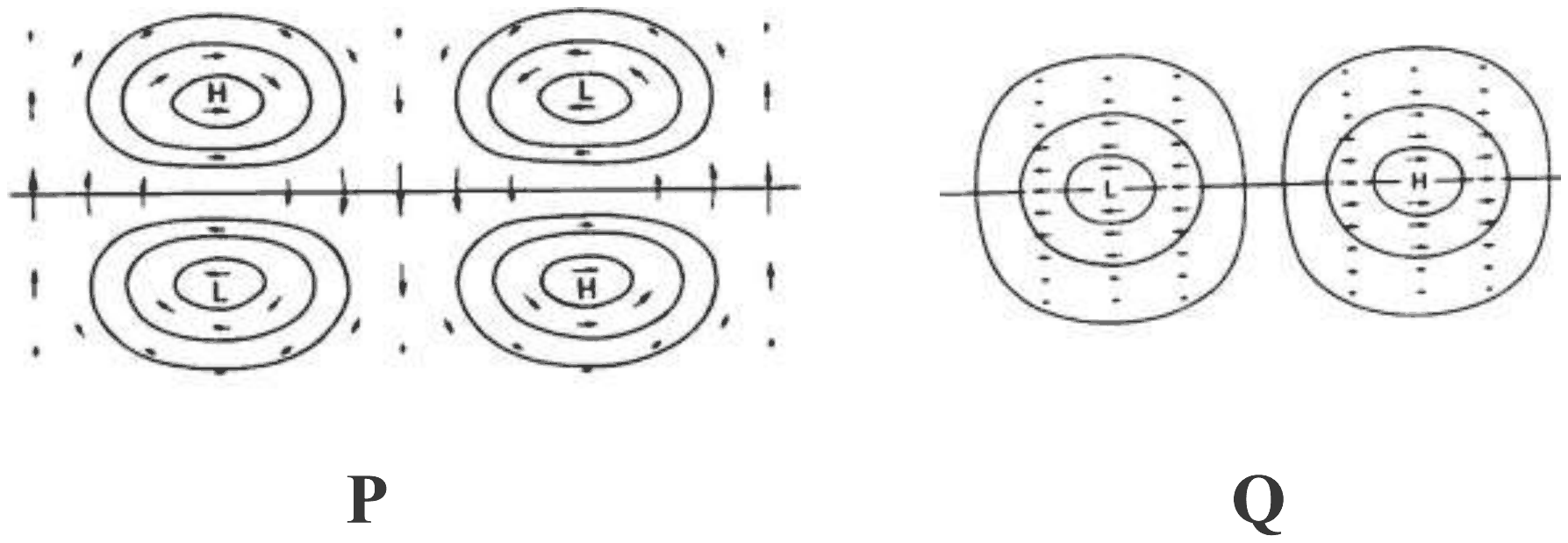
Answer: B

P and Q are equatorial Rossby and equatorial Kelvin waves.

Both patterns are organised about the equator, so they are equatorially trapped waves, not mid-latitude or polar ones. In P the pressure cells lie off the equator with opposite signs to north and south, with flow circling each cell and crossing the equator: the Rossby-type equatorial wave with cross-equatorial flow (the mixed Rossby-gravity, or Yanai, wave). In Q the highs and lows are centred on the equator and the wind is purely east-west, in geostrophic balance with the north-south pressure gradient: the equatorial Kelvin wave, which has no meridional velocity.

Option D reverses the two, and options A and C name mid-latitude and polar waves, which these equator-centred patterns are not.

Please log in or register to report this question.

3.

Rossby waves depend fundamentally upon the variation of the Coriolis parameter with latitude, known as :

Exam Year(s)

MH SET - 2019, SET Exam - 2019,

Answer: C

The variation of the Coriolis parameter with latitude is the beta effect.

The Coriolis parameter is \(f = 2\Omega\sin\phi\), and its northward gradient is \(\beta = df/dy\). As an air or water parcel moves north or south, conservation of absolute vorticity makes its relative vorticity change, and this restoring tendency is what produces westward-propagating Rossby waves. The beta-plane approximation is named after it.

'Alfa', 'gamma' and 'lambda' effects are not the name given to this gradient.

Please log in or register to report this question.

4.

Which of the following is not Dispersive wave ?

Exam Year(s)

MH SET - 2021, SET Exam - 2021,

Answer: C

The non-dispersive wave is the shallow water gravity wave.

A wave is dispersive when its speed depends on its wavelength. In shallow water the speed of a gravity wave is

\[ c = \sqrt{g h} \]

which depends only on depth, so all wavelengths travel together; tsunamis are the classic example.

Deep-water gravity waves travel at \(c = \sqrt{g\lambda/2\pi}\), so long waves outrun short ones. Rossby waves (printed Russby) and inertia (inertia-gravity) waves also have speeds that depend on wavelength, so they are dispersive.

Please log in or register to report this question.

5.

The effects of gravity acting on perturbations to a density gradient in vertical are referred as :

Exam Year(s)

MH SET - 2024, SET Exam - 2024,

Answer: C

They are Gravity waves, also called buoyancy waves.

In a stably stratified fluid, a parcel displaced vertically is pushed back by buoyancy and overshoots, so it oscillates. These oscillations, where gravity acts on disturbances to the vertical density gradient, propagate as internal gravity waves in the atmosphere and ocean; lee waves over mountains are an example.

Rossby waves arise from the variation of the Coriolis effect with latitude, Kelvin waves are trapped against a coast or the equator by rotation, and inertia waves are oscillations driven by the Earth's rotation alone.

Please log in or register to report this question.

6.

The Madden-Julian Oscillations (MJO) has a zonal wavenumber 1 with maximum amplitude in the deep tropics, and it moves eastward around the equator with a period of :

Exam Year(s)

MH SET - 2025, SET Exam - 2025,

Answer: C

The MJO has a period of 30-60 days.

The Madden-Julian Oscillation, discovered by Roland Madden and Paul Julian in 1971, is the dominant intraseasonal variation in the tropics: an eastward-moving envelope of enhanced and suppressed convection that travels around the globe in about 30 to 60 days (often quoted as 30-90 days). It affects the active and break phases of the Indian monsoon and tropical cyclone formation.

10-20 days is the period of the quasi-biweekly mode of the monsoon, a different oscillation. 70-80 and 80-90 days lie beyond the MJO's usual range.

Please log in or register to report this question.

Answer: A

Sound waves are restored by the pressure changes that accompany compression and rarefaction of the air, and they travel at about 340 metres per second near the surface. Buoyancy restores gravity waves, the Coriolis force restores inertial oscillations, and the planetary vorticity gradient restores Rossby waves. Classifying each wave by its restoring mechanism is the most reliable way to keep the whole family straight, since the mathematics of each follows directly from the physics of what pushes the parcel back.

Please log in or register to report this question.

Answer: B

A parcel displaced upward in a stably stratified atmosphere becomes denser than its surroundings and sinks back, overshooting and oscillating at the buoyancy frequency. That oscillation propagating through the fluid is an internal gravity wave. Compressibility gives sound waves, the latitudinal variation of the Coriolis parameter gives Rossby waves, and friction damps waves rather than restoring them. Checking the units of each quantity catches a wrong formula before the arithmetic begins.

Please log in or register to report this question.

Answer: C

The dispersion relation gives the frequency as the buoyancy frequency times the cosine of the angle the wavenumber vector makes with the vertical, so no internal gravity wave can exceed the buoyancy frequency. In the troposphere that corresponds to a period of about ten minutes. The Coriolis parameter bounds the frequency from below once rotation is included, giving the inertia-gravity wave band. Reading the definition literally, rather than recalling a formula, is the reliable route through questions of this shape.

Please log in or register to report this question.

Answer: D

For internal gravity waves the group velocity is perpendicular to the wavenumber vector, so energy propagates at right angles to the direction in which the crests move. Downward phase propagation therefore corresponds to upward energy propagation, which is how waves generated in the troposphere are identified in stratospheric observations. This counterintuitive property is one of the most distinctive features of the wave type. Most errors here come from carrying a result across from a neighbouring case where it does not hold.

Please log in or register to report this question.

Loading…

Other Subjects

Tags: Atmospheric Waves Questions and Answers || Atmospheric Waves MCQ Questions and Answers || Atmospheric Waves GK Questions and Answers || Atmospheric Waves GK MCQ Questions || Atmospheric Waves Multiple Choice Questions and Answers || Atmospheric Waves GK || GK on Atmospheric Waves || Atmospheric Dynamics Questions and Answers || Atmospheric Dynamics MCQ Questions and Answers || Atmospheric Dynamics GK Questions and Answers || GK on Atmospheric Dynamics