
Machine-translated by Google. Questions are authored in English.
Top

Plant Anatomy Questions and Answers

1.

The swollen base of a petiole is known as

Exam Year(s)

GATE Life Sciences - 2012,

Answer: C

The swollen base of a petiole is the Pulvinus.

A pulvinus is a cushion-like swelling at the base of a petiole (or leaflet stalk), made of thin-walled motor cells. Changes in their turgor move the leaf, as in the sleep movements of legumes and the rapid folding of Mimosa pudica.

A ligule is a thin membranous outgrowth where the leaf sheath meets the blade in grasses. A hastula is a small projection at the junction of the petiole and blade in some palms. Stipules are the paired outgrowths at the base of a leaf, beside the petiole rather than a swelling of it.

Please log in or register to report this question.
2.

Parenchyma cells associated with sieve tube members are called

Exam Year(s)

GATE Life Sciences - 2012,

Answer: B

They are called Companion cells.

In angiosperm phloem, each sieve tube member is linked by many plasmodesmata to one or more companion cells, which arise from the same mother cell. The sieve tube member loses its nucleus and most organelles at maturity, and the nucleated, metabolically active companion cell keeps it alive and loads sugars into it.

Albuminous (Strasburger) cells play the equivalent role for the sieve cells of gymnosperms, not sieve tube members. Bulliform cells are large epidermal cells in grass leaves that make the leaf roll in drought, and subsidiary cells surround the guard cells of stomata.

Please log in or register to report this question.

3.

In Angiosperms, normally 'Exarch Xylem' occurs in

Exam Year(s)

GATE Life Sciences - 2022,

Answer: C

Exarch xylem normally occurs in the dicot root.

'Exarch' means the protoxylem lies toward the outside, next to the pericycle, and the metaxylem develops toward the centre, so the xylem matures centripetally. This is the arrangement of the radial vascular bundles of roots, in dicots and monocots alike.

Stems, whether dicot or monocot, have endarch xylem: the protoxylem faces the pith and maturation proceeds outward. The veins of a leaf continue the stem's bundles, with the xylem on the upper side and the protoxylem innermost, so a dicot leaf is not exarch either.

Please log in or register to report this question.

4.

Anomalous secondary growth is observed in

Exam Year(s)

GATE Life Sciences - 2022,

Answer: D

Anomalous secondary growth is seen in Dracaena.

Monocots normally have no vascular cambium and no secondary growth. Dracaena, the dragon tree, is an exception: a secondary thickening meristem develops in the cortex outside the primary bundles and produces new vascular bundles and ground tissue inward, so the trunk thickens. Because this does not follow the usual cambial pattern of dicots, it is called anomalous secondary growth.

Triticum (wheat), Oryza (rice) and Zea (maize) are grasses whose stems have scattered closed bundles and do not undergo secondary growth.

Please log in or register to report this question.

Answer: C

The correct statement is that Casparian strips act as a cellular barrier to allow selective nutrient uptake and exclusion of pathogens.

The Casparian strip is a band of suberin and lignin in the radial and transverse walls of the root endodermis. It blocks the apoplastic path, so water and solutes must cross the endodermal plasma membranes, where uptake is selective, and it also hinders the entry of pathogens into the stele.

It is found in the endodermis (and in some plants an exodermis), not the epidermis, and it is a feature of roots, not mainly of shoots. Non-vascular plants such as mosses have no endodermis or vascular tissue at all, so the strip cannot be common in them.

Please log in or register to report this question.

6.

Periderm is a protective tissue found in stems and roots of gymnosperm and woody dicotyledons. It contributes to the increased thickness by secondary growth. Match the peridermal components given in Group I with the cell/tissue types given in Group II.

Group IGroup II
(P) Phelloids(1) Tissue resembling cortical parenchyma
(Q) Phellogen(2) Cork cambium
(R) Phellem(3) Cork-like cells
(S) Phelloderm(4) Cork

Exam Year(s)

GATE Life Sciences - 2023,

Answer: B

The match is P-3; Q-2; R-4; S-1.

  • Phelloids are cells within the phellem that resemble cork cells but lack suberised walls: cork-like cells.
  • Phellogen is the cork cambium, the lateral meristem that produces the periderm.
  • Phellem, produced to the outside by the phellogen, is the cork.
  • Phelloderm, produced to the inside, is living tissue that resembles cortical parenchyma.

The other options interchange phellogen and phelloids or call the phelloderm cork, mixing up the meristem with its two products.

Please log in or register to report this question.

7.

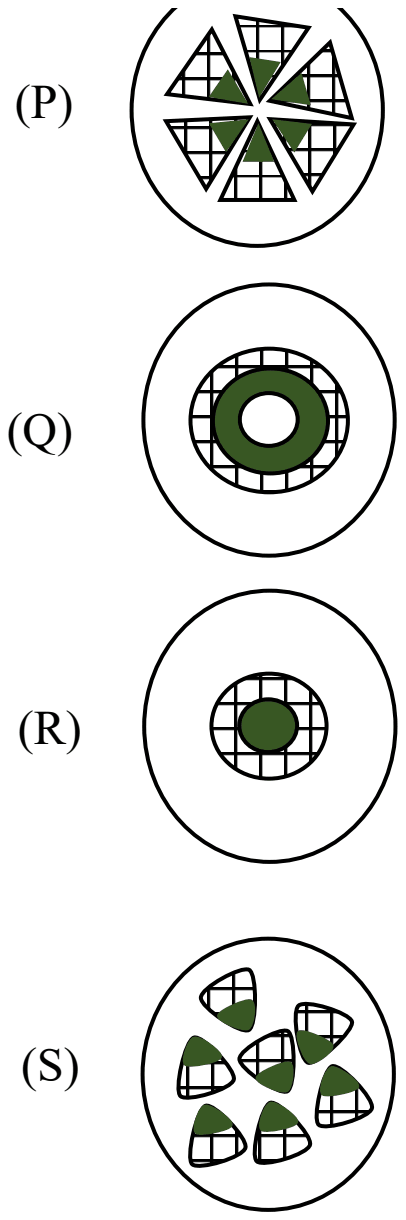
Central vascular cylinder or stele consists of the primary vascular system (xylem and phloem) and the associate fundamental tissue. Match the schematics of stele in Group I (xylem shown in green, and phloem shown as a square grid) with their respective types in Group II.

Group I:

Four stem cross-sections: P a ring of separate wedge-shaped bundles, xylem inside phloem; Q a central pith ringed by xylem with phloem outside; R a solid central xylem core surrounded by phloem; S many bundles scattered through the section

Group II: (1) Protostele; (2) Eustele; (3) Atactostele; (4) Ectophloic siphonostele; (5) Amphiphloic siphonostele

Exam Year(s)

GATE Life Sciences - 2023,

Answer: A

The match is P-2; Q-4; R-1; S-3.

  • P, a ring of separate collateral bundles with phloem outside the xylem around a central pith, is a eustele, typical of dicot and gymnosperm stems.
  • Q, a continuous cylinder of xylem around a pith with phloem only on the outside, is an ectophloic siphonostele.
  • R, a solid central core of xylem surrounded by phloem with no pith, is a protostele, the simplest type.
  • S, with many bundles scattered through the ground tissue, is an atactostele, characteristic of monocot stems.

An amphiphloic siphonostele would show phloem on both sides of the xylem ring, which none of the drawings has, so options using item 5 are wrong.

Please log in or register to report this question.

8.

The collateral and open type of vascular bundle with endarch xylem strand is usually found in

Exam Year(s)

GATE Life Sciences - 2024,

Answer: B

This bundle is found in the dicot stem.

In a dicot stem the vascular bundles are collateral (xylem and phloem on the same radius, phloem outside), open (a strip of cambium between xylem and phloem allows secondary growth) and endarch (protoxylem towards the centre).

A monocot stem also has collateral, endarch bundles, but they are closed, with no cambium. Roots, both monocot and dicot, have radial bundles, with xylem and phloem on alternate radii, and exarch xylem.

Please log in or register to report this question.

9.

Which one of the following mature cell types is live but usually lacks nucleus?

Exam Year(s)

GATE Life Sciences - 2025,

Answer: C

The cell type is the phloem sieve element.

As a sieve element matures it loses its nucleus, vacuole membrane, ribosomes and most other organelles, leaving an open conduit for the flow of sugars through the sieve plates. It stays alive, with a functional plasma membrane, because the neighbouring companion cell, joined to it by many plasmodesmata, supplies the proteins and energy it can no longer make.

Phloem parenchyma, companion cells and phloem-pole pericycle cells are ordinary living cells that keep their nuclei; the companion cell in particular is nucleus-rich and metabolically very active, precisely because it supports the enucleate sieve element.

Please log in or register to report this question.

10.

Correctly match the carnivorous plants (Group I) with the organs (Group II) they modify to trap the prey.

Group IGroup II
(P) Pitcher plant (Nepenthes)(1) Leaf
(Q) Bladderwort (Utricularia)(2) Fruit
(R) Sundew (Drosera)(3) Stem
(S) Venus flytrap (Dionaea)(4) Tendril

Exam Year(s)

GATE Life Sciences - 2025,

Answer: B

The correct match is P-1; Q-1; R-1; S-1: all four trap prey with modified leaves.

  • The pitcher of Nepenthes is a modified leaf blade, with the tendril-like midrib extension carrying the pitcher and its lid.
  • The bladders of Utricularia are modified leaf segments that suck in small animals.
  • The sticky glandular tentacles of Drosera cover the surface of its leaves.
  • The snap trap of Dionaea is the two-lobed leaf blade, which closes when its trigger hairs are touched.

No carnivorous plant traps prey with fruits or stems, so every option using fruit (2) or stem (3) is wrong. The tendril of Nepenthes is itself part of the leaf, so it does not make the pitcher a separate organ type.

Please log in or register to report this question.

Loading…
Tags: Plant Anatomy Questions and Answers