
Machine-translated by Google. Questions are authored in English.
Top

Steady State Conduction Questions and Answers

1.

Critical thickness of insulation (rcr) for a pipe having thermal conductivity (k) and convective heat transfer coefficient (ho) is __________.

Exam Year(s)

GATE AG - 2024,

Answer: B

The critical radius of insulation for a pipe is \(k/h_{o}\).

For insulation of outer radius r on a pipe, the total resistance per unit length is conduction through the insulation plus convection from its outer surface:

\[ R' = \frac{\ln(r/r_{i})}{2\pi k} + \frac{1}{2\pi r h_{o}} \]

Setting \(dR'/dr = 0\) gives \(\frac{1}{kr} = \frac{1}{h_{o}r^{2}}\), so \(r_{cr} = k/h_{o}\). Below this radius, adding insulation actually increases heat loss, because the larger surface gains more convection than the extra conduction resistance costs.

\(2k/h_{o}\) is the critical radius for a sphere. \(h_{o}/k\) and \(2h_{o}/k\) invert the ratio and do not even have the units of length.

Please log in or register to report this question.
2.

A 2 mm diameter electric wire is insulated with 2 mm thick plastic. The plastic has a thermal conductivity of 0.5 W.m−1.K−1. The wire is exposed to air at 320 K and outside convective heat transfer coefficient is 25 W.m−2.K−1. Wire surface temperature is constant at 420 K and remains unaffected by the covering. Assuming steady state heat transfer conditions, the ratio of heat loss per metre of wire length with insulation to that without insulation is nearest to

(Take π = 3.14)

Exam Year(s)

GATE AG - 2026,

Answer: A

The ratio is about 2.58: the insulation more than doubles the heat loss.

Bare wire, radius 1 mm, loses heat by convection only:

\[ \begin{aligned} q_{0} &= h(2\pi r_{1})\Delta T \\ &= 25(2)(3.14)(0.001)(100) = 15.7\ \text{W/m} \end{aligned} \]

Insulated wire, outer radius 3 mm, has conduction and convection resistances in series (per metre):

\[ \begin{aligned} R &= \frac{\ln(3/1)}{2\pi k} + \frac{1}{h\,2\pi r_{2}} \\ &= \frac{1.0986}{3.14} + \frac{1}{0.471} = 0.350 + 2.123 \\ &= 2.473\ \text{K.m/W} \\ q &= \frac{100}{2.473} = 40.4\ \text{W/m} \end{aligned} \]

\[ \frac{q}{q_{0}} = \frac{40.4}{15.7} = 2.58 \]

The reason is the critical radius of insulation, \(k/h = 0.5/25 = 20\) mm. Below it, adding insulation increases the outer surface faster than it adds resistance, so the loss rises. 0.39 is the inverse ratio, which would be right only if insulation always reduced heat loss.

Please log in or register to report this question.
3.

Consider a rod of uniform thermal conductivity whose one end (\(x = 0\)) is insulated and the other end (\(x = L\)) is exposed to flow of air at temperature \(T_{\infty}\) with convective heat transfer coefficient \(h\). The cylindrical surface of the rod is insulated so that the heat transfer is strictly along the axis of the rod. The rate of internal heat generation per unit volume inside the rod is given as

\[ \dot{q} = \cos\frac{2\pi x}{L} . \]

The steady state temperature at the mid-location of the rod is given as \(T_{A}\). What will be the temperature at the same location, if the convective heat transfer coefficient increases to \(2h\)?

Exam Year(s)

GATE ME - 2022,

Answer: C

The temperature stays \(T_{A}\).

The total heat generated in the rod, per unit cross-section, is

\[ \int_{0}^{L}\cos\frac{2\pi x}{L}\,dx = 0 \]

The end \(x = 0\) and the sides are insulated, so in steady state the heat leaving at \(x = L\) must equal this net generation, zero. The convective flux \(h(T(L) - T_{\infty})\) is therefore zero, so \(T(L) = T_{\infty}\) whatever the value of \(h\).

The temperature inside follows from \(kT'' = -\dot{q}\) with \(T'(0) = 0\) and \(T(L) = T_{\infty}\), none of which involves \(h\); at mid-length it is \(T_{\infty} - L^{2}/(2\pi^{2}k)\). Doubling \(h\) changes nothing, so the temperature stays \(T_{A}\).

The other options assume a net heat flow through the convective end, which is zero here.

Please log in or register to report this question.
4.

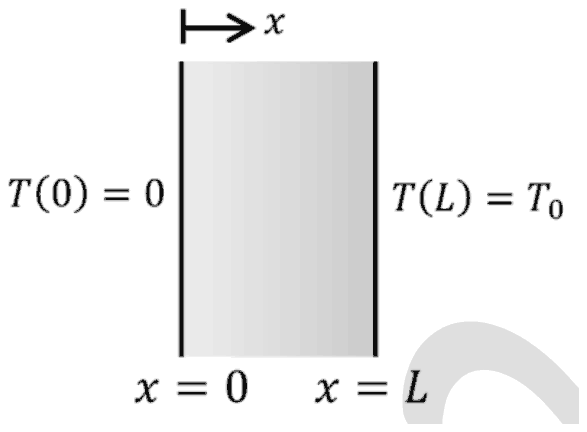
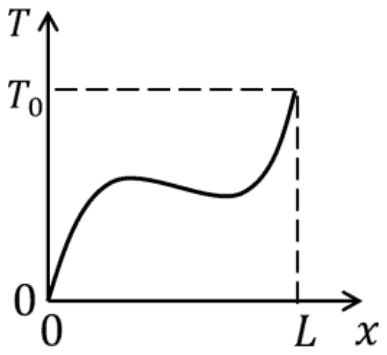
A plane, solid slab of thickness \(L\), shown in the figure, has thermal conductivity \(k\) that varies with the spatial coordinate \(x\) as \(k = A + Bx\), where \(A\) and \(B\) are positive constants (\(A \gt 0, B \gt 0\)). The slab walls are maintained at fixed temperatures of \(T(x = 0) = 0\) and \(T(x = L) = T_{0} \gt 0\). The slab has no internal heat sources. Considering one-dimensional heat transfer, which one of the following plots qualitatively depicts the steady-state temperature distribution within the slab?

Slab with face x = 0 at T(0) = 0 and face x = L at T(L) = T0

Exam Year(s)

GATE ME - 2024,

Answer: B

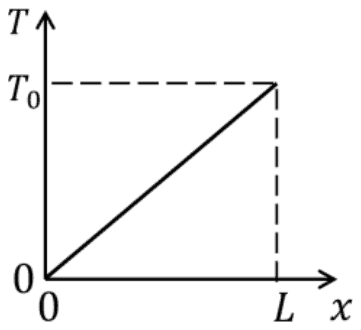
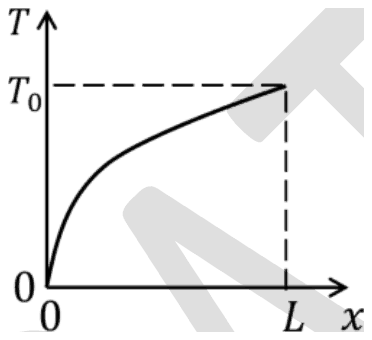
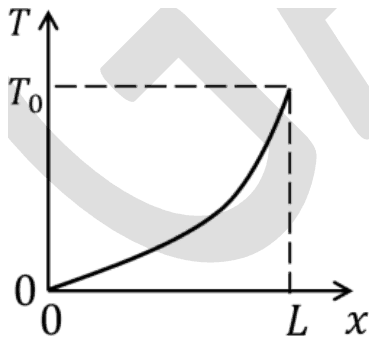
The temperature distribution is plot (B): rising steeply near x = 0 and flattening towards x = L.

With no heat sources, the steady heat flux through the slab is the same at every x:

\[ \begin{aligned} q &= -k\frac{dT}{dx} = \text{constant} \\ \frac{dT}{dx} &= \frac{\text{const}}{A + Bx} \end{aligned} \]

Since T rises from 0 to \(T_{0}\), the slope is positive, and because k = A + Bx grows with x, the slope gets smaller as x increases. The profile is therefore steep where the conductivity is low and gentle where it is high: a curve that is concave down.

The straight line (A) is the constant-conductivity case. Plot C has the slope increasing with x, which would need k to decrease. Plot D has a temperature that falls in the middle, which would need heat to flow both ways at once, impossible without sources.

Please log in or register to report this question.
5.

In which of the following cases , non isotropic conductivity is exhibited?

Exam Year(s)

RSMSSB JE - 2025, RSMSSB - 2025,

Answer: B

Non-isotropic conductivity is shown by wood.

Wood is fibrous: heat flows more easily along the grain than across it, typically about twice as fast, so its thermal conductivity depends on direction. A material like this is called anisotropic.

Lead, copper and brass are metals with a crystalline structure that, in bulk, conducts heat equally in all directions, so they are isotropic for heat conduction.

Please log in or register to report this question.
6.

For a current carrying wire of 20mm diameter exposed to air (h = 20W/m2K), maximum heat dissipation occurs when thickness of insulation (0.5 W/mK) is :

Exam Year(s)

RSMSSB JE - 2025, RSMSSB - 2025,

Answer: D

The insulation thickness for maximum heat dissipation is 15 mm.

For a cylinder, heat loss is greatest when the outer radius of the insulation equals the critical radius:

\[ \begin{aligned} r_{c} &= \frac{k}{h} = \frac{0.5}{20} = 0.025\ \text{m} = 25\ \text{mm} \\ t &= r_{c} - r = 25 - 10 = 15\ \text{mm} \end{aligned} \]

The wire's radius is 10 mm, half its 20 mm diameter. 25 mm is the critical radius itself, not the thickness, and 30 mm and 20 mm come from using the diameter in place of the radius.

Please log in or register to report this question.

7.

A brick wall (k = 0.9 W/mk) of thickness 0.18 m separates the warm air in a room from the cold ambient air, on a particular winter day, the outside air temperature is -5°C and the room needs to be maintained at 27°C.The heat transfer coefficient associated with outside air is 20 W/m2k. Neglecting the corrective resistance of the air inside the room, the heat loss in (W/m2) ,is:

Exam Year(s)

RSMSSB JE - 2025, RSMSSB - 2025,

Answer: C

The heat loss is \(128\ \text{W/m}^{2}\).

Neglecting the inside air resistance, the heat passes through the wall and the outside air film in series. Per square metre:

\[ \begin{aligned} R &= \frac{0.18}{0.9} + \frac{1}{20} = 0.20 + 0.05 = 0.25 \\ q &= \frac{27 - (-5)}{0.25} = \frac{32}{0.25} = 128 \end{aligned} \]

Using the wall resistance alone gives \(32/0.2 = 160\), which forgets the outside film. 88 and 110 do not follow from these resistances.

Please log in or register to report this question.

8.

Calculate the rate of heat transfer per unit area through a copper plate 45 mm thick, whose one face is maintained at 350°C and the other face at 50°C. Take thermal conductivity of copper as 370 W/m°C.

Exam Year(s)

RSMSSB JE - 2025, RSMSSB - 2025,

Answer: B

The heat flux is \(2.466\ \text{MW/m}^{2}\).

For steady one-dimensional conduction through a plane wall, Fourier's law gives the heat transfer per unit area:

\[ \begin{aligned} q &= \frac{k (T_{1} - T_{2})}{L} \\ &= \frac{370 \times (350 - 50)}{0.045} \\ &= \frac{111{,}000}{0.045} \\ &\approx 2.466 \times 10^{6}\ \text{W/m}^{2} \end{aligned} \]

That is 2.466 MW/m\(^{2}\). The thickness must be in metres: using 45 instead of 0.045 makes the answer a thousand times too small, 0.0025 MW/m\(^{2}\). Copper's high conductivity is why the flux is so large for a 300°C difference.

Please log in or register to report this question.

Loading…
Tags: Steady State Conduction Questions and Answers || Steady State Conduction MCQ Questions and Answers || Steady State Conduction GK Questions and Answers || Steady State Conduction GK MCQ Questions || Steady State Conduction Multiple Choice Questions and Answers || Steady State Conduction GK || GK on Steady State Conduction || Heat Transfer Questions and Answers || Heat Transfer MCQ Questions and Answers || Heat Transfer GK Questions and Answers || GK on Heat Transfer