
Machine-translated by Google. Questions are authored in English.
Top

Fourier and Laplace Methods Questions and Answers

1.

The function \(f(x) = \begin{cases} x, & -\pi \lt x \lt 0 \\ -x, & 0 \lt x \lt \pi \end{cases}\) is expanded as a Fourier series of the form \(a_{0} + \sum_{n=1}^{\infty} a_{n}\cos(nx) + \sum_{n=1}^{\infty} b_{n}\sin(nx)\). Which of the following is true?

Exam Year(s)

IIT JAM - 2018,

Answer: A

The answer is \(a_{0} \neq 0, b_{n} = 0\).

The function equals \(-|x|\): it is even, since \(f(-x) = f(x)\). An even function has no sine terms, so every \(b_{n} = 0\).

The constant term is the mean value over the period:

\[ \begin{aligned} a_{0} &= \frac{1}{2\pi}\int_{-\pi}^{\pi} (-|x|)\,dx \\ &= -\frac{\pi}{2} \neq 0 \end{aligned} \]

Treating the function as odd (because each piece is linear in x) would wrongly give \(a_{0} = 0\) and nonzero \(b_{n}\).

Please log in or register to report this question.
2.

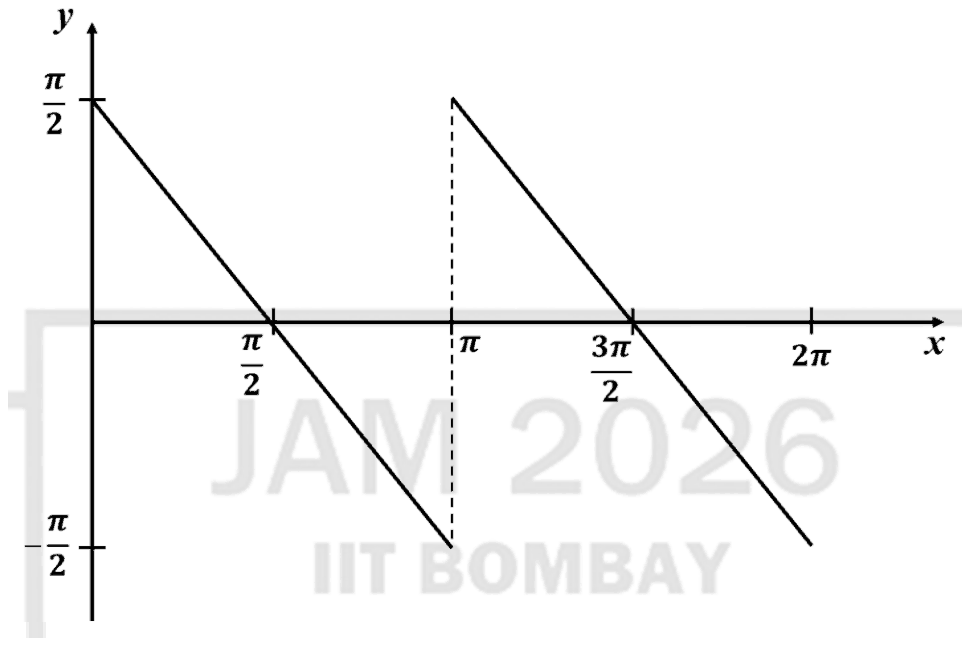
A piecewise regular function \(f(x)\) is shown in the figure. It is expanded in Fourier series given by

\[ \begin{aligned} f(x) = \frac{a_{0}}{2} &+ \sum_{n=1}^{\infty} a_{n}\cos(nx) \\ &+ \sum_{n=1}^{\infty} b_{n}\sin(nx), \end{aligned} \]

where \(a_{0}, a_{n}, b_{n}\)’s are the Fourier coefficients.

Sawtooth y against x: from x = 0 to pi the line falls from pi/2 through zero at pi/2 to -pi/2, jumps back to pi/2 at x = pi, and the same line repeats from pi to 2 pi, crossing zero at 3 pi/2

Which of the following options is correct?

Exam Year(s)

IIT JAM - 2026,

Answer: B

The correct option is that all \(a_n\) are zero.

On \(0 < x < \pi\) the graph is \(f(x) = \frac{\pi}{2} - x\), repeated with period \(\pi\). Shifting one period back, on \(-\pi < x < 0\) it is \(f(x) = -\frac{\pi}{2} - x\). So for \(0 < x < \pi\):

\[ f(-x) = -\tfrac{\pi}{2} + x = -f(x) \]

The function is odd. The cosine coefficients \(a_n = \frac{1}{\pi}\int_{-\pi}^{\pi} f(x)\cos nx\,dx\) integrate an odd function over a symmetric interval, so every one of them, \(a_0\) included, is zero; only sine terms survive.

Since \(a_0\) is twice the average value and the sawtooth averages to zero, \(a_0 = 3\pi\) and \(a_0 = 3\pi/2\) are wrong. The \(b_n\) cannot all vanish, or \(f\) would be identically zero.

Please log in or register to report this question.

Loading…
Tags: Fourier and Laplace Methods Questions and Answers || Fourier and Laplace Methods MCQ Questions and Answers || Fourier and Laplace Methods GK Questions and Answers || Fourier and Laplace Methods GK MCQ Questions || Fourier and Laplace Methods Multiple Choice Questions and Answers || Fourier and Laplace Methods GK || GK on Fourier and Laplace Methods || Mathematical Physics Questions and Answers || Mathematical Physics MCQ Questions and Answers || Mathematical Physics GK Questions and Answers || GK on Mathematical Physics