
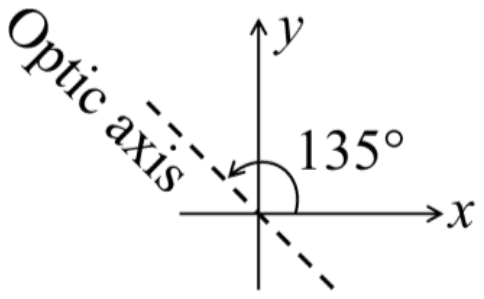
A quarter wave plate introduces a path difference of \(\lambda/4\) between the two components of polarization parallel and perpendicular to the optic axis. An electromagnetic wave with \(\vec{E} = (\hat{x} + \hat{y})E_{0}e^{i(kz - \omega t)}\) is incident normally on a quarter wave plate which has its optic axis making an angle 135° with the \(x\)-axis as shown.
The emergent electromagnetic wave would be
GATE Physics - 2018,
Answer: C
The emergent wave is linearly polarized with polarization as that of incident wave.
The incident field \((\hat{x} + \hat{y})E_{0}\) is linearly polarized at 45° to the \(x\)-axis. The optic axis is at 135°, which is exactly perpendicular to that direction.
A wave plate only changes the polarization when the field has components both parallel and perpendicular to the optic axis, because the plate delays one relative to the other. Here the field has no component along the optic axis: it lies entirely along the perpendicular direction, so the plate merely delays it as a whole and the polarization is unchanged.
Circular polarization would need equal components along and across the optic axis (field at 45° to it), and other angles give elliptical polarization. A rotation by 90° is what a half-wave plate does to light at 45° to its axis, not a quarter-wave plate with the field along an eigen-axis.
Please log in or register to report this question.