
Machine-translated by Google. Questions are authored in English.
Top

Geometrical Optics Review Questions and Answers

1.

Consider a convex lens of focal length f. A point object moves towards the lens along its axis between 2f and f. If the speed of the object is \(V_{O}\), then its image would move with speed \(V_{I}\). Which of the following is correct?

Exam Year(s)

IIT JAM - 2018,

Answer: C

The answer is \(V_{I} \gt V_{O}\); the image moves away from the lens.

From the lens equation \(\frac{1}{v} - \frac{1}{u} = \frac{1}{f}\), differentiating with respect to time gives

\[ \begin{aligned} \frac{dv}{dt} &= \frac{v^{2}}{u^{2}}\frac{du}{dt} \\ &= m^{2}\frac{du}{dt} \end{aligned} \]

For an object between \(2f\) and \(f\) the image is real, beyond \(2f\) on the other side, and magnified (\(|m| \gt 1\)). So the image speed is \(m^{2}\) times the object speed, greater than \(V_{O}\). As the object approaches \(f\) the image runs off towards infinity, so it moves away from the lens.

Equal speeds occur only at \(u = 2f\), where \(|m| = 1\), and a slower image would need \(|m| \lt 1\), which happens only for objects beyond \(2f\).

Please log in or register to report this question.
2.

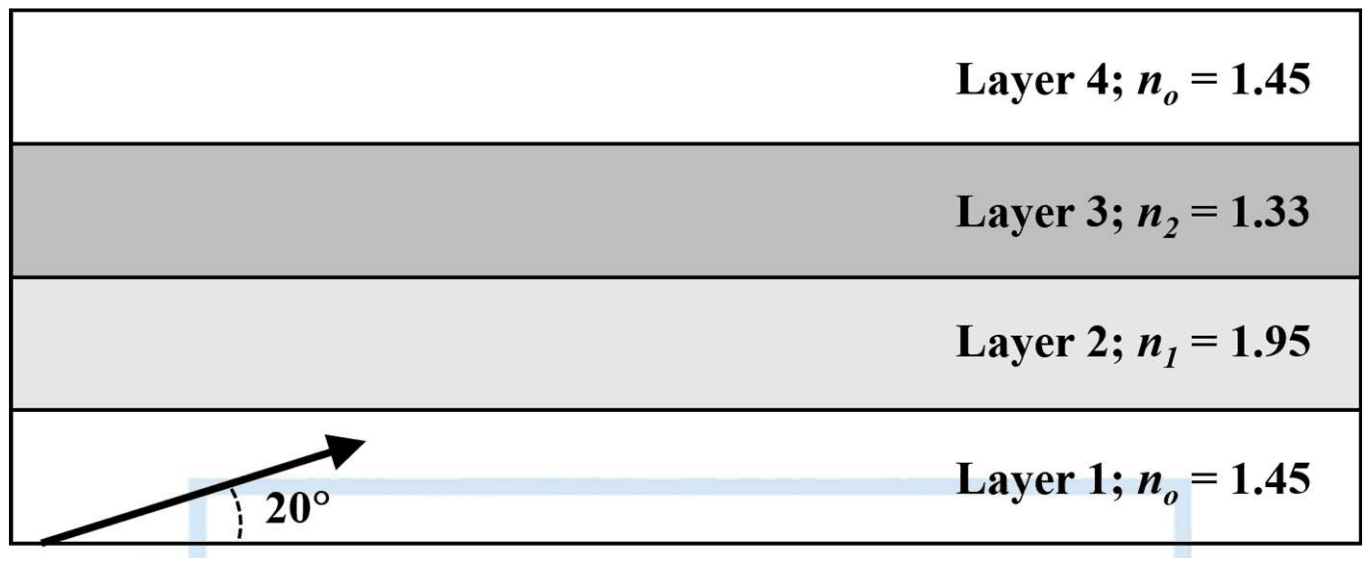
Consider a multilayered structure composed of thin films of refractive indices no, n1, and n2 as shown in the figure. A ray traveling in the first layer hits the interface at an angle of 20° with the horizontal. Which of the following options is correct?

Four horizontal layers from bottom to top: Layer 1 n0 = 1.45, Layer 2 n1 = 1.95, Layer 3 n2 = 1.33 and Layer 4 n0 = 1.45; a ray in Layer 1 travels upward at 20 degrees to the horizontal

Exam Year(s)

IIT JAM - 2026,

Answer: C

The correct option is that the ray would not enter the 3rd layer.

A ray at 20° to the horizontal makes 70° with the normal. For parallel layers, Snell's law keeps \(n \sin\theta\) the same in every layer:

\[ \begin{aligned} n\sin\theta &= 1.45 \sin 70^\circ = 1.363 \\ \text{layer 2:}\ \sin\theta_2 &= 1.363/1.95 = 0.699 \\ \text{layer 3:}\ \sin\theta_3 &= 1.363/1.33 = 1.025 \end{aligned} \]

The ray enters layer 2 at about 44° from the normal, but a sine greater than 1 is impossible, so at the boundary with layer 3 it is totally internally reflected.

The trap is the 20° option: layer 4 has the same index as layer 1, so if the ray did get through it would leave at 20° again, but it never reaches layer 4. 44° is the angle from the normal inside layer 2, not an angle in layer 4.

Please log in or register to report this question.

Loading…
Tags: Geometrical Optics Review Questions and Answers || Geometrical Optics Review MCQ Questions and Answers || Geometrical Optics Review GK Questions and Answers || Geometrical Optics Review GK MCQ Questions || Geometrical Optics Review Multiple Choice Questions and Answers || Geometrical Optics Review GK || GK on Geometrical Optics Review || Optics and Photonics Questions and Answers || Optics and Photonics MCQ Questions and Answers || Optics and Photonics GK Questions and Answers || GK on Optics and Photonics