
Machine-translated by Google. Questions are authored in English.
Top

Kinematics Questions and Answers

11.

If a moving body changes its position from x1 to x2 in a time interval Δt , then \(\frac{x_{2} - x_{1}}{\Delta t}\) is defined as

Exam Year(s)

KEAM - 2025,

Answer: B

The quantity is the average velocity.

The change in position, x2 − x1, is the displacement. Displacement divided by the time interval over which it happens is, by definition, the average velocity over that interval. It depends only on the end points, not on how the body moved in between.

Instantaneous velocity is the limit of this ratio as Δt tends to zero, the derivative dx/dt, so it needs a vanishing interval, not a finite one. Average and instantaneous acceleration are rates of change of velocity, not of position. 'Average displacement' is not a rate at all, and the ratio has units of m s-1, not metres.

Please log in or register to report this question.
12.

A car at rest is accelerated at 2ms-2 for 1 minute and then retarded at 2ms-2 for 1 minute to attain rest. The distance travelled by the car is

Exam Year(s)

KEAM - 2025,

Answer: E

The car travels 7200 m.

Phase 1, speeding up from rest at \(2\ \text{m s}^{-2}\) for 60 s:

\[ \begin{aligned} v &= at = 2 \times 60 = 120\ \text{m s}^{-1} \\ s_{1} &= \tfrac{1}{2}at^{2} = \tfrac{1}{2} \times 2 \times 60^{2} \\ &= 3600\ \text{m} \end{aligned} \]

Phase 2, slowing from 120 m/s to rest at the same rate in another 60 s, is the mirror image, so it covers another 3600 m:

\[ s = 3600 + 3600 = 7200\ \text{m} \]

The trap is 3600 m, which counts only one phase. A velocity-time graph is a quick check: a triangle with base 120 s and height 120 m/s has area \(\tfrac{1}{2} \times 120 \times 120 = 7200\) m.

Please log in or register to report this question.

13.

If a freely falling body from the top of a tower takes 3 s and 5 s to cross the \(28^{th}\) floor and \(4^{th}\) floor respectively, then the height difference between these floors is (g = 10 ms−2)

Exam Year(s)

KEAM - 2025,

Answer: A

The height difference is 80 m.

Falling from rest, the distance fallen in time \(t\) is \(\frac{1}{2}gt^{2}\):

\[ \begin{aligned} h_{3} &= \tfrac{1}{2}(10)(3)^{2} = 45\ \text{m} \\ h_{5} &= \tfrac{1}{2}(10)(5)^{2} = 125\ \text{m} \\ h_{5} - h_{3} &= 80\ \text{m} \end{aligned} \]

Using \(\frac{1}{2}g(5 - 3)^{2} = 20\) m treats the motion as if it restarted from rest, and the other options come from using \(gt\) or wrong times.

Please log in or register to report this question.

14.

If θ is the angle of projection of an object for which the horizontal range is equal to the maximum height attained, then the value of tan θ is

Exam Year(s)

KEAM - 2025,

Answer: C

\(\tan\theta =\) 4.

Set the range equal to the maximum height:

\[ \begin{aligned} \frac{2u^{2}\sin\theta\cos\theta}{g} &= \frac{u^{2}\sin^{2}\theta}{2g} \\ 4\cos\theta &= \sin\theta \;\Rightarrow\; \tan\theta = 4 \end{aligned} \]

(about \(76^{\circ}\)). \(\tan\theta = 1\) gives the maximum range, at \(45^{\circ}\), not equal range and height, and \(\frac{1}{2}\) or \(\sqrt{2}\) come from dropping a factor of 2.

Please log in or register to report this question.

15.

The velocity of a swimmer in the direction of flow of river is 10 \(kmh^{-1}\) and that against the flow of river is 6 kmh−1. The velocity of the swimmer in still water in kmh−1 is

Exam Year(s)

KEAM - 2025,

Answer: B

The swimmer's speed in still water is 8 kmh−1.

Downstream the speeds add and upstream they subtract: \(v + u = 10\) and \(v - u = 6\). Adding:

\[ \begin{aligned} 2v &= 16 \\ v \\ &= 8\ \text{km h}^{-1}, \quad u \\ &= 2\ \text{km h}^{-1} \end{aligned} \]

2 is the river's speed, the usual confusion, and the other values do not satisfy both equations.

The general result: still-water speed is the average of the downstream and upstream speeds, and the river's speed is half their difference.

Please log in or register to report this question.

16.

Two particles A and B move in concentric circles with radii in the ratio 2 : 1. If for every completion of one circle of A , B completes 5 circles , then the ratio of their respective orbital velocities is

Exam Year(s)

KEAM - 2025,

Answer: C

The ratio of orbital velocities is 2 : 5.

Speed in a circle is \(v = 2\pi rf\). A completes 1 circle while B completes 5, so \(f_{A} : f_{B} = 1 : 5\), and \(r_{A} : r_{B} = 2 : 1\):

\[ \begin{aligned} \frac{v_{A}}{v_{B}} &= \frac{r_{A}f_{A}}{r_{B}f_{B}} \\ &= \frac{2 \times 1}{1 \times 5} \\ &= \frac{2}{5} \end{aligned} \]

5 : 2 inverts it, 1 : 5 ignores the radii, and 1 : 1 or 1 : 2 do not follow.

Please log in or register to report this question.

17.

A particle moving with an initial velocity of 1 ms-1 has an uniform acceleration of 2 m s-2. The distances travelled by the particle in the first two intervals of 5 s are respectively

Exam Year(s)

KEAM - 2025,

Answer: D

The distances are 30 m and 80 m.

Use \(s = ut + \frac{1}{2}at^{2}\) with u = 1 m/s and a = 2 m/s\(^{2}\). The second interval is the distance in 10 s minus the distance in 5 s.

\[ \begin{aligned} s_{5} &= 1(5) + \tfrac{1}{2}(2)(25) = 30\ \text{m} \\ s_{10} &= 1(10) + \tfrac{1}{2}(2)(100) = 110\ \text{m} \\ s_{10} - s_{5} &= 80\ \text{m} \end{aligned} \]

30 m and 110 m gives the total distance after 10 s instead of the distance in the second interval. The other pairs come from leaving out the ut term or the factor \(\frac{1}{2}\).

Please log in or register to report this question.

18.

When a cricketer hits a ball at an angle of 45° with an initial velocity of 40 ms-1,the ball falls on the ground at a distance of 160 m. If he hits the ball at the same angle with an initial velocity of 50 ms-1 the ball will fall at a distance of

Exam Year(s)

KEAM - 2025,

Answer: E

The ball will fall at 250 m.

The horizontal range is \(R = \frac{u^{2}\sin 2\theta}{g}\). At the same angle, R is proportional to \(u^{2}\).

\[ \begin{aligned} R_{2} &= 160 \times \left(\frac{50}{40}\right)^{2} \\ &= 160 \times \frac{25}{16} = 250\ \text{m} \end{aligned} \]

Scaling with u instead of \(u^{2}\) gives 200 m, which is not offered; 180, 280, 300 and 480 m do not follow from either scaling.

Please log in or register to report this question.

19.

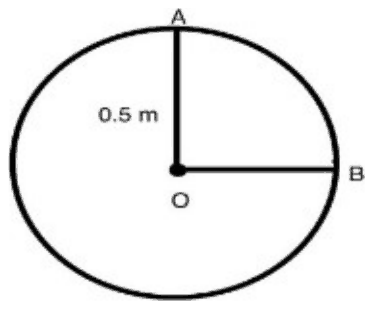
A ball moves in a circle of radius 0.5 m from A to B in √2 s. The average velocity of the ball is (in ms-1)

A circle with centre O and radius 0.5 m; A is the top of the circle and B the rightmost point, so the radii OA and OB are at right angles

Exam Year(s)

KEAM - 2025,

Answer: B

The average velocity is 0.5 m s\(^{-1}\).

Average velocity is displacement divided by time, not distance. A and B are ends of two perpendicular radii, so the displacement AB is the hypotenuse of a right triangle with legs 0.5 m.

\[ \begin{aligned} AB &= \sqrt{0.5^{2} + 0.5^{2}} = 0.5\sqrt{2}\ \text{m} \\ v_{avg} &= \frac{0.5\sqrt{2}}{\sqrt{2}} = 0.5\ \text{m s}^{-1} \end{aligned} \]

Using the arc length \(\frac{\pi}{4}\) m instead gives the average speed, about 0.56 m/s, which is not the average velocity. 0.25 takes only the radius over twice the time.

Please log in or register to report this question.

20.

A car starting from rest moves such that its acceleration varies with time as a = 6t (ms−2) . Its velocity (in ms−1) and displacement (in m) after 4 seconds, respectively, are

Exam Year(s)

KEAM - 2025,

Answer: A

The velocity and displacement are 48 m/s and 64 m.

Integrate the acceleration twice, starting from rest at the origin:

\[ \begin{aligned} v &= \int_{0}^{t} 6t\,dt = 3t^{2} = 3(16) = 48 \\ s &= \int_{0}^{t} 3t^{2}\,dt = t^{3} = 64 \end{aligned} \]

The other pairs use constant-acceleration formulas, which do not apply when the acceleration varies with time.

Please log in or register to report this question.

Loading…
Tags: Kinematics Questions and Answers