
Machine-translated by Google. Questions are authored in English.
Top

Laws of Motion Questions and Answers

1.

A feather of mass 15 g is dropped from a height. It is found to fall with a constant velocity. What is the net force acting on it ?

Exam Year(s)

CTET - 2023,

Answer: A

The net force on the feather is zero.

By Newton's first law, a body moving with constant velocity has no acceleration, and so the net (resultant) force on it is zero. As the feather falls, air resistance grows until it balances the feather's weight; from then on the two forces cancel and the feather falls at a constant (terminal) velocity.

The non-zero options mistake the weight for the net force, and even the weight is only \(0{\cdot}015 \times 9{\cdot}8 \approx 0{\cdot}147\) N, smaller than all three of them.

Please log in or register to report this question.
2.

Why are the soles of the shoes treaded?

Exam Year(s)

CTET - 2018,

Answer: C

Soles are treaded to increase friction.

The grooves of a tread give the sole a better grip on the ground. They increase friction between the shoe and the surface, so we do not slip while walking or running, especially on wet or smooth ground. Car and bicycle tyres are treaded for the same reason.

Reducing friction would make slipping more likely. Treads do not exist mainly to protect the shoe or extend its life; in fact friction wears the sole down over time.

Please log in or register to report this question.

Answer: A

The incorrect statement is that ball bearings are used to increase friction between parts of a machine.

Ball bearings replace sliding with rolling, and rolling friction is much smaller than sliding friction, so they are used to reduce friction, for example in the hubs of bicycles and the shafts of fans and motors.

The other statements are correct: friction can be reduced but never completely eliminated on Earth, since no surface is perfectly smooth; rolling friction is less than sliding friction; and the drag on an object moving through a fluid depends on its shape, which is why aeroplanes and fish are streamlined.

Please log in or register to report this question.

4.

Consider the two statements S1 and S2 given below and choose the correct option.

S1 - Non-zero work has to be done on a moving particle to change its momentum.
S2 - To change momentum of a particle, a non-zero net force should act on it.

Exam Year(s)

CTET - 2026,

Answer: D

S1 is false but S2 is true.

S2 is Newton's second law: the rate of change of momentum equals the net force, so momentum changes only if a non-zero net force acts.

S1 is false because momentum can change with no work done. In uniform circular motion, the centripetal force is always perpendicular to the velocity, so it does no work and the speed stays constant, yet the direction of motion, and hence the momentum, keeps changing. Work changes kinetic energy, not necessarily momentum.

Please log in or register to report this question.

5.

In order to slide a huge box lying on the ground in her room, Reshma should apply a force which is greater than which of the following forces ?

Exam Year(s)

CTET - 2021,

Answer: A

Reshma must apply a force greater than the static friction.

When a push is applied to a box at rest, static friction from the floor opposes it and grows to match the push, up to a maximum (limiting friction). The box starts to slide only when the applied force exceeds that maximum static friction.

The other forces are not the barrier to sliding. Gravity acts downward and the normal force acts upward, both perpendicular to the horizontal push, though the normal force sets how large friction can be. Muscular force is the force Reshma herself applies, not the force she must overcome.

Please log in or register to report this question.

6.

A box of mass 500 gm is lying on a horizontal table. Which of the following statements is true regarding the force(s) acting on it ? [g = 10 m/s2]

Exam Year(s)

CTET - 2024,

Answer: C

A pair of balanced forces acts on it.

The box's weight acts downward:

\[ W = mg = 0.5 \times 10 = 5\ \text{N} \]

The table pushes up with an equal normal reaction of 5 N. The two forces are equal and opposite, so the net force is zero and the box stays at rest.

Gravity certainly acts on it, so 'no force' is wrong, and an unbalanced force of 5 N in either direction would make the box accelerate, which it does not.

Please log in or register to report this question.

7.

Sameer rolls his marble on three different surfaces spread out on floor - taut cellophane sheet, carpet and newspaper. The force of friction acting on the marble in the increasing order is

Exam Year(s)

CTET - 2019,

Answer: C

In increasing order of friction: cellophane sheet, newspaper, carpet.

Friction depends on the roughness of the surfaces in contact. A taut cellophane sheet is the smoothest of the three, so it offers the least friction and the marble rolls farthest on it. Newspaper is rougher, and a carpet, with its pile of fibres, is the roughest and offers the most friction, stopping the marble soonest.

The other orders either put newspaper below cellophane or carpet below one of the smoother surfaces, which reverses the roughness of the surfaces.

Please log in or register to report this question.

8.

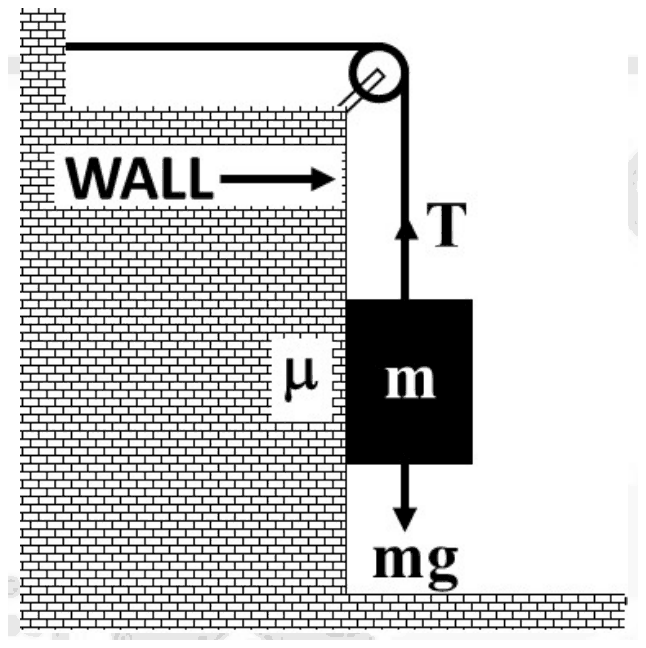
Consider a block of mass 'm' hanging using a string and pulley arrangement, as shown in the figure. The weight 'mg' and tension 'T' are working on the block in such a way that the block is not moving and the string is parallel to the perfectly vertical wall. If the block is just in contact (but not attached/fixed) with the wall and the coefficient of static friction is 'μ', then the static frictional force acting on the block is

String over a pulley at the top of a vertical wall, hanging beside the wall face; block m touches the wall at a contact marked mu, with tension T drawn upwards and weight mg downwards

Exam Year(s)

IIT JAM - 2026,

Answer: A

The static frictional force is 0.

Friction between two surfaces depends on the normal force pressing them together. Here the string is vertical, so both forces on the block, the tension T upwards and the weight mg downwards, are vertical. No horizontal force pushes the block into the wall, so the normal reaction from the wall is zero, and so is any friction.

There is also no tendency to slide: the block is at rest with \(T = mg\), so nothing is left for friction to balance. The other options multiply \(\mu\) by a vertical force. That confuses the weight or tension with the normal force, and in any case \(\mu N\) is only the largest static friction possible, not the friction actually acting.

Please log in or register to report this question.

9.

When a person of mass m climbs up or down a rope with uniform speed \(v\) , the tension in the rope is (\(g\) = acceleration due to gravity)

Exam Year(s)

KEAM - 2025,

Answer: A

The tension is \(mg\).

Uniform speed means zero acceleration, so the net force on the person is zero whether they move up or down. The rope must then exactly balance the weight: \(T - mg = 0\).

Expressions such as \(m(g + v)\), \(m(g - v)\) or \(mgv\) add a velocity to an acceleration, which is dimensionally wrong. The tension differs from \(mg\) only while the person is speeding up or slowing down.

Please log in or register to report this question.

10.

Two objects of masses 1 kg and 2 kg are moving towards each other with accelerations 2 \(ms^{-2}\) and 3 \(ms^{-2}\) respectively on a smooth horizontal surface. The acceleration of centre of mass of the system is

Exam Year(s)

KEAM - 2025,

Answer: A

The centre of mass accelerates at \(\frac{4}{3}\) m s-2 in the direction of acceleration of the 2 kg mass.

Take the 1 kg mass's acceleration as positive. Moving towards each other, the 2 kg mass accelerates the opposite way:

\[ \begin{aligned} a_{cm} &= \frac{m_{1}a_{1} + m_{2}a_{2}}{m_{1} + m_{2}} \\ &= \frac{1(2) + 2(-3)}{3} = -\frac{4}{3}\ \text{m s}^{-2} \end{aligned} \]

The negative sign puts it along the 2 kg mass's acceleration. Adding the two terms without the opposite sign gives \(\frac{8}{3}\), and \(\frac{2}{3}\) comes from swapping the masses.

Please log in or register to report this question.

Loading…
Tags: Laws of Motion Questions and Answers