
Machine-translated by Google. Questions are authored in English.
Top

Fillers and Reinforcements Questions and Answers

Direction for [ Question No: 1 To 1 ] :

In tensile testing of carbon fiber reinforced epoxy composite samples, the following data were recorded:

gauge length = 4 cm
cross-section = 0.8 cm × 0.3 cm
increase in gauge length at the break point = 0.03 cm
breaking load = 50 kg

Answer: D

The Young's modulus is \(2.77 \times 10^{4}\) kg/cm2.

Since the curve is linear up to the break, the modulus is the breaking stress over the breaking strain:

\[ \begin{aligned} \varepsilon &= \frac{0.03}{4} = 0.0075 \\ E &= \frac{208.3}{0.0075} = 2.78 \times 10^{4}\ \text{kg/cm}^{2} \end{aligned} \]

which is the key's \(2.77 \times 10^{4}\) within rounding. The lower options would require a larger strain or a smaller stress than the data give.

Please log in or register to report this question.
2.

Polymer wetting is improved by the addition of fillers with functional groups. In a typical case-study, natural-clay was modified with hydroxyl groups and compounded with Nylon 6 along with an antioxidant. The resulting composite exhibited poor mechanical properties. Which one among the options given explains this observation?

Exam Year(s)

GATE XE - 2023,

Answer: C

The keyed explanation is The surface functional groups of the filler formed hydrogen bonds with the antioxidant.

The hydroxyl groups were grafted onto the clay so that the filler would interact with the polar amide groups of Nylon 6, wetting well and transferring load across the interface. Common antioxidants, such as hindered phenols, are themselves polar and carry hydrogen-bonding groups. When they hydrogen-bond to the hydroxylated clay surface, they occupy the sites meant to bond with the nylon, so the filler-matrix interface stays weak; at the same time the antioxidant is held on the filler instead of protecting the polymer. Either way the composite is mechanically poor.

A reaction between the filler's groups and Nylon 6 is what the modification aims for, and it would improve, not weaken, the composite. Nothing in the case points to the antioxidant degrading or reacting with the nylon; the observation turns on the competition at the filler surface.

Please log in or register to report this question.

3.

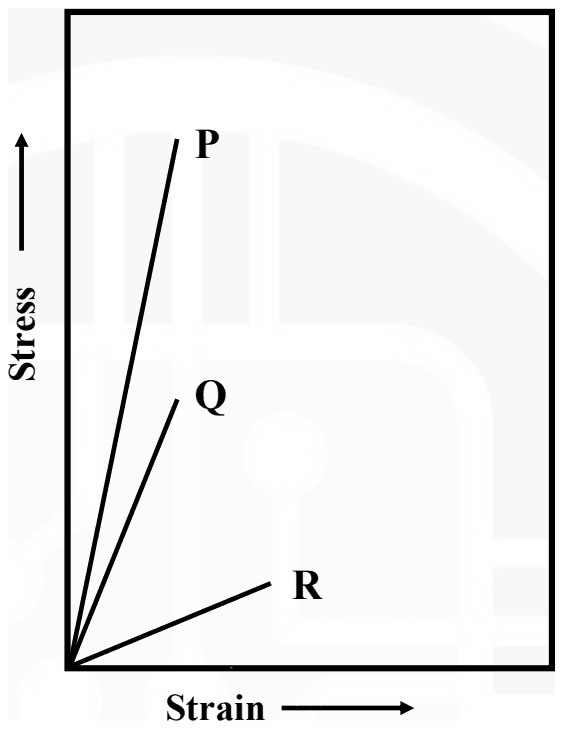
The stress-strain profiles in the figure were obtained following longitudinal tensile loading for a brittle polymer, glass fibre, and a composite lamina consisting of unidirectional continuous glass fibres and the polymer matrix. Assume that the matrix is free of voids, there is perfect bonding between glass fibres and the matrix, and there are no residual stresses in the composite lamina.

Stress against strain: three straight lines from the origin, P the steepest, Q of intermediate slope and R the least steep

Identify the correct stress-strain profile for the polymer matrix, glass fibre, and their composite lamina from the above figure.

Exam Year(s)

GATE XE - 2026,

Answer: B

The profiles are P - Glass fibre ; Q - Composite ; R - Matrix.

In longitudinal loading of a unidirectional lamina with perfect bonding, fibre and matrix strain together, so the composite modulus follows the rule of mixtures:

\[ E_{c} = E_{f}V_{f} + E_{m}(1-V_{f}) \]

This lies between the fibre modulus and the matrix modulus. Glass fibre (about 70 GPa) is far stiffer than a brittle polymer matrix (a few GPa), so the steepest line P is the glass fibre, the least steep R is the matrix, and the intermediate Q is the composite.

Any option giving the composite the steepest or the shallowest line contradicts the rule of mixtures, and putting the matrix above the glass fibre reverses their stiffnesses.

Please log in or register to report this question.

Loading…
Tags: Fillers and Reinforcements Questions and Answers || Fillers and Reinforcements MCQ Questions and Answers || Fillers and Reinforcements GK Questions and Answers || Fillers and Reinforcements GK MCQ Questions || Fillers and Reinforcements Multiple Choice Questions and Answers || Fillers and Reinforcements GK || GK on Fillers and Reinforcements || Polymer Technology Questions and Answers || Polymer Technology MCQ Questions and Answers || Polymer Technology GK Questions and Answers || GK on Polymer Technology