
Machine-translated by Google. Questions are authored in English.
Top

Harmonic Oscillator Questions and Answers

1.

For a one-dimensional harmonic oscillator, the creation operator \((a^{\dagger})\) acting on the \(n^{th}\) state \(|\psi_{n}\rangle\), where \(n = 0, 1, 2, \ldots\), gives \(a^{\dagger}|\psi_{n}\rangle = \sqrt{n + 1}|\psi_{n+1}\rangle\). The matrix representation of the position operator \(x = \sqrt{\frac{\hbar}{2m\omega}}(a + a^{\dagger})\) for the first three rows and columns is

Exam Year(s)

GATE Physics - 2022,

Answer: C

The matrix is \(\sqrt{\frac{\hbar}{2m\omega}}\) times the matrix with 1 and \(\sqrt{2}\) next to the diagonal:

\[ \begin{pmatrix} 0 & 1 & 0 \\ 1 & 0 & \sqrt{2} \\ 0 & \sqrt{2} & 0 \end{pmatrix} \]

Using \(a^{\dagger}|\psi_{n}\rangle = \sqrt{n+1}|\psi_{n+1}\rangle\) and \(a|\psi_{n}\rangle = \sqrt{n}|\psi_{n-1}\rangle\), the only non-zero elements of \(a + a^{\dagger}\) are

\[ \begin{aligned} \langle n+1|(a + a^{\dagger})|n\rangle &= \sqrt{n+1} \\ \langle n|(a + a^{\dagger})|n+1\rangle &= \sqrt{n+1} \end{aligned} \]

So the elements next to the diagonal are 1 (between \(n = 0\) and 1) and \(\sqrt{2}\) (between 1 and 2), and the diagonal is zero, because \(x\) changes \(n\) by one. The matrix is symmetric, as a Hermitian operator with real elements must be.

The diagonal matrix with 1, \(\sqrt{2}\), \(\sqrt{3}\) is not how \(x\) acts; the option with 1, 1 misses the \(\sqrt{2}\); and the last option couples states 0 and 2, which \(x\) cannot do.

Please log in or register to report this question.
2.

A particle of mass m is in a potential \(V(x) = \frac{1}{2}m\omega^{2}x^{2}\) for \(x \gt 0\) and \(V(x) = \infty\) for \(x \le 0\), where \(\omega\) is the angular frequency. The ratio of the energies corresponding to the lowest energy level to the next higher level is

Exam Year(s)

GATE Physics - 2025,

Answer: A

The ratio is \(\frac{3}{7}\).

The infinite wall at \(x = 0\) forces the wavefunction to vanish there. Of the full oscillator's eigenfunctions, only the odd ones (\(n = 1, 3, 5, \ldots\)) vanish at the origin, and on \(x \gt 0\) they still satisfy the Schrodinger equation. So the allowed energies are

\[ \begin{aligned} E &= \left(n + \tfrac{1}{2}\right)\hbar\omega,\ n = 1, 3, \ldots \\ \frac{E_{1}}{E_{3}} &= \frac{\frac{3}{2}\hbar\omega}{\frac{7}{2}\hbar\omega} = \frac{3}{7} \end{aligned} \]

\(\frac{1}{3}\) is the ratio for the full oscillator (\(\frac{1}{2}\) to \(\frac{3}{2}\)), and \(\frac{3}{5}\) uses consecutive levels \(n = 1, 2\), ignoring that even states are forbidden.

Please log in or register to report this question.
3.

Let \(|m\rangle\) and \(|n\rangle\) denote the energy eigenstates of a one-dimensional simple harmonic oscillator. The position and momentum operators are \(\hat{X}\) and \(\hat{P}\), respectively. The matrix element \(\langle m|\hat{P}\hat{X}|n\rangle\) is non-zero when

Exam Year(s)

GATE Physics - 2025,

Answer: B

The matrix element is non-zero when \(m = n\) or \(m = n \pm 2\).

Write \(\hat{X} \propto (a + a^{\dagger})\) and \(\hat{P} \propto i(a^{\dagger} - a)\). Then

\[ \begin{aligned} \hat{P}\hat{X} &\propto (a^{\dagger} - a)(a + a^{\dagger}) \\ &= a^{\dagger 2} - a^{2} + a^{\dagger}a - aa^{\dagger} \\ &= a^{\dagger 2} - a^{2} - 1 \end{aligned} \]

\(a^{\dagger 2}\) raises \(n\) by 2, \(a^{2}\) lowers it by 2, and the constant \(-1\) (from \([a, a^{\dagger}] = 1\)) gives a diagonal element. Indeed \(\langle n|\hat{P}\hat{X}|n\rangle = -\frac{i\hbar}{2}\), not zero.

'\(m = n \pm 2\) only' misses that diagonal term; \(n \pm 1\) would come from a single operator, and \(n \pm 3\) from three.

Please log in or register to report this question.
4.

The Hamiltonian for a quantum particle of mass \(m\) is given below, where \(\omega \lt \Omega\). The Schrödinger equation for this system can be solved exactly using the orthogonal transformations: \(x = \frac{x_{1} - x_{2}}{\sqrt{2}}\) and \(y = \frac{x_{1} + x_{2}}{\sqrt{2}}\).

\[ \begin{aligned} H = &-\frac{\hbar^{2}}{2m}\left[\frac{\partial^{2}}{\partial x^{2}} + \frac{\partial^{2}}{\partial y^{2}}\right] \\ &+ \frac{1}{2}m\Omega^{2}(x^{2} + y^{2}) + m\omega^{2}xy \end{aligned} \]

The ground state energy of this system is

Exam Year(s)

GATE Physics - 2026,

Answer: A

The ground state energy is \(\frac{\hbar}{2}[\sqrt{\Omega^{2}-\omega^{2}}+\sqrt{\Omega^{2}+\omega^{2}}]\).

The rotation keeps the kinetic term and \(x^{2} + y^{2} = x_{1}^{2} + x_{2}^{2}\), while \(xy = \frac{1}{2}(x_{1}^{2} - x_{2}^{2})\). The potential separates into two independent oscillators:

\[ \begin{aligned} V &= \tfrac{1}{2}m\Omega^{2}(x_{1}^{2} + x_{2}^{2}) + \tfrac{1}{2}m\omega^{2}(x_{1}^{2} - x_{2}^{2}) \\ &= \tfrac{1}{2}m(\Omega^{2} + \omega^{2})x_{1}^{2} + \tfrac{1}{2}m(\Omega^{2} - \omega^{2})x_{2}^{2} \end{aligned} \]

The normal-mode frequencies are \(\sqrt{\Omega^{2} \pm \omega^{2}}\) (real because \(\omega \lt \Omega\)), and the ground state has \(\frac{1}{2}\hbar\) times each. The option without the factor \(\frac{1}{2}\) counts a full quantum per mode, and the options with \(\Omega^{2} \pm \Omega\omega\) under the roots do not match the normal-mode frequencies, since the coupling term is \(m\omega^{2}xy\), with no factor of \(\Omega\).

Please log in or register to report this question.
5.

The energy \(E\) and degeneracy \(d\) of the second excited state of a three-dimensional, isotropic quantum harmonic oscillator with angular frequency \(\omega\) are

Exam Year(s)

GATE Physics - 2026,

Answer: A

The second excited state has \(E = \frac{7}{2}\hbar\omega\) and \(d = 6\).

For the 3D isotropic oscillator \(E = (n_{x} + n_{y} + n_{z} + \frac{3}{2})\hbar\omega\). The ground state has n = 0, the first excited state n = 1, and the second excited state n = 2, so \(E = \frac{7}{2}\hbar\omega\).

Its degeneracy is the number of ways to write 2 as \(n_{x} + n_{y} + n_{z}\): (2,0,0), (0,2,0), (0,0,2), (1,1,0), (1,0,1), (0,1,1), six in all, matching \((n + 1)(n + 2)/2 = 6\). d = 3 counts only one of the two kinds of combination. \(\frac{5}{2}\hbar\omega\) is the first excited state, whose degeneracy is 3, not the second.

Please log in or register to report this question.

6.

The potential of a quantum harmonic oscillator is modified from \(\frac{1}{2}kx^{2}\) to \(\frac{1}{2}kx^{2} + 3ax\), where \(k\) and \(a\) are constants and x is the position variable. When, the values of \(a = 2\) and \(k = 1\), which of the following options gives the change in the ground state energy?

(\(a\) and \(k\) are in appropriate units)

Exam Year(s)

IIT JAM - 2026,

Answer: D

The ground state energy changes by \(-18\).

Completing the square shows the new potential is the same oscillator, shifted sideways and downwards:

\[ \begin{aligned} \tfrac{1}{2}kx^{2} + 3ax &= \tfrac{1}{2}k\left(x + \tfrac{3a}{k}\right)^{2} \\ &\quad - \tfrac{9a^{2}}{2k} \end{aligned} \]

The shift in \(x\) does not change the spectrum, since \(k\) and so \(\omega\) are unchanged; every level, including the ground state \(\frac{1}{2}\hbar\omega\), drops by the constant \(\frac{9a^2}{2k}\).

\[ \begin{aligned} \Delta E &= -\frac{9a^{2}}{2k} \\ &= -\frac{9 \times 4}{2 \times 1} = -18 \end{aligned} \]

The shift grows with the square of the linear coefficient \(3a\), so the smaller options each leave out part of \(\frac{9a^2}{2k}\). The result is exact, not a first-order estimate, because a linear term in a harmonic potential can be removed completely.

Please log in or register to report this question.

7.

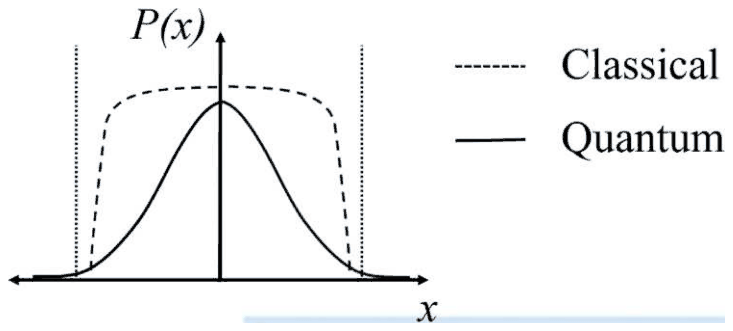
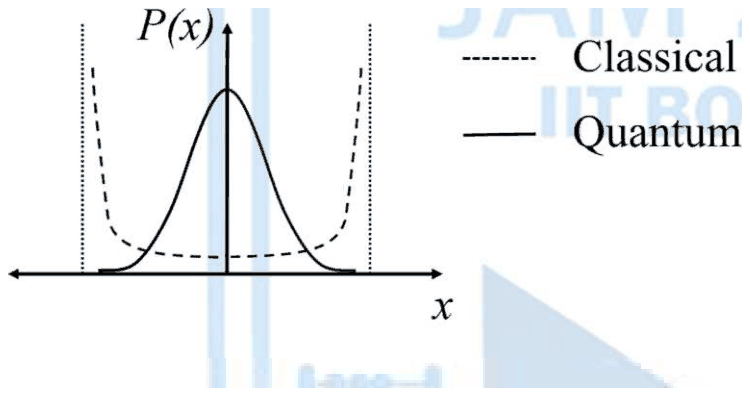
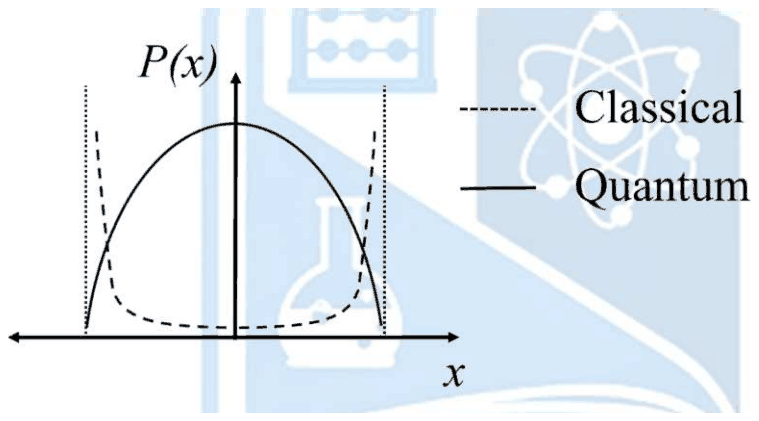
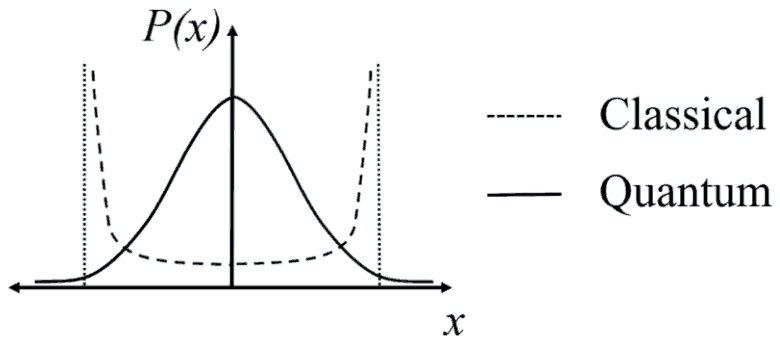
Which ONE of the following figures correctly represents the probability density, \(P(x)\), of a particle undergoing simple harmonic oscillation as a function of position \(x\)?

The dashed line is for the classical case. The solid line is for the quantum case, where the system is in its ground state. The dotted vertical lines on the \(x\) axis denote the classical turning points.

Exam Year(s)

IIT JAM - 2026,

Answer: D

The correct figure is (D): a Gaussian ground-state density, peaked at the centre and leaking past the turning points, drawn with the classical U-shaped density.

Classically the particle moves slowest near the turning points, so it spends most time there: \(P_{cl}(x) \propto \frac{1}{v(x)} \propto \frac{1}{\sqrt{x_{0}^{2} - x^{2}}}\). This is smallest at the centre and grows without limit at \(x = \pm x_{0}\), the dashed U shape.

The ground state is \(\psi_{0} \propto e^{-m\omega x^{2}/2\hbar}\), so \(P(x) \propto e^{-m\omega x^{2}/\hbar}\). It is largest at \(x = 0\). Its turning points are at \(x_{0}^{2} = \frac{\hbar}{m\omega}\), where \(P\) has only fallen to \(\frac{1}{e}\) of its peak, so it extends well beyond them into the classically forbidden region.

(A) wrongly draws a flat-topped classical curve. (B) draws a quantum curve that has died out before the turning points, so no penetration. (C) draws a quantum curve shaped like a parabola that ends exactly at the turning points, which a wavefunction never does.

Please log in or register to report this question.

8.

Which of the following operator commutes with Hamiltonian of one-dimensional oscillator. x and Px are position and momentum operators, a and a+ are annihilation and creation operators :

Exam Year(s)

MH SET - 2018, SET Exam - 2018,

Answer: D

The operator that commutes with the Hamiltonian is \( a^{+}a \), the number operator.

For the oscillator \( H = \hbar\omega\left(a^{+}a + \frac{1}{2}\right) \), so \( H \) is a function of \( a^{+}a \) alone and \( [H, a^{+}a] = 0 \). The energy eigenstates are the number states \( |n\rangle \).

The ladder operators do not commute with it: \( [H, a] = -\hbar\omega a \) and \( [H, a^{+}] = \hbar\omega a^{+} \), which is why they lower and raise the energy. The momentum does not either: \( [H, P_{x}] = i\hbar m\omega^{2}x \), since the potential depends on \( x \).

Please log in or register to report this question.

Loading…
Tags: Harmonic Oscillator Questions and Answers || Harmonic Oscillator MCQ Questions and Answers || Harmonic Oscillator GK Questions and Answers || Harmonic Oscillator GK MCQ Questions || Harmonic Oscillator Multiple Choice Questions and Answers || Harmonic Oscillator GK || GK on Harmonic Oscillator || Quantum Mechanics Questions and Answers || Quantum Mechanics MCQ Questions and Answers || Quantum Mechanics GK Questions and Answers || GK on Quantum Mechanics