
Machine-translated by Google. Questions are authored in English.
Top

Basic Electrical Engineering Questions and Answers

1.

Capacitors connected in series behave like:

Exam Year(s)

DSSSB JE - 2023,

Answer: B

Capacitors in series behave like resistors connected in parallel. For capacitors in series the reciprocal of the equivalent capacitance is the sum of the reciprocals, \(1/C_{eq} = 1/C_1 + 1/C_2 + \dots\), which is exactly the rule that resistors in parallel obey for their conductances. Resistors in series add directly (\(R_{eq} = R_1 + R_2 + \dots\)), so the first and third options describe the opposite behaviour: it is capacitors in parallel that add directly, like resistors in series. A galvanometer is a current-detecting instrument and has no connection with how capacitances combine.

Please log in or register to report this question.
2.

A 100-Watt, 200 Volts lamp is connected in series with a second lamp of 100 Watt, 150 Volts across a 250 Volts supply. Find the voltage across the second lamp.

Exam Year(s)

DSSSB JE - 2023,

Answer: A

The resistance of a lamp is \(V^2/P\). The first lamp has \(200^2/100 = 400\ \Omega\) and the second \(150^2/100 = 225\ \Omega\). In series the total resistance is 625 ohm and the current is \(250/625 = 0.4\) A. The voltage across the second lamp is

\[ V_2 = 0.4 \times 225 = 90\ \text{V} \]

The first lamp then has 160 V across it. The options 100 V and 125 V would result from splitting the supply equally or in the ratio of the rated voltages, which is wrong because the lamps have different resistances; 160 V is the voltage across the first lamp, not the second.

Please log in or register to report this question.

3.

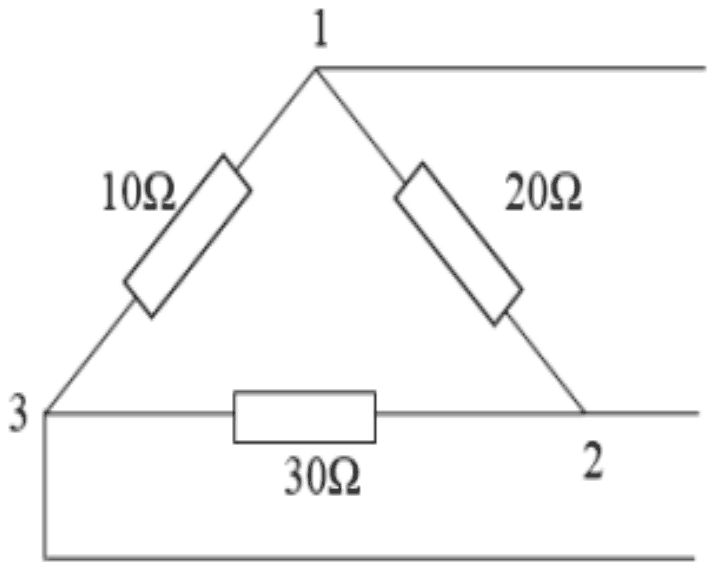
A delta connection of three resistors: 10 ohm between nodes 1 and 3, 20 ohm between nodes 1 and 2, and 30 ohm between nodes 3 and 2.

What will be the value of R2 if the delta connection is converted into equivalent star connection?

Exam Year(s)

DSSSB JE - 2023,

Answer: D

In a delta to star conversion, each star resistor equals the product of the two delta resistors that meet at its node divided by the sum of all three. Node 2 is joined to the 20 ohm and 30 ohm resistors, so

\[ \begin{aligned} R_2 = \frac{20 \times 30}{10 + 20 + 30} \\ &= \frac{600}{60} = 10\ \Omega \end{aligned} \]

For comparison, the star resistor at node 1 would be 10 x 20/60 = 3.33 ohm and at node 3 it would be 10 x 30/60 = 5 ohm. These are the other options 3.33 and 5, obtained by choosing the wrong pair of resistors for node 2.

Please log in or register to report this question.

4.

Calculate the current ‘I’ flowing in the given circuit.

A circuit with a 100 V battery in series with a 50 ohm resistor; the current I flows round the loop.

Exam Year(s)

DSSSB - 2023,

Answer: B

The circuit is a 100 V source across a single 50 ohm resistor, so by Ohm's law the current is the voltage divided by the resistance.

\[ I = \frac{V}{R} = \frac{100}{50} = 2\ \mathrm{A} \]

So the current is 2 A, option (B). The value 20 A would need a resistance of 5 ohms, 1 A would need 100 ohms and 0.5 A would need 200 ohms, none of which is in the circuit, and there is only one resistor, so no division of current takes place.

Please log in or register to report this question.

5.

In which of the following resistors does the value of resistance decrease nonlinearly with increase in temperature?

Exam Year(s)

DSSSB - 2023,

Answer: B

A negative temperature coefficient (NTC) resistor, such as a thermistor, has a resistance that falls as its temperature rises, and the fall is non-linear, roughly exponential. Positive temperature coefficient resistors increase their resistance with temperature, voltage dependent resistors change their resistance with the applied voltage, and light dependent resistors change it with the illumination. So the answer is Negative temperature co-efficient resistors, option (B).

Please log in or register to report this question.

6.

The shunt field resistance of DC machines comes under the category of:

Exam Year(s)

DSSSB - 2023,

Answer: B

The shunt field winding of a DC machine is made of many turns of fine wire, and its resistance is much higher than that of the armature or series winding, but it is still only tens to a few hundred ohms. In the usual classification of resistances into low (below 1 ohm), medium (about 1 ohm to 100 kilo-ohm) and high, it falls in the medium class, which is the key's answer, option (B). It is not low resistance like the series field or armature, and it is not high or very high like insulation resistance.

Please log in or register to report this question.

7.

Determine the equivalent resistance between the terminals a and b of the given circuit.

A resistor circuit between terminals a and b with four 10 ohm resistors: a pair at the top left and two vertical branches on the right.

Exam Year(s)

DSSSB - 2023,

Answer: C

In the figure two 10 ohm resistors form a parallel pair at the top, so they give 5 ohms, and two 10 ohm resistors form a parallel pair at the right, which again gives 5 ohms. The two pairs are in series between the terminals a and b.

\[ R_{ab} = 5 + 5 = 10\ \Omega \]

So the equivalent resistance is 10 ohms, option (C). The value 5 ohms is the resistance of one pair only, and 15 and 20 ohms would need three or four resistors in series.

Please log in or register to report this question.

8.

Find the current \(i_{7}\) in the following figure.

Currents i1, i2 and i3, each 1 A, enter a node on the left; i5 flows between the two nodes; at the right node i6 of 3 A enters and i7 leaves.

Exam Year(s)

DSSSB - 2023,

Answer: D

By Kirchhoff's current law, the currents entering a node equal the currents leaving it. At the left node i1, i2 and i3, each 1 A, enter and i5 leaves, so i5 = 3 A. At the right node i5 and i6 enter, with i6 = 3 A, and i7 leaves, so

\[ i_{7} = i_{5} + i_{6} = 3 + 3 = 6\ \mathrm{A} \]

So i7 is 6 A, option (D). The values 0 A, 3 A and 4 A come from ignoring one of the currents or giving i6 the wrong direction. The same rule gives a quick check on the figure: the three incoming currents of 1 A each make 3 A in the middle, and then the 3 A from i6 adds to it.

Please log in or register to report this question.

Answer: B

In a series circuit the same current flows through every part, the total resistance is the sum of the individual resistances, the voltage drops add up to the supply voltage, and the total power is the sum of the powers dissipated in the resistances. The statement that the total resistance is always less than the sum of the individual resistances is wrong, since it is equal to the sum, and it is in a parallel circuit that the total is less than any one of them. So the incorrect statement is option (B).

Please log in or register to report this question.

10.

Determine the electric power consumed by an electric iron which is supplied with 240 V supply if the current drawn by the electric iron is 3A.

Exam Year(s)

DSSSB - 2023,

Answer: C

The power consumed by a resistive load such as an electric iron is the product of the voltage and the current, P = V x I.

\[ P = 240 \times 3 = 720\ \mathrm{W} \]

So the iron consumes 720 W, option (C), which is a reasonable rating for a small iron. The value 80 W is the voltage divided by the current, 240 W is the voltage alone, and 1120 W does not follow from the data given. A resistive appliance such as an iron takes the same power on AC as on DC at the same rms voltage, so the power factor is one and the simple product of volts and amperes can be used.

Please log in or register to report this question.

Loading…
Tags: DC Circuit Analysis Questions and Answers || DC Circuit Analysis MCQ Questions and Answers || DC Circuit Analysis GK Questions and Answers || DC Circuit Analysis GK MCQ Questions || DC Circuit Analysis Multiple Choice Questions and Answers || DC Circuit Analysis GK || GK on DC Circuit Analysis || Basic Electrical Engineering Questions and Answers || Basic Electrical Engineering MCQ Questions and Answers || Basic Electrical Engineering GK Questions and Answers || GK on Basic Electrical Engineering