Machine-translated by Google. Questions are authored in English.
Top

Strength of Materials Questions and Answers

1.

The ratio of Young's modulus to the modulus of rigidity of a material with Poisson's ratio 0.2 will be ______.

Exam Year(s)

DSSSB JE - 2023,

Answer: B

The elastic constants are connected by \(E = 2G(1 + \nu)\), where E is Young's modulus, G the modulus of rigidity and \(\nu\) Poisson's ratio. So

\[ \frac{E}{G} = 2(1 + \nu) = 2(1 + 0.2) = 2.4 \]

The value 0.2 is just Poisson's ratio. The values 2.8 and 3.2 would come from using a Poisson's ratio of 0.4 or 0.6 and are not consistent with the data. The ratio of E to G for any real material lies between 2 and 3.

Please log in or register to report this question.

2.

A steel rod 1 m long and 20 mm × 20 mm in cross-section is subjected to a tensile force of 40 kN. What is the elongation of the rod, if the modulus of elasticity for the rod material is 200 GPa.

Exam Year(s)

DSSSB JE - 2023,

Answer: B

The elongation of an axially loaded bar is \(\delta = PL/(AE)\). The area is \(20 \times 20 = 400\) mm\(^2\), the load is 40,000 N, the length is 1000 mm and \(E = 200{,}000\) N/mm\(^2\):

\[ \begin{aligned} \delta \\ &= \frac{40000 \times 1000}{400 \times 200000} \\ &= 0.5\ \text{mm} \end{aligned} \]

The options 0.25, 0.75 and 0.95 mm correspond to a wrong load, area or modulus (for example 0.25 mm would be found with an area of 800 mm\(^2\)).

Please log in or register to report this question.

Answer: D

Hooke's law says that strain is proportional to the applied stress up to the proportional limit. The constant of proportionality is the modulus of elasticity. The law does not link strain to temperature, pressure or the volume of the solid in this way, so the options A, B and C are wrong.

Please log in or register to report this question.

4.

Match the column 'Moduli of elasticity' with the column 'Descriptions'. Moduli of elasticity Descriptions a) Young's modulus i) It is the ratio of the shearing stress applied to the body to the shearing strain produced. b) Bulk (or) Volume modulus ii) It is defined as the ratio of linear stress to linear strain. c) Shearing (or) Rigidity modulus iii) It is defined as the ratio of bulk stress to bulk strain.

Exam Year(s)

DSSSB TGT - 2023,

Answer: A

The correct match is a-ii, b-iii, c-i. Young's modulus is the ratio of linear stress to linear strain (ii). The bulk or volume modulus is the ratio of bulk stress to bulk strain (iii). The shearing or rigidity modulus is the ratio of the shearing stress applied to the body to the shearing strain produced (i). \[ Y = \frac{\text{linear stress}}{\text{linear strain}} \] Each of the other options gives at least one modulus the definition of a different one.

Please log in or register to report this question.

5.

The three-dimensional stress-strain relationship for an isotropic material is given as

\[ \begin{Bmatrix} \sigma_{xx} \\ \sigma_{yy} \\ \sigma_{zz} \\ \tau_{yz} \\ \tau_{xz} \\ \tau_{xy} \end{Bmatrix} = \begin{bmatrix} P & Q & Q & 0 & 0 & 0 \\ Q & P & Q & 0 & 0 & 0 \\ Q & Q & P & 0 & 0 & 0 \\ 0 & 0 & 0 & R & 0 & 0 \\ 0 & 0 & 0 & 0 & R & 0 \\ 0 & 0 & 0 & 0 & 0 & R \end{bmatrix} \begin{Bmatrix} \varepsilon_{xx} \\ \varepsilon_{yy} \\ \varepsilon_{zz} \\ \gamma_{yz} \\ \gamma_{xz} \\ \gamma_{xy} \end{Bmatrix} \]

where, P, Q and R are the three elastic constants, σ and τ represent normal and shear stresses and ε and γ represent normal and engineering shear strains. Which one of the following options is correct?

Exam Year(s)

GATE AE - 2024,

Answer: A

The correct relation is \(R = \frac{P - Q}{2}\).

For an isotropic material, Hooke's law in Lamé form, with similar equations for the other components, is

\[ \begin{aligned} \sigma_{xx} &= (\lambda + 2\mu)\varepsilon_{xx} \\ &\quad + \lambda(\varepsilon_{yy} + \varepsilon_{zz}) \\ \tau_{yz} &= \mu\gamma_{yz} \end{aligned} \]

Comparing with the matrix, \(P = \lambda + 2\mu\), \(Q = \lambda\) and \(R = \mu\),

so \(P - Q = 2\mu = 2R\), giving \(R = (P - Q)/2\). This is the isotropy condition: of the three constants only two are independent.

\((Q - P)/2\) would make the shear modulus negative, since \(P \gt Q\) for any real material. The two options for \(Q\) rearrange the relation incorrectly; the correct rearrangement is \(Q = P - 2R\).

Please log in or register to report this question.

6.

For a homogeneous, isotropic material, the relation between the shear modulus (\(G\)), Young’s modulus (\(E\)), and Poisson’s ratio (\(\nu\)) is ____.

Exam Year(s)

GATE AE - 2025,

Answer: C

The relation is \(E = 2G(1 + \nu)\).

For an isotropic linear elastic material only two of the elastic constants are independent. Analysing pure shear as equal tension and compression at 45° gives the link between them:

\[ G = \frac{E}{2(1 + \nu)} \]

For steel, with E about 200 GPa and \(\nu \approx 0.3\), this gives G about 77 GPa, the familiar value. With \(\nu = 0.3\), the option \(2G = E(1 + \nu)\) gives G = 0.65E instead of about 0.38E, and the options \(G = 2E(1 + \nu)\) and \(2E = G(1 + \nu)\) make G larger than E, which no real material shows.

Please log in or register to report this question.

7.

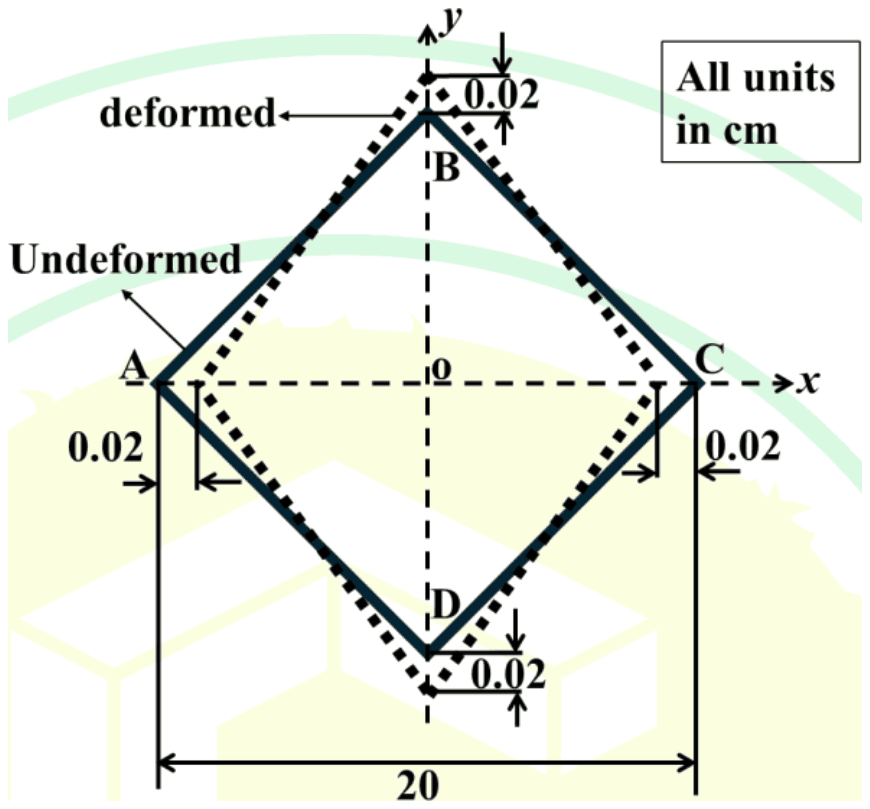
In the given figure, plate ABCD in its undeformed configuration (solid line) is a rhombus with all the internal angles being 90°. The lengths of the undeformed diagonals are 20 cm. ABCD deforms as shown by the dotted lines. Upon deformation, diagonal AC reduces to 19.96 cm and BD increases to 20.04 cm. In the given x-y coordinate system, the engineering shear strain \(\gamma_{xy}\) is equal to ____.

Square plate ABCD (solid, undeformed) with diagonal AC along the x axis and diagonal BD along the y axis, meeting at O, diagonals 20 cm; dotted deformed shape in which A and C each move 0.02 cm towards O along x and B and D each move 0.02 cm away from O along y; all units in cm

Exam Year(s)

GATE AE - 2025,

Answer: A

The engineering shear strain is 0.

The x and y axes run along the diagonals AC and BD. In the deformation, AC shortens and BD lengthens symmetrically about O, so points on the x axis stay on the x axis and points on the y axis stay on the y axis. The angle between the x and y directions remains 90°, so \(\gamma_{xy} = 0\), and the strains are purely normal:

\[ \begin{aligned} \varepsilon_{xx} &= \frac{19.96 - 20}{20} = -0.002 \\ \varepsilon_{yy} &= \frac{20.04 - 20}{20} = +0.002 \end{aligned} \]

The x and y axes are principal directions here. The sides of the square do change their angle: the shear strain measured along axes at 45° to x and y is \(\varepsilon_{yy} - \varepsilon_{xx} = 0.004\), the trap in options C and D. The value 0.002 is a normal strain, not a shear strain.

Please log in or register to report this question.

8.

A 1 m long rod is to be designed to support an axial tensile load \(P\) (\(P \gg\) weight of the rod). The material for the rod is to be chosen from one of the four provided in the table. Using strength-based failure criterion for design, which material results in the lowest weight of the rod?

PropertiesMaterial αMaterial βMaterial γMaterial δ
Density (kg/m3)2700450078009000
Young’s modulus (GPa)70115200130
Yield Strength (MPa)270900520540

Exam Year(s)

GATE AE - 2025,

Answer: B

The lightest rod is made from Material β.

For a strength-based design the cross-section must carry P at the yield stress, \(A = P/\sigma_{y}\). The mass of a rod of length l is then

\[ m = \rho A l = P\,l\,\frac{\rho}{\sigma_{y}} \]

so the best material has the highest specific strength \(\sigma_{y}/\rho\). In MPa per (kg/m3): α 270/2700 = 0.100, β 900/4500 = 0.200, γ 520/7800 = 0.067, δ 540/9000 = 0.060. Material β gives half the mass of α and about a third that of γ or δ.

Young's modulus would matter for a stiffness-based design (limiting the extension), not for a strength-based one, which is why γ, with the highest modulus, is not the answer.

Please log in or register to report this question.

9.

The number of independent elastic constants that a fully anisotropic linear elastic material can have is ______.

Exam Year(s)

GATE AE - 2026,

Answer: B

A fully anisotropic linear elastic material has 21 independent elastic constants.

Hooke's law relates the six stress components to the six strain components through a 6 x 6 stiffness matrix of 36 entries. The existence of a strain energy function makes this matrix symmetric, which leaves

\[ \frac{6 \times 7}{2} = 21 \]

independent constants.

36 counts every entry and ignores that symmetry. 2 is the number for an isotropic material (for example E and \(\nu\), or the two Lame constants), and 9 is the orthotropic case; 10 does not correspond to the general anisotropic material.

Please log in or register to report this question.

10.

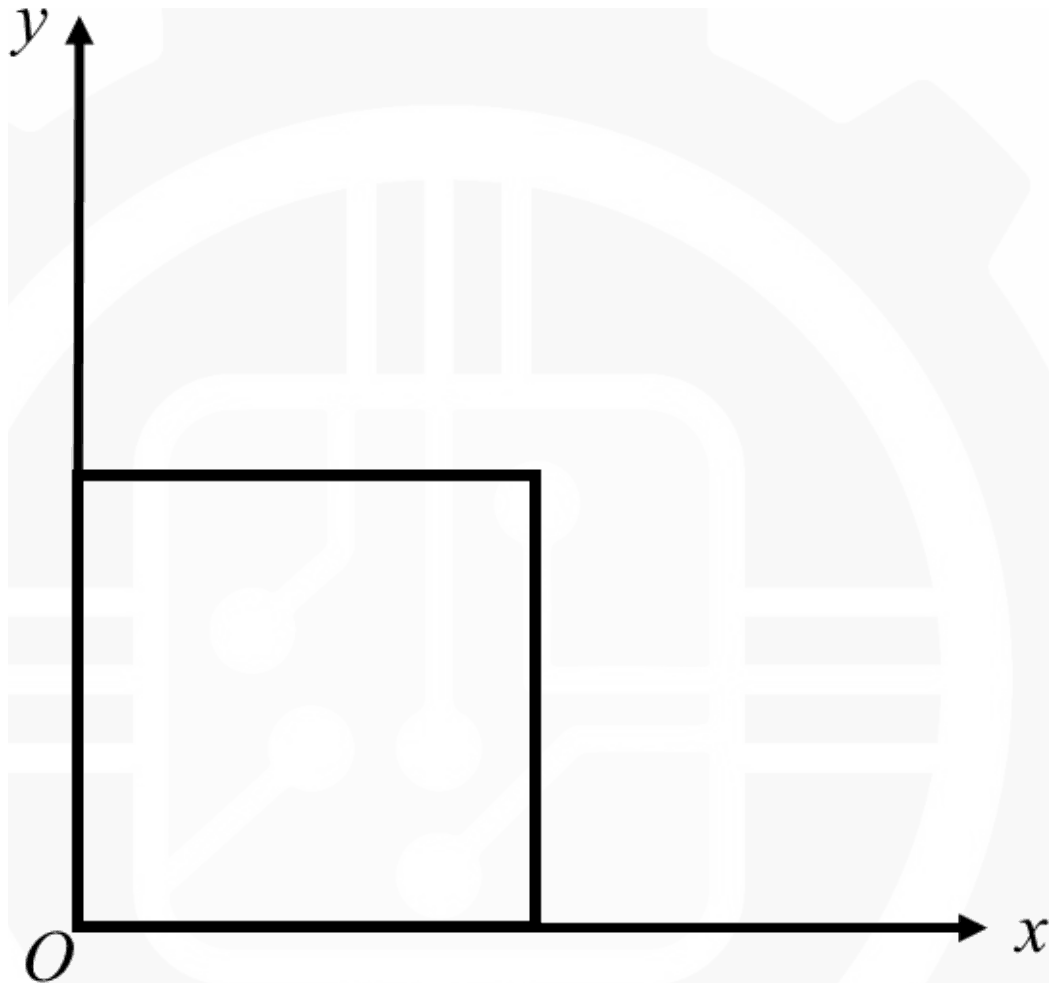
Consider a unit square body as shown in the figure below. The body is subjected to the deformation field \(u = -ay\) and \(v = ax\), where '\(a\)' is a constant. Due to the application of this deformation field, the body undergoes _______ in the x-y plane.

Unit square with one corner at the origin O and two sides along the x and y axes

Exam Year(s)

GATE AE - 2026,

Answer: D

The body undergoes rigid body rotation.

For \(u = -ay\) and \(v = ax\), the strains and the rotation are

\[ \begin{aligned} \varepsilon_x &= \frac{\partial u}{\partial x} = 0, \quad \varepsilon_y = \frac{\partial v}{\partial y} = 0 \\ \gamma_{xy} &= \frac{\partial u}{\partial y} + \frac{\partial v}{\partial x} = -a + a = 0 \\ \omega_z &= \frac{1}{2}\left(\frac{\partial v}{\partial x} - \frac{\partial u}{\partial y}\right) = a \end{aligned} \]

All strains vanish, so the square changes neither its side lengths nor its right angles; it only turns, by the small angle \(a\) about the origin, counterclockwise for positive \(a\).

Biaxial deformation needs non-zero normal strains, pure shear needs a non-zero \(\gamma_{xy}\) with no rotation, and pure bending needs strains that vary linearly across the section. None of these appears here.

Please log in or register to report this question.

Loading…
Tags: Simple Stresses and Strains Questions and Answers || Simple Stresses and Strains MCQ Questions and Answers || Simple Stresses and Strains GK Questions and Answers || Simple Stresses and Strains GK MCQ Questions || Simple Stresses and Strains Multiple Choice Questions and Answers || Simple Stresses and Strains GK || GK on Simple Stresses and Strains || Strength of Materials Questions and Answers || Strength of Materials MCQ Questions and Answers || Strength of Materials GK Questions and Answers || GK on Strength of Materials