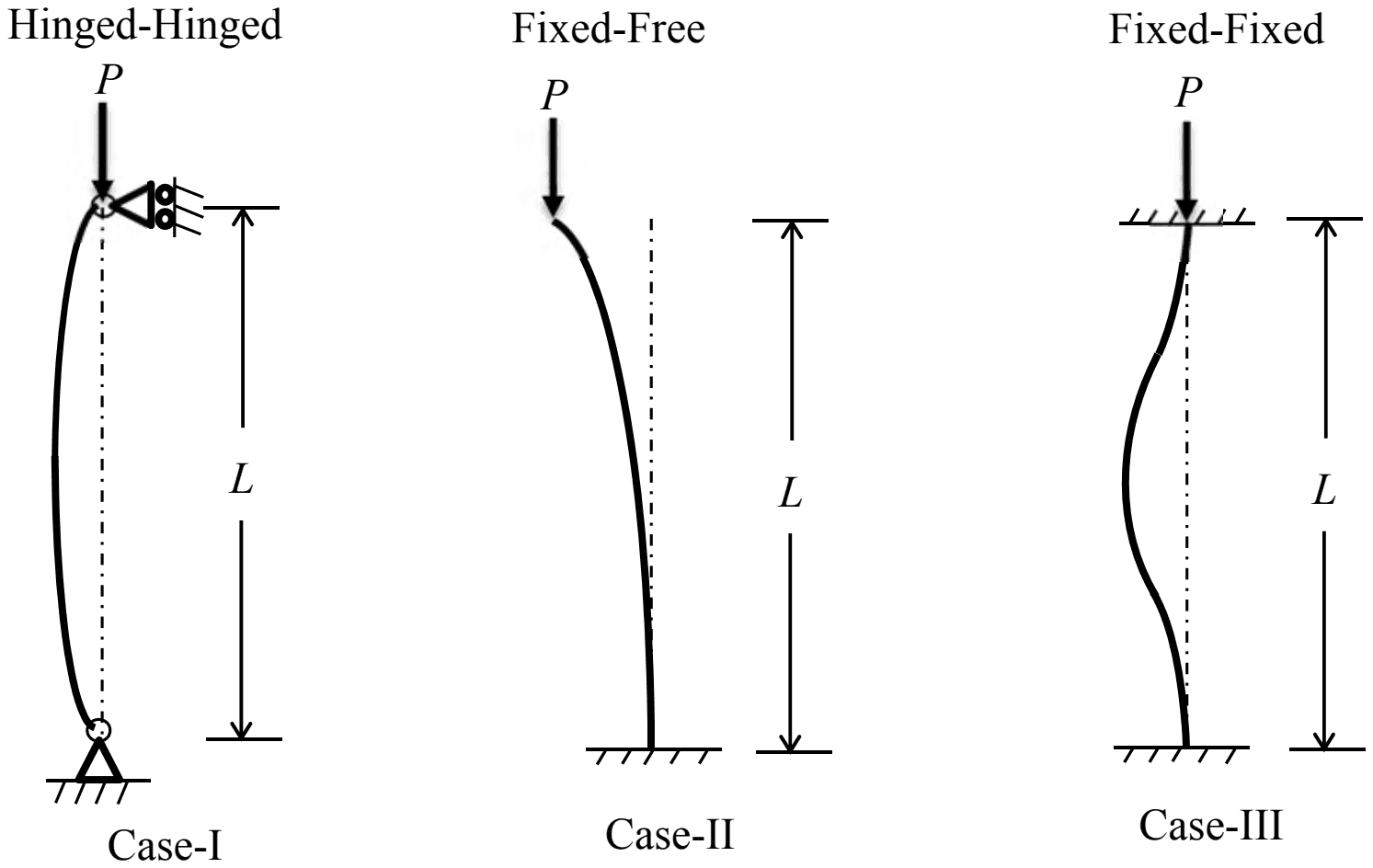
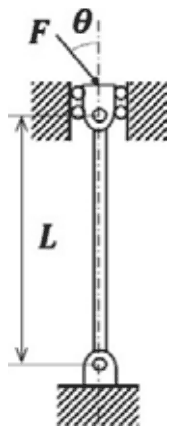
An initially stress-free massless elastic beam of length L and circular cross-section with diameter d (\(d \ll L\)) is held fixed between two walls as shown. The beam material has Young’s modulus E and coefficient of thermal expansion α.
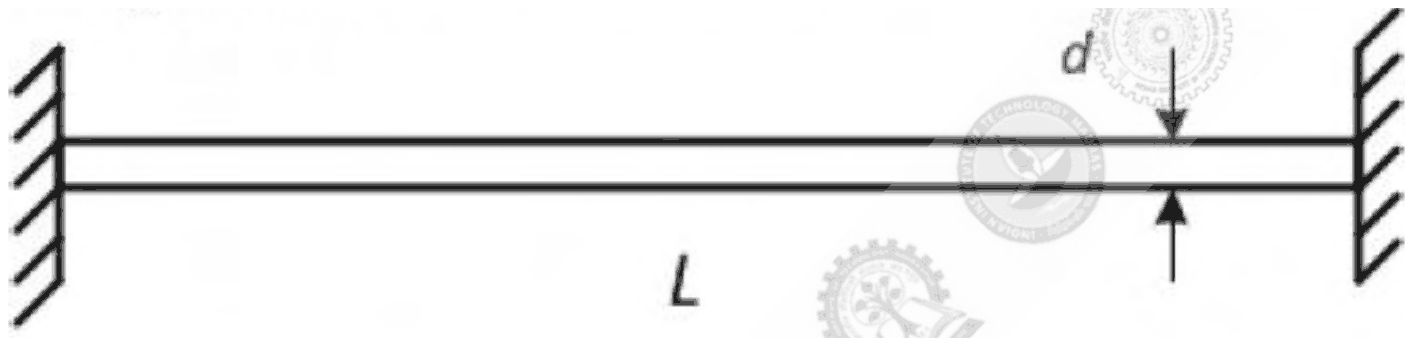
If the beam is slowly and uniformly heated, the temperature rise required to cause the beam to buckle is proportional to
GATE ME - 2017,
Answer: B
The buckling temperature rise is proportional to \(d^{2}\).
With both ends fixed, heating builds up a compressive thermal force \(P = EA\alpha\Delta T\). The beam buckles when this reaches the Euler load for a fixed-fixed column:
\[ \begin{aligned} EA\alpha\Delta T &= \frac{4\pi^{2}EI}{L^{2}} \\ \Delta T &= \frac{4\pi^{2}}{\alpha L^{2}}\cdot\frac{I}{A} \end{aligned} \]
For a circle \(I/A = (\pi d^{4}/64)/(\pi d^{2}/4) = d^{2}/16\), the square of the radius of gyration, so \(\Delta T \propto d^{2}\). E cancels out.
\(d^{4}\) is the dependence of the buckling load itself (through I), forgetting that the thermal force also grows with the area \(d^{2}\); d and \(d^{3}\) do not follow.
Please log in or register to report this question.