Machine-translated by Google. Questions are authored in English.
Top

Mirror and Water Images Questions and Answers

11.

Which one of the following options has the correct sequence of objects arranged in the increasing number of mirror lines (lines of symmetry)?

Exam Year(s)

GATE ME - 2025,

Answer: B

The correct order is Isosceles triangle; Equilateral triangle; Square; Circle.

An isosceles (non-equilateral) triangle has 1 line of symmetry, an equilateral triangle 3, a square 4, and a circle infinitely many, through every diameter.

The first option is in decreasing order. The third puts the equilateral triangle (3) before the isosceles triangle (1), and the fourth puts the square (4) before the equilateral triangle (3).

Please log in or register to report this question.
12.

A line of symmetry is defined as a line that divides a figure into two parts in a way such that each part is a mirror image of the other part about that line.

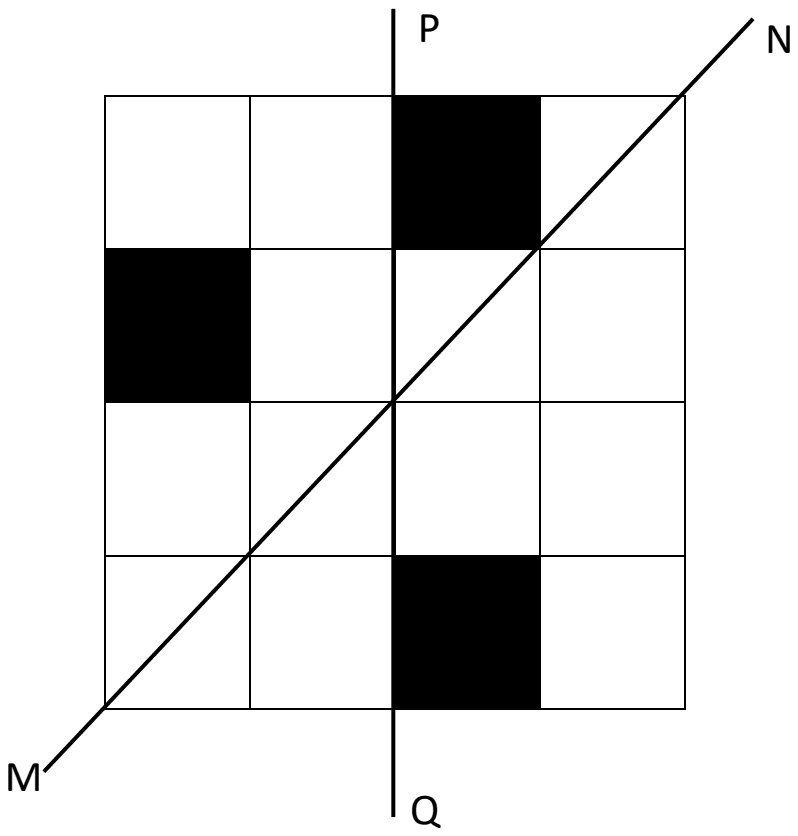
The given figure consists of 16 unit squares arranged as shown. In addition to the three black squares, what is the minimum number of squares that must be coloured black, such that both PQ and MN form lines of symmetry? (The figure is representative)

A 4 by 4 grid with black squares at row 1 column 3, row 2 column 1 and row 4 column 3; PQ is the vertical centre line and MN the diagonal from bottom left to top right

Exam Year(s)

GATE Physics - 2023,

Answer: C

At least 5 more squares must be coloured.

Number the rows 1 to 4 from the top and the columns 1 to 4 from the left. The black squares are at (1, 3), (2, 1) and (4, 3). PQ is the vertical centre line, which swaps column \(c\) with column \(5 - c\). MN is the diagonal from the bottom left corner to the top right corner, which sends the square at (\(r\), \(c\)) to (\(5 - c\), \(5 - r\)).

Apply both reflections repeatedly to (1, 3): it reaches (1, 2), (2, 4), (3, 4), (4, 3), (4, 2), (3, 1) and (2, 1). These are the eight edge squares that are not corners, and all three black squares are among them. For both lines to be lines of symmetry, all eight must be black, so the five missing ones, (1, 2), (2, 4), (3, 1), (3, 4) and (4, 2), must be added.

3 or 4 would leave some black square without its mirror image, and 6 is more than needed.

Please log in or register to report this question.
13.

An object is said to have an \(n\)-fold rotational symmetry if the object, rotated by an angle of \(\frac{2\pi}{n}\), is identical to the original.

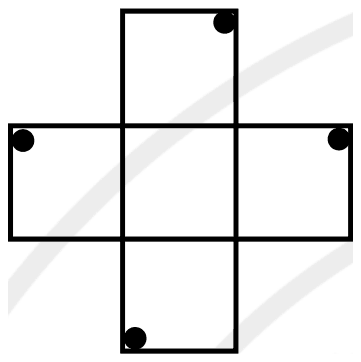
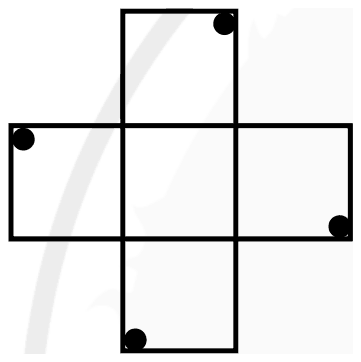
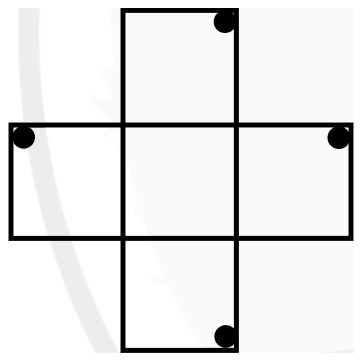
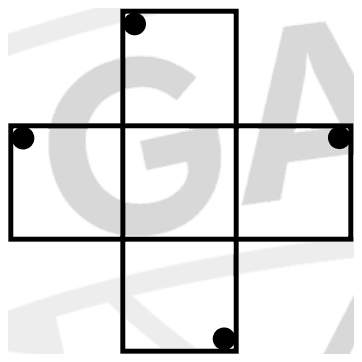
Which one of the following objects exhibits 4-fold rotational symmetry about an axis perpendicular to the plane of the screen?

Note: The figures shown are representative.

Exam Year(s)

GATE Physics - 2025,

Answer: B

The object with 4-fold rotational symmetry is (B).

A 4-fold symmetry means a 90° rotation leaves the object unchanged, so each arm's dot must move onto the next arm's dot. In (B) the dots are at the top arm's outer right corner, the right arm's outer lower corner, the bottom arm's outer left corner and the left arm's outer upper corner. Turning the figure 90° clockwise carries each of these exactly onto the next, so (B) maps onto itself.

In (A) and (C) the left and right arms carry their dots on the same (upper) side, a mirror arrangement rather than a rotational one, so a 90° turn moves a dot to an empty corner. (D) has the same fault on the vertical arms. Each of these has at most a reflection or 2-fold symmetry, not a 4-fold one.

Please log in or register to report this question.
14.

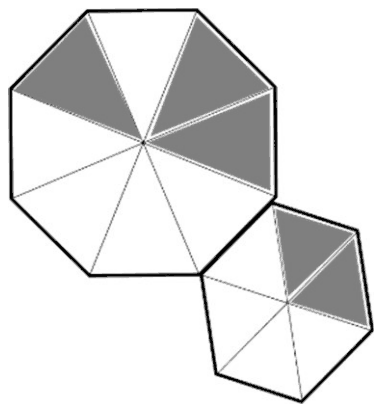
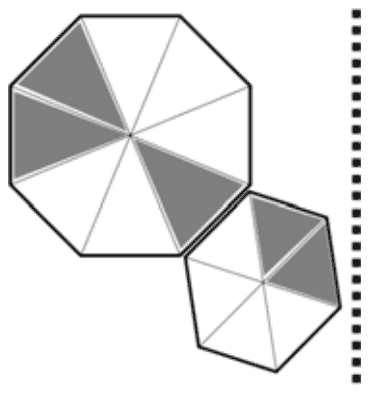
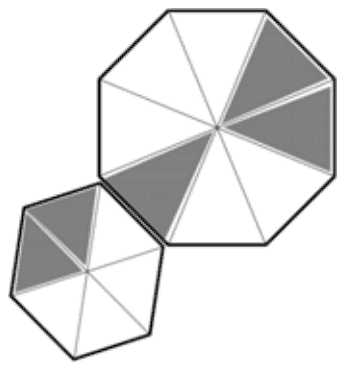
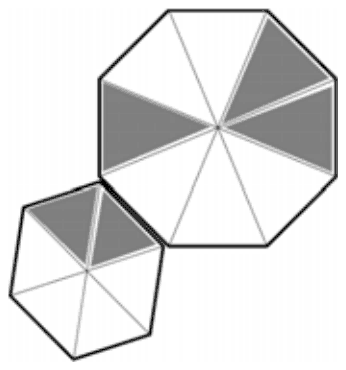
A regular octagon with three shaded sectors, joined at its lower right to a hexagon with two shaded sectors, beside a vertical dotted mirror line on the right

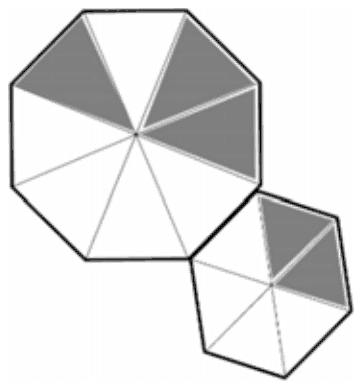
For the picture shown above, which one of the following is the correct picture representing reflection with respect to the mirror shown as the dotted line?

Exam Year(s)

GATE XE - 2022,

Answer: A

The correct reflection is (A).

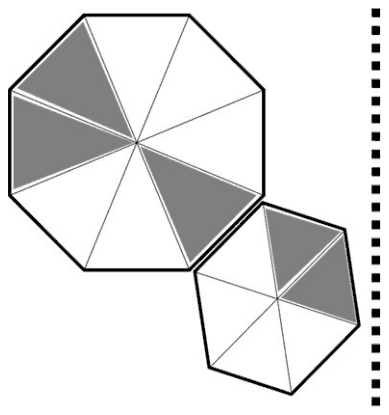
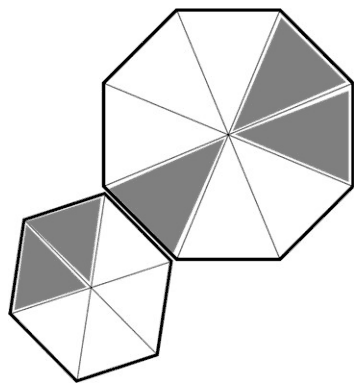
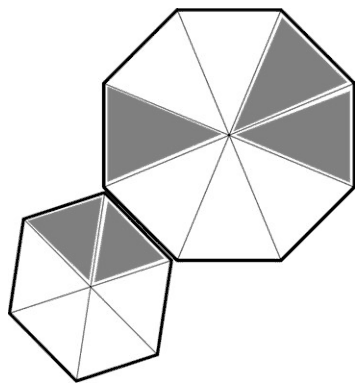
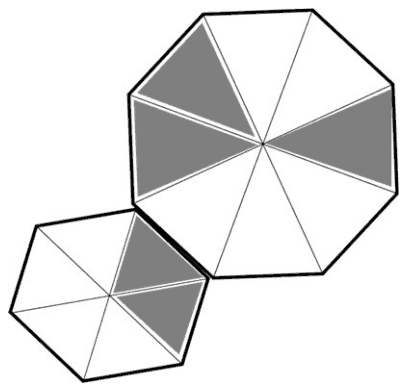
A mirror on a vertical line swaps left and right and keeps up and down. In the original, the hexagon sits at the lower right of the octagon, so in the image it must sit at the lower left. The octagon's shaded sectors, which point to the upper left, to the left and to the lower right towards the hexagon, must point to the upper right, the right and the lower left. The hexagon's shaded sectors, on its right side, must move to its left side.

Picture (A) has all of these. (D) leaves the hexagon at the lower right, where it was before reflection. (B) and (C) put the hexagon on the correct side, but their shaded sectors are not the mirror images of the original ones: in (C) the hexagon's shading stays on its right, and in (B) the octagon keeps a shaded sector on its left away from the hexagon.

Please log in or register to report this question.
15.

An opaque cylinder (shown below) is suspended in the path of a parallel beam of light, such that its shadow is cast on a screen oriented perpendicular to the direction of the light beam. The cylinder can be reoriented in any direction within the light beam. Under these conditions, which one of the shadows P, Q, R, and S is NOT possible?

A solid cylinder, and four shadow shapes: P a circle, Q a rectangle with semicircular ends, R a rectangle, S a parallelogram with slanted sides

Exam Year(s)

GATE XE - 2023,

Answer: D

The impossible shadow is S, the parallelogram.

With parallel light falling square on the screen, the shadow is the orthogonal projection of the cylinder. Looking along its axis gives a circle (P). Looking side-on gives a rectangle (R). At any angle between, the two circular ends project as ellipses joined by straight tangent lines, giving a rounded shape like Q.

A parallelogram would need slanted straight ends, but the ends of a cylinder are circles, and a circle projects as a circle, an ellipse or, edge-on, a straight segment perpendicular to the axis's projection. Edge-on ends give the rectangle R, never slanted sides, so S cannot occur.

Please log in or register to report this question.
16.

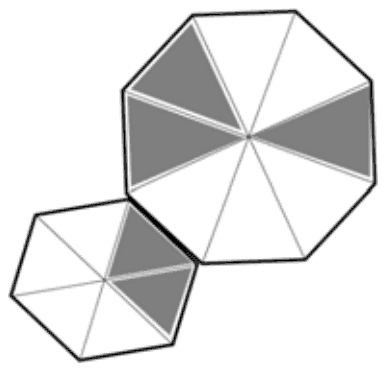
Octagon at upper left joined to a hexagon at lower right, dotted mirror line on the right

For the picture shown above, which one of the following is the correct picture representing reflection with respect to the mirror shown as the dotted line?

Exam Year(s)

GATE Life Sciences - 2022,

Answer: A

The correct reflection is the one in option (A).

A vertical mirror reverses left and right but keeps up and down. In the original, the octagon is at the upper left and the hexagon at the lower right, next to the mirror. Its image therefore has the hexagon at the lower left, next to the mirror, and the octagon at the upper right.

The shading must flip too. The original octagon is shaded on its upper left and left sectors and on the sector pointing down to the hexagon; in the image these become upper right, right, and the sector pointing down-left to the hexagon. The hexagon's shaded sectors move from its upper right to its upper left. Option (A) shows exactly this.

Option (B) shades the octagon's left side instead of the sector toward the hexagon. Option (C) shades the wrong octagon sectors and the wrong side of the hexagon. Option (D) keeps the octagon on the left, which is not a reflection in a vertical line at all.

Please log in or register to report this question.
17.

An opaque cylinder (shown below) is suspended in the path of a parallel beam of light, such that its shadow is cast on a screen oriented perpendicular to the direction of the light beam. The cylinder can be reoriented in any direction within the light beam. Under these conditions, which one of the shadows P, Q, R, and S is NOT possible?

[The figure shows a solid circular cylinder and four shaded shadows: P a circle, Q a rectangle with semicircular ends, R a rectangle, and S a parallelogram with slanted ends.]

Exam Year(s)

GATE Life Sciences - 2023,

Answer: D

The impossible shadow is S, the parallelogram.

With a parallel beam and a screen perpendicular to it, the shadow is the orthographic projection of the cylinder. Looking along the axis gives a circle (P). Looking at right angles to the axis gives a rectangle (R). At any angle in between, the circular ends project as ellipses and the shadow is a band with rounded ends, the shape of Q.

A parallelogram would need the ends to project as straight, slanted lines. A circular end can only project as a circle, an ellipse or, edge-on, a straight line perpendicular to the sides, so slanted straight ends never occur.

Please log in or register to report this question.
18.

A clock shows 9:00 AM. Then the correct time in the water is :

Exam Year(s)

HPPSC HPAS - 2025,

Answer: A

The time seen in the water is 9:30 AM.

A water image flips the clock top to bottom. The minute hand at 12 appears at 6, and the hour hand at 9, which lies on the horizontal line, stays at 9. So the image shows the hands at 9 and 6, which reads as 9:30.

A quick rule for water images is to subtract the time from 18:30; here \(18{:}30 - 9{:}00 = 9{:}30\). 3 AM is what a mirror (left-right) image of 9:00 shows, 3:30 AM matches neither image, and 9:00 would mean no reflection at all.

Please log in or register to report this question.
19.

Which of the following is mirror image of the given word?

NATIONAL

Exam Year(s)

ISRO Assistant - 2023,

Answer: B

The mirror image of NATIONAL is option (b).

With a mirror at the side, the order of the letters is reversed and each letter is flipped left to right. NATIONAL read backwards is LANOITAN, and the flipped letters make the L and the N look turned round. Option (b) shows exactly that sequence of letters.

Option (a) is the word unchanged, so it is not a mirror image at all. Options (c) and (d) show a different sequence of letters from LANOITAN (the letters are rearranged rather than reversed), so they cannot be reflections of NATIONAL.

Please log in or register to report this question.
20.

What will be the time shown by the water image of clock showing time 4 Hours 45 Minutes?

Exam Year(s)

ISRO Assistant - 2023,

Answer: A

The water image of 4:45 reads 1 Hour 45 minutes.

A water image is the reflection in a mirror lying flat below the clock, which turns the dial upside down. The standard rule is: if the minutes are 30 or more, subtract the time from 17:90; if they are under 30, subtract from 18:30.

\[ 17{:}90 - 4{:}45 = 13{:}45 \]

13:45 on a 12-hour dial is 1:45. A direct check agrees: the minute hand at 9 lies on the line of reflection and stays at 9, so the minutes are 45, and the hour hand moves from just before 5 to just past 1.

Options (b), (c) and (d) have minute hands at 3, 7 and 5 respectively, but a minute hand pointing at 9 cannot move, so none of them can be the reflection.

Please log in or register to report this question.
Loading…