
Machine-translated by Google. Questions are authored in English.
Top

Area Questions and Answers

Important Instructions
11.

The length of a rectangle is twice its breadth. If the perimeter of the rectangle is 66 m, then the area of the rectangle, in m2, is:

Exam Year(s)

DSSSB PGT - 2023,

Answer: C

The area is 242 square metres. Let the breadth be b, so the length is 2b. The perimeter is 2(2b + b) = 6b = 66, so b = 11 m and the length is 22 m. The area is 22 x 11 = 242 square metres. The option 121 is the square of the breadth and 338 and 616 do not come from the given dimensions. The area is length times breadth, 22 x 11 = 242 square metres, and the perimeter is 2(22 + 11) = 66 metres, which agrees with the data. The options 338, 616 and 121 do not give a perimeter of 66 for any rectangle whose length is twice its breadth.

Please log in or register to report this question.
12.

Length of a rectangle is 5 times of its breadth. If the perimeter of rectangle is 300 cm, then what will be the length of the rectangle?

Exam Year(s)

DSSSB - 2023,

Answer: A

Let the breadth be b, so the length is 5b. The perimeter of a rectangle is twice the sum of the length and the breadth, so 2(5b + b) = 12b = 300 cm, and b = 25 cm. The length is then 5 x 25 = 125 cm. Check: 2(125 + 25) = 300 cm, and 125 is five times 25. So the length is 125 cm, option (A). The value 25 cm is the breadth, and 100 cm, 150 cm and 250 cm do not give a perimeter of 300 cm with a length five times the breadth.

Please log in or register to report this question.
13.

The perimeter of a regular hexagon of side 8 cm is:

Exam Year(s)

DSSSB - 2023,

Answer: B

The perimeter is 48 cm.

A regular hexagon has six equal sides, so its perimeter is six times the side.

\[ 6\times8=48\text{ cm} \]

47, 49 and 50 cm are not six times 8.

A regular hexagon has six equal sides and six equal angles of 120 degrees each. Its perimeter is the sum of all six sides, 8 + 8 + 8 + 8 + 8 + 8 = 48 cm. The area would use a different formula, which is not needed here.

Please log in or register to report this question.
14.

The diagonal of a square is \(5\sqrt{2}\) cm. The diagonal of another square whose area is double that of the first square is:

Exam Year(s)

DSSSB - 2023,

Answer: B

The diagonal is 10 cm.

A square with diagonal d has area d2/2. The first square has d = 5√2, so its area is 25. The second has area 50, so its diagonal satisfies d2/2 = 50.

\[ d^{2}=100 \Rightarrow d=10\text{ cm} \]

12, 8 and 7 cm would give areas of 72, 32 and 24.5, none of which is 50.

When the area doubles, the side grows by a factor of root 2, and so does the diagonal. The first diagonal is 5√2, so the new one is 5√2 × √2 = 10 cm. This is a quick way to check the answer.

Please log in or register to report this question.

15.

The area of a rectangular field is 1008 m2. Its shorter side is \(\frac{1}{8}\) of the sum of its longer side and one of its diagonals. What is the cost of fencing the field at ₹ 24 per m?

Exam Year(s)

DSSSB TGT - 2023,

Answer: C

The cost of fencing is ₹ 3,792. Let the longer side be \(l\), the shorter side \(b\) and the diagonal \(d\). The condition says \(b = \frac{l + d}{8}\), so \(d = 8b - l\). Squaring and using \(d^{2} = l^{2} + b^{2}\): \[ 64b^{2} - 16bl + l^{2} = l^{2} + b^{2} \] \[ 63b^{2} = 16bl \Rightarrow l = \frac{63b}{16} \] With area \(lb = 1008\): \[ \begin{aligned} \frac{63b^{2}}{16} &= 1008 \Rightarrow b^{2} \\ &= 256,\ b \\ &= 16,\ l \\ &= 63 \end{aligned} \] Perimeter \(= 2(63 + 16) = 158\) m, and \(158\times 24 = 3792\).

Please log in or register to report this question.

16.

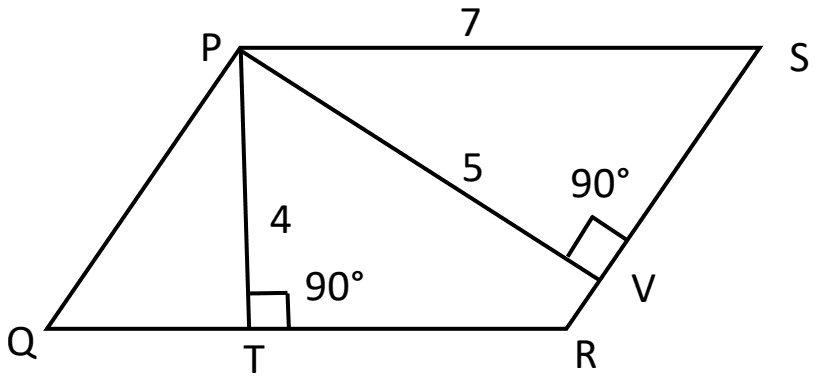
In the given figure, PQRS is a parallelogram with PS = 7 cm, PT = 4 cm and PV = 5 cm. What is the length of RS in cm? (The diagram is representative.)

Parallelogram PQRS with PS = 7 along the top, PT = 4 drawn from P perpendicular to QR meeting it at T, and PV = 5 drawn from P perpendicular to RS meeting it at V, right angles marked at T and V

Exam Year(s)

GATE AE - 2023,

Answer: B

RS is 28/5 cm.

The area of a parallelogram is any side times the perpendicular distance to it from the opposite side, and it is the same whichever pair of sides you use. PT is the height onto base QR, and QR = PS = 7 cm. PV is the height onto side RS.

\[ \begin{aligned} \text{Area} &= QR \times PT = 7 \times 4 = 28 \\ \text{Area} &= RS \times PV = 5\,RS \\ RS &= \frac{28}{5}\ \text{cm} \end{aligned} \]

The distractor 20/7 comes from 4 × 5 / 7, mixing the two heights; 35/4 comes from 7 × 5 / 4, putting the heights the wrong way round; 9/2 is simply (4 + 5)/2.

Please log in or register to report this question.

17.

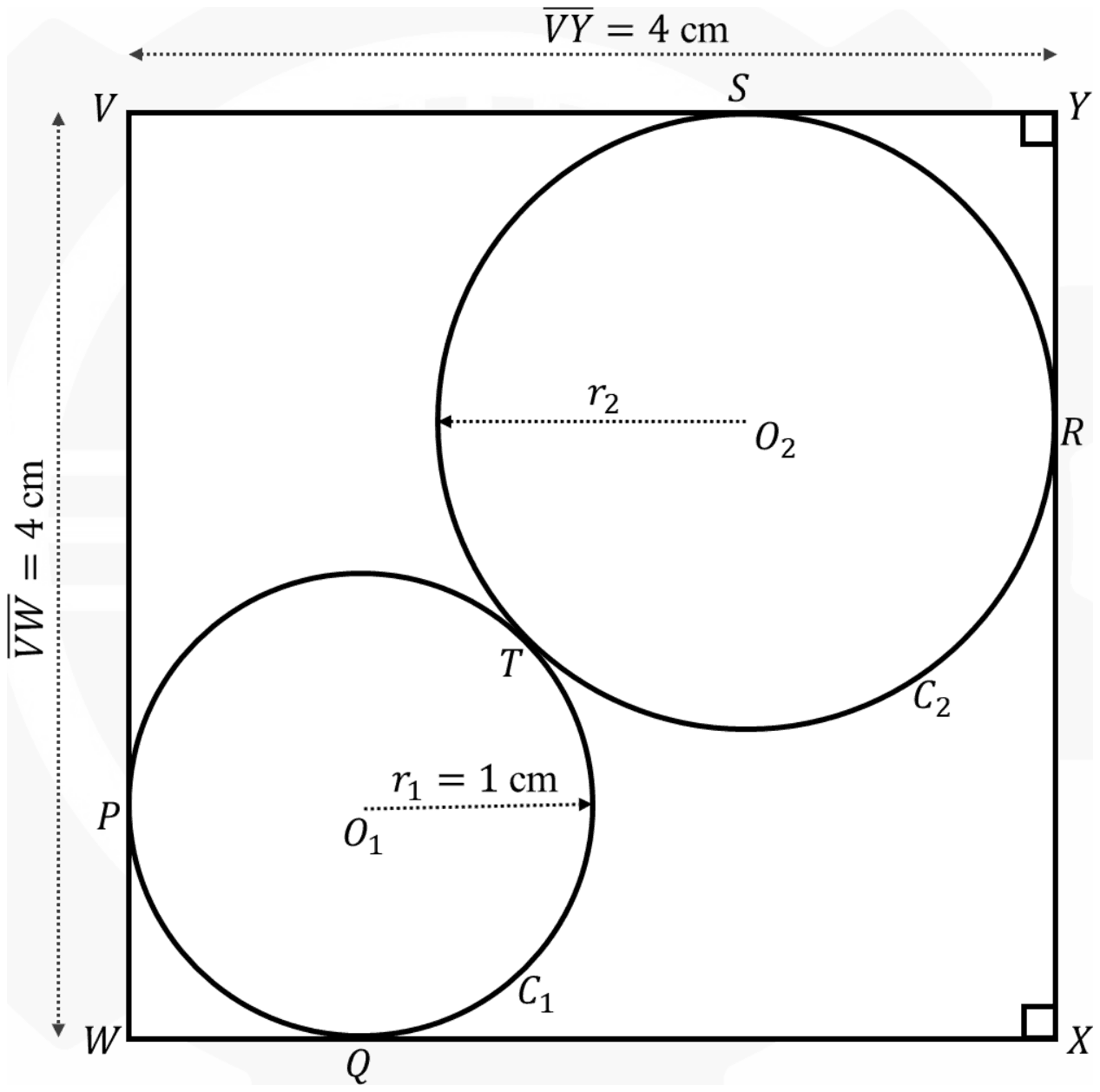
As shown in the figure, circle \(C_1\) with center \(O_1\) and radius \(r_1\) touches the square \(VWXY\) at points \(P\) and \(Q\) while circle \(C_2\) with center \(O_2\) and radius \(r_2\) touches the square \(VWXY\) at points \(R\) and \(S\). The two circles touch each other at \(T\).

Given \(r_1 = 1\) cm and \(\overline{VY} = \overline{VW} = 4\) cm, \(r_2\) = _____ cm.

Square VWXY of side 4 cm. Circle C1 of radius 1 cm touches sides VW at P and WX at Q near corner W; circle C2 touches XY at R and YV at S near corner Y; the circles touch at T

Exam Year(s)

GATE AE - 2026,

Answer: C

The radius is \(r_2 =\) \(7 - 4\sqrt{2}\) cm, about 1.34 cm.

Put W at the origin with the square of side 4 cm. \(C_1\) touches the two sides at W, so \(O_1 = (1, 1)\). \(C_2\) touches the two sides at Y, so \(O_2 = (4 - r_2, 4 - r_2)\). Both centres lie on the diagonal WY, and touching circles have centres \(r_1 + r_2\) apart:

\[ \begin{aligned} \sqrt{2}\,(3 - r_2) &= 1 + r_2 \\ r_2 &= \frac{3\sqrt{2} - 1}{\sqrt{2} + 1} \\ &= (3\sqrt{2} - 1)(\sqrt{2} - 1) \\ &= 7 - 4\sqrt{2} \end{aligned} \]

The other values fail a size check: \(4 - 3\sqrt{2}\) is negative, and \(1 + 2\sqrt{2} \approx 3.83\) and \(5 + 3\sqrt{2} \approx 9.24\) would not fit in a 4 cm square beside a 1 cm circle.

Please log in or register to report this question.

18.

The area of a square is \(d\). What is the area of the circle which has the diagonal of the square as its diameter?

Exam Year(s)

GATE CS - 2018,

Answer: D

The area of the circle is \(\frac{1}{2}\pi d\).

Let the side of the square be \(s\), so \(s^{2} = d\). The diagonal is \(s\sqrt{2}\), and it is the diameter, so the radius is \(\frac{s\sqrt{2}}{2}\).

\[ \begin{aligned} \text{area} &= \pi \left(\frac{s\sqrt{2}}{2}\right)^{2} \\ &= \pi \cdot \frac{2s^{2}}{4} = \frac{1}{2}\pi d \end{aligned} \]

\(\pi d\) uses the diagonal as the radius, and \(\pi d^{2}\) and \(\frac{1}{4}\pi d^{2}\) treat \(d\) as a length rather than an area, so they have the wrong dimensions.

Please log in or register to report this question.

19.

A rectangle becomes a square when its length and breadth are reduced by 10 m and 5 m, respectively. During this process, the rectangle loses 650 m2 of area. What is the area of the original rectangle in square meters?

Exam Year(s)

GATE ME - 2018, GATE XE - 2018,

Answer: B

The original area is 2250 m2.

Let the length be l and the breadth b. The reduced sides are equal, so l - 10 = b - 5, that is, l = b + 5. The lost area is 650:

\[ \begin{aligned} lb - (l - 10)(b - 5) &= 650 \\ 5l + 10b - 50 &= 650 \\ 5(b + 5) + 10b &= 700 \\ b = 45,\ l &= 50 \end{aligned} \]

So the rectangle is 50 m by 45 m, area 2250 m2, and the square left is 40 m by 40 m (1600 m2, which is 650 less). 1125 and 4500 are half and double the answer, and 2924 does not fit the conditions.

Please log in or register to report this question.

20.

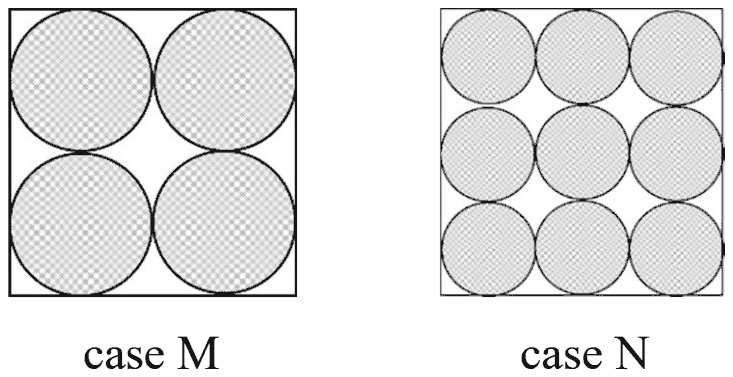
Equal sized circular regions are shaded in a square sheet of paper of 1 cm side length. Two cases, case M and case N, are considered as shown in the figures below. In the case M, four circles are shaded in the square sheet and in the case N, nine circles are shaded in the square sheet as shown.

What is the ratio of the areas of unshaded regions of case M to that of case N?

Case M: four equal shaded circles in a 2 by 2 grid, touching each other and the sides of the square. Case N: nine equal shaded circles in a 3 by 3 grid, touching in the same way

Exam Year(s)

GATE ME - 2022,

Answer: B

The ratio is 1 : 1.

In case M, four circles fill the 1 cm square in a 2 by 2 grid, so each has diameter 1/2 cm and radius 1/4 cm. In case N, nine circles fill it in a 3 by 3 grid, so each has radius 1/6 cm. The shaded areas are:

\[ \begin{aligned} M: \; 4 \times \pi \left(\tfrac{1}{4}\right)^{2} &= \tfrac{\pi}{4} \\ N: \; 9 \times \pi \left(\tfrac{1}{6}\right)^{2} &= \tfrac{\pi}{4} \end{aligned} \]

Both unshaded areas are therefore \(1 - \pi/4\) square cm, and the ratio is 1 : 1.

In general, \(n^{2}\) touching circles in an \(n\) by \(n\) grid always cover \(\pi/4\) of the square, whatever \(n\) is. The ratios 2 : 3 and 3 : 2 come from comparing the numbers of circles, 4 and 9, or their rows, instead of their areas.

Please log in or register to report this question.

Loading…
Tags: Area Questions and Answers || Area MCQ Questions and Answers || Area GK Questions and Answers || Area GK MCQ Questions || Area Multiple Choice Questions and Answers || Area GK || GK on Area || Quantitative Aptitude Questions and Answers || Quantitative Aptitude MCQ Questions and Answers || Quantitative Aptitude GK Questions and Answers || GK on Quantitative Aptitude