Machine-translated by Google. Questions are authored in English.
Top

Completion of Incomplete Pattern Questions and Answers

1.

In the following question, you are given a figure that is embedded in one of them. Trace out the alternative figure which contains fig. as its part. (Rotation not allowed)

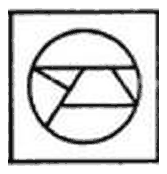
A triangle pointing right whose tip touches a vertical line, with a slanted line rising from the base of a right-angled shape beside it

Exam Year(s)

DSSSB - 2023,

Answer: D

The official key is option (D). The given figure is a triangle pointing right whose tip touches a vertical line, with a slanted line rising from the base of a right-angled shape beside it. In option (D) the large triangle on the left has its tip meeting the left side of the small square at the right, and that square contains a vertical side, a base and a slanted line rising from the lower left corner, the same shape as in the given figure and in the same orientation (rotation is not allowed). What was not confirmed in full is that the other three figures lack this part. The key is kept as printed because nothing contradicts it.

Please log in or register to report this question.
2.

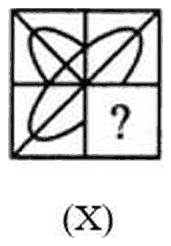
Which of the above option will replace the question mark?

A square divided into four cells with crossing lines and leaf shapes, the last cell marked with a question mark

Exam Year(s)

DSSSB - 2023,

Answer: D

The key gives option 4. The figure X is a square split into four cells, in which three cells show the pattern of crossing lines and leaf (lens) shapes and the fourth is hidden. The missing cell has to complete the pattern in the same style as the other cells, so that the lens shapes and the diagonal lines continue across the cell borders. Of the four candidates only the one the key names carries the right line and the right lens, and the other three have lines in the wrong direction or too many lines. This is a figure completion question and the answer follows the official key.

Please log in or register to report this question.

3.

Which of the above option will replace the question mark?

A square divided into a grid of black and white blocks with the last cell marked with a question mark

Exam Year(s)

DSSSB - 2023,

Answer: D

The key gives option 4. The big figure is a grid of black and white squares with the bottom right block hidden. The blocks of the grid repeat as a pattern in which each coloured area continues across the grid, so the missing block must give the right arrangement of black and white squares. Among the four candidates the key names the fourth, which fits the pattern of the neighbouring blocks, while the others place a black or a white square where the pattern needs the opposite. The question is identical in wording to Q11, differing only in the figure.

Please log in or register to report this question.

4.

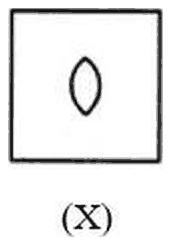
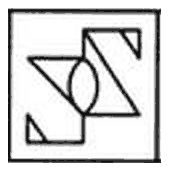
Which of the above option will embed the original image X?

A small square X holding a lens shape

Exam Year(s)

DSSSB - 2023,

Answer: C

The original image X, a small lens shape, is embedded in option 3. In an embedded-figure question the given figure must appear unchanged, with the same size and orientation, inside one of the larger figures. The third drawing contains the lens shape in the middle, where its outline is shared by other lines. The first, second and fourth drawings contain curved shapes that look like it but the lens in them is cut by lines, or has a different proportion, so X cannot be traced in them. The answer follows the official key.

Please log in or register to report this question.

5.

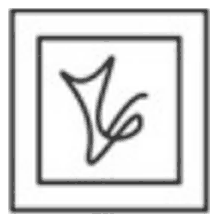
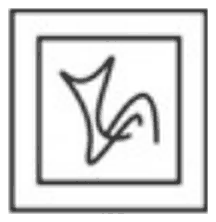
Select the alternative figure in which the given figure (X) is embedded.

Given figure X, a small square with a hand-drawn curve

Exam Year(s)

DSSSB TGT - 2023,

Answer: B

Figure 1 contains X. In a question of this type, the given figure must appear unchanged, in the same size and orientation, inside one of the larger figures, with extra lines added around it. The nested squares of figure 1 enclose the same hand-drawn curve as X without altering it, which is why it is the keyed option. The official key names figure 1; figures 2, 3 and 4 are the other three candidates, in which X is not found intact. The way to check is to place X over each candidate and compare detail by detail: X must appear unchanged, not just similar in general shape, and the official key names figure 1 as the candidate where it does.

Please log in or register to report this question.

6.

Which of the above option will embed the original image X?

A square X holding an S-shaped line

Exam Year(s)

DSSSB - 2023,

Answer: B

The S-shaped line X is embedded in option 2. X is a zigzag line with a long upper stroke, a turn and a lower stroke, and it has to be found with its shape unchanged inside the circular drawing. In the second circle, a line running from the top left, turning sharply and ending at the bottom, traces exactly the shape of X. In the other three circles the lines are drawn at different angles, or the turns fall in different places, so the shape cannot be traced. The answer follows the official key.

Please log in or register to report this question.

7.

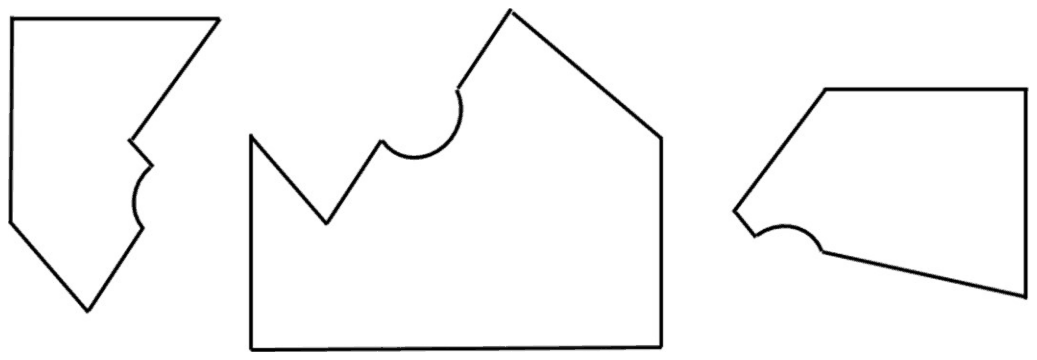
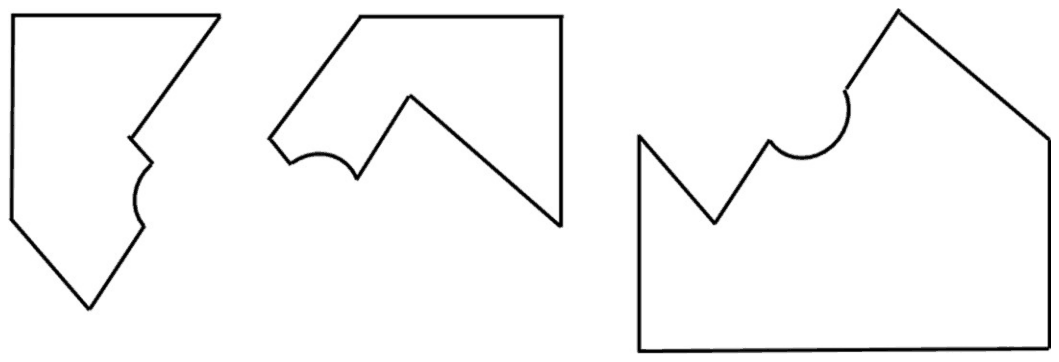
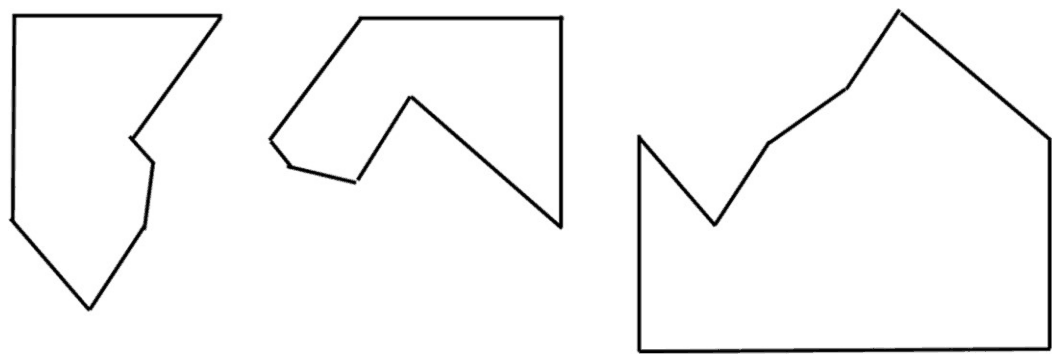
Which one of the following sets of pieces can be assembled to form a square with a single round hole near the center? Pieces cannot overlap.

Exam Year(s)

GATE AG - 2022,

Answer: C

The set that forms the square with one round hole is (C).

In set (C) each of the three pieces carries one curved notch, and each notch sits at the inner end of the edges along which the pieces meet. When the pieces are fitted together with their straight outer edges forming the sides of the square, the three notches come together near the centre and close into a single round hole.

Set (D) has no curved edges at all, so it cannot make a round hole. In set (A) the middle piece has no notch and the notch on the large piece sits on its outer slope beside the peak, so the curved edges cannot meet in one circle near the centre. In set (B) the middle piece of the other sets is replaced by a four-sided piece of a different outline, so the edges do not match and the pieces cannot close into a square around one hole.

Please log in or register to report this question.

8.

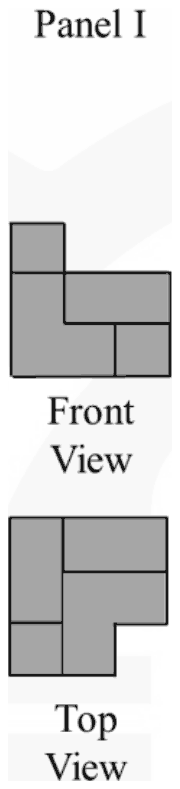
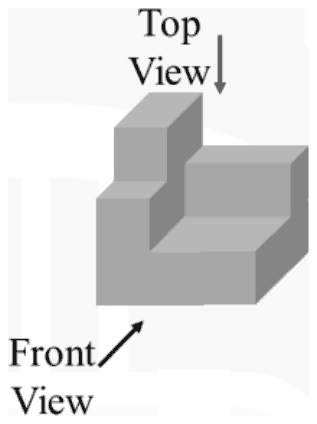
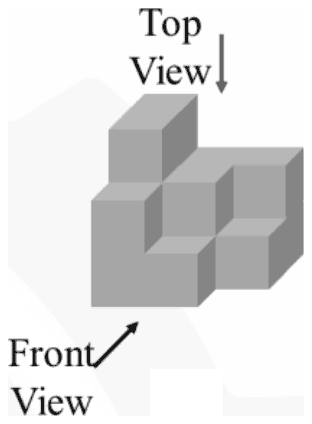
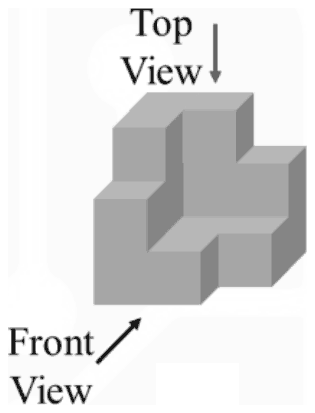
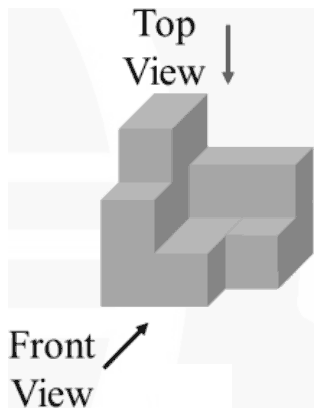
In Panel I of the figure below, the front view and top view of a structure are shown. Which one of the 3D structures shown in Panel II possesses the views shown in Panel I?

Panel I: the front view above and the top view below of a structure made of grey blocks

Exam Year(s)

GATE CS - 2026,

Answer: D

The key gives (iv). I could check (iv) against the two views and exclude (iii); I could not exclude (i) and (ii) as firmly from the drawings alone.

Reading Panel I: the front view has three columns whose tallest heights are 3, 2 and 2 units, with only the left column reaching the top. The top view is a 3 by 3 footprint with the front-right corner missing, and the left column is split into a long back piece and a small front piece.

Structure (iv) fits this: it has one tall cube at the back left, a two-high column in front of it, a two-wide step behind at height 2, and a lower cube at the right that is set back from the front, which leaves the front-right corner empty. Structure (iii) has a second tall column near the middle, which would show a height of 3 in the middle column of the front view, and the views do not allow that.

This is a figure question, so the explanation is from the drawings only; no published solution was found to confirm the key independently.

Please log in or register to report this question.

9.

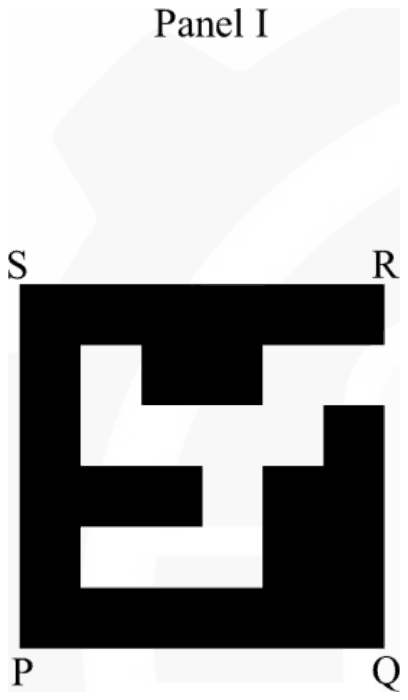
A black square PQRS has been cut into two parts. One part of it is shown in Panel I. Which one of the shapes in Panel II is the other part?

A black square PQRS drawn on a grid with a white region cut out of it

Exam Year(s)

GATE CS - 2026,

Answer: C

The other part is shape (iii).

Read Panel I as a 6 by 6 grid of unit squares, columns numbered 1 to 6 from the left. The white region, which the missing part must fill exactly, lies in rows 2 to 5:

  • row 2: column 2, and columns 5 and 6 against the right edge;
  • row 3: columns 2 to 5, a bar of four;
  • row 4: column 4 alone, a one-square neck;
  • row 5: columns 2 to 4, a bar of three.

Shape (iii) has exactly this outline: a single square and a two-square block on top, a bar of four, a one-square neck under its third square, and a bar of three at the bottom ending under the neck. It fits without rotation.

Shape (i) has a bottom bar of four squares, one too many. Shape (ii) has its bottom bar shifted one square to the right. Shape (iv) has a neck two squares wide and a bottom bar of two, so neither matches the cut-out.

Please log in or register to report this question.

10.

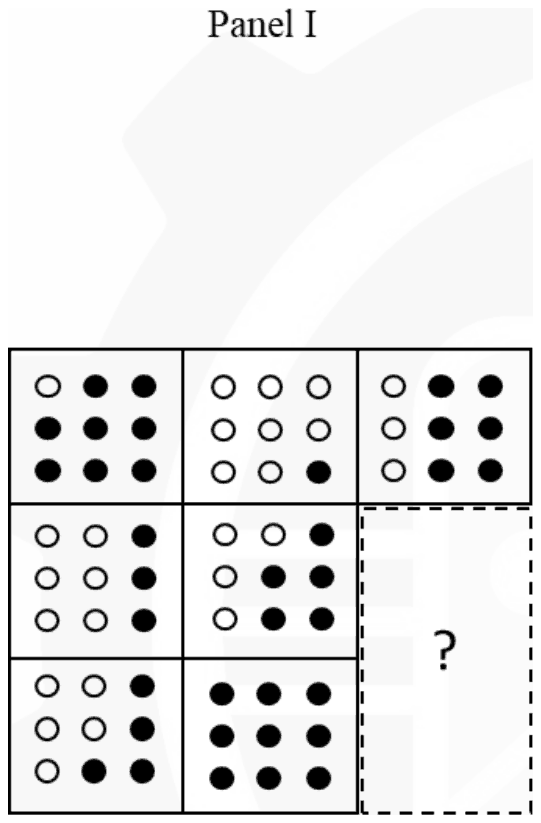
Two tiles are missing in Panel I. Which one of the options in Panel II is the appropriate choice for the missing tiles?

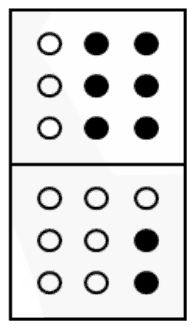
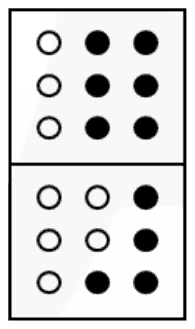
A 3 by 3 arrangement of tiles, each a 3 by 3 pattern of filled and empty dots, with the two right-hand tiles of the lower rows missing

Exam Year(s)

GATE CS - 2026,

Answer: A

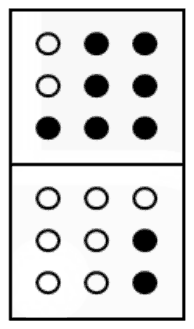
The missing tiles are option (i).

Count the filled dots in each tile of Panel I. The grid reads:

816
35?
49?

The first row sums to 15, and so do the first two columns (8 + 3 + 4 and 1 + 5 + 9). This is the 3 by 3 magic square, every row and column totalling 15. So the missing tiles must have 15 - 8 = 7 filled dots (middle row) and 15 - 13 = 2 (bottom row), which also makes the last column 6 + 7 + 2 = 15.

Option (i) has 7 filled dots above and 2 below. Option (ii) has 6 and 2, option (iii) 7 and 3, and option (iv) 6 and 4, so none of them completes the square.

Please log in or register to report this question.

Loading…