Machine-translated by Google. Questions are authored in English.
Top

Static Longitudinal Stability Questions and Answers

101.

Regarding the horizontal tail of a conventional airplane, which one of the following statements is true?

Exam Year(s)

GATE AE - 2022,

Answer: A

The horizontal tail contributes to \(C_{m_{\alpha}} \lt 0\).

Static longitudinal stability requires the pitching moment coefficient to fall as angle of attack rises (\(C_{m_{\alpha}} \lt 0\)), so that a nose-up disturbance produces a nose-down restoring moment. A tail behind the centre of gravity gains lift when the angle of attack increases, and because it acts on a long moment arm aft of the c.g., that lift produces a nose-down moment. This is the main stabilising contribution in a conventional airplane.

The tail does not make \(C_{m_{\alpha}}\) zero (neutral stability) or positive (unstable); those would describe an aircraft without adequate tail volume. The tail is usually set to give a positive \(C_{m0}\) for trim, but paired with a positive \(C_{m_{\alpha}}\) that option describes an unstable airplane.

Please log in or register to report this question.
102.

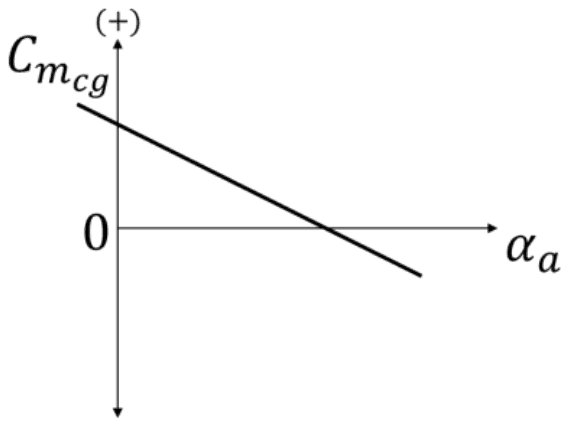
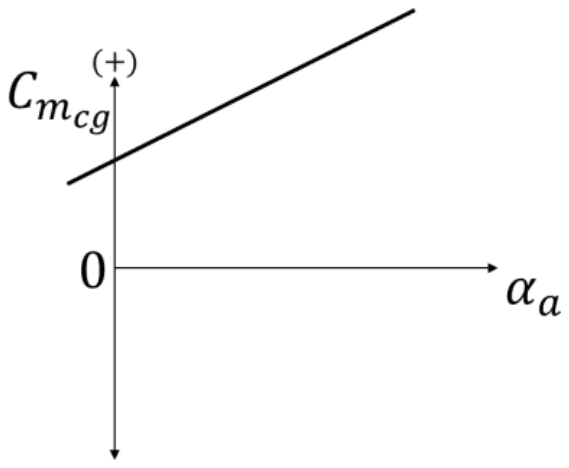
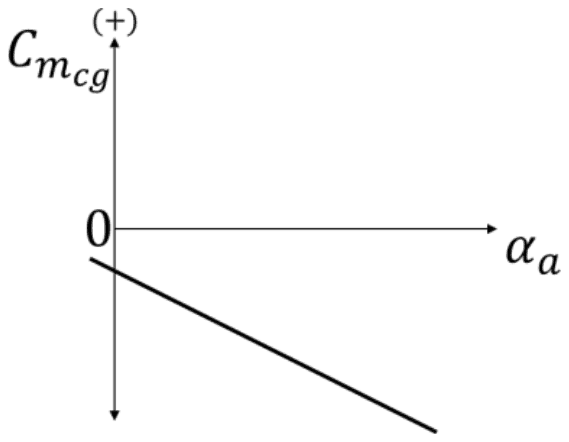
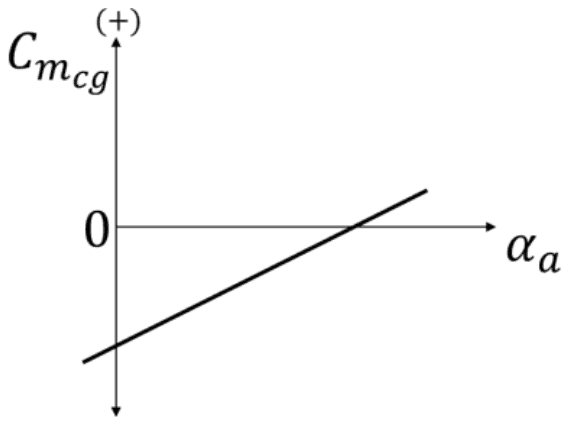
For a longitudinally statically stable aircraft, which one of the following represents the relationship between the coefficient of pitching moment about the center of gravity \(C_{m_{cg}}\) and absolute angle of attack \(\alpha_{a}\)?

(Note: nose-up moment is positive.)

Exam Year(s)

GATE AE - 2023,

Answer: D

The stable relationship is graph (D): positive \(C_{m_{cg}}\) at zero lift and a negative slope.

Static longitudinal stability needs \(dC_{m_{cg}}/d\alpha_{a} \lt 0\): if a gust raises the angle of attack, the aircraft must develop a nose-down (negative) moment that returns it. Trim also has to be possible at a positive angle of attack, where the wing gives positive lift, so \(C_{m_{cg}}\) must pass through zero at some positive \(\alpha_{a}\). With a negative slope, that means the line starts from a positive value \(C_{m_{0}}\) at \(\alpha_{a} = 0\), which is graph (D).

Graphs (A) and (C) have a positive slope and are statically unstable. Graph (B) has the right negative slope but a negative \(C_{m_{0}}\), so it only reaches zero moment at a negative angle of attack, where lift is negative: the aircraft would be stable but could not be trimmed in normal flight.

Please log in or register to report this question.
Answer: B

The condition is that the center of gravity should be forward of the neutral point.

The neutral point is the centre of gravity position at which the airplane is neutrally stable in pitch, where \(\partial C_{m}/\partial \alpha = 0\). With the CG ahead of it, an increase in angle of attack produces a nose-down restoring moment, so \(\partial C_{m}/\partial \alpha \lt 0\) and the static margin, the distance from CG to neutral point as a fraction of mean chord, is positive.

The other three options each describe instability: CG aft of the neutral point, a positive \(\partial C_{m}/\partial \alpha\) and a negative static margin are three ways of saying the same unstable condition.

Please log in or register to report this question.
Loading…
Tags: Static Longitudinal Stability Questions and Answers || Static Longitudinal Stability MCQ Questions and Answers || Static Longitudinal Stability GK Questions and Answers || Static Longitudinal Stability GK MCQ Questions || Static Longitudinal Stability Multiple Choice Questions and Answers || Static Longitudinal Stability GK || GK on Static Longitudinal Stability || Aircraft Stability and Control Questions and Answers || Aircraft Stability and Control MCQ Questions and Answers || Aircraft Stability and Control GK Questions and Answers || GK on Aircraft Stability and Control