
Machine-translated by Google. Questions are authored in English.
Top

Two Port Networks Questions and Answers

1.

A two-port network, with reference to z-parameters, is said to be reciprocal if which of the following conditions is satisfied?

Exam Year(s)

DSSSB AE - 2023,

Answer: C

For a two-port network described by impedance (z) parameters, the voltage equations are \(V_1 = Z_{11}I_1 + Z_{12}I_2\) and \(V_2 = Z_{21}I_1 + Z_{22}I_2\). A network is reciprocal when the transfer impedances are equal, \(Z_{12} = Z_{21}\); for a passive network of resistors, capacitors and inductors this is always true.


The condition \(Z_{11} = Z_{22}\) is the condition for a symmetrical network, not for reciprocity. The conditions \(Z_{12} = Z_{22}\) and \(Z_{11} = Z_{21}\) are not general conditions on any network. The answer is option C.

Please log in or register to report this question.
2.

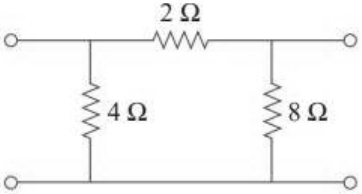
Find the y-parameter (\(y_{22}\)) for the given two-port network.

Two-port network: a 2 ohm resistor in the series arm between the top terminals, a 4 ohm resistor shunt at the input side and an 8 ohm resistor shunt at the output side

Exam Year(s)

DSSSB AE - 2023,

Answer: B

The y-parameter \(y_{22}\) is the output short circuit admittance, found by shorting the input terminals and applying a source at the output.


\[ y_{22} = \frac{I_2}{V_2}\bigg|_{V_1 = 0} \]


With the input shorted, the 4 ohm resistor is shorted out and does not carry current. The 2 ohm series resistor goes from the output terminal to the shorted input, so it is in parallel with the 8 ohm shunt resistor.


\[ \begin{aligned} y_{22} = \frac{1}{2} + \frac{1}{8} = 0.5 + 0.125 \\ &= 0.625\ \text{S} \end{aligned} \]


The value 0.5 S leaves out the 8 ohm branch and 0.75 S wrongly includes the 4 ohm resistor. The answer is option B.

Please log in or register to report this question.
3.

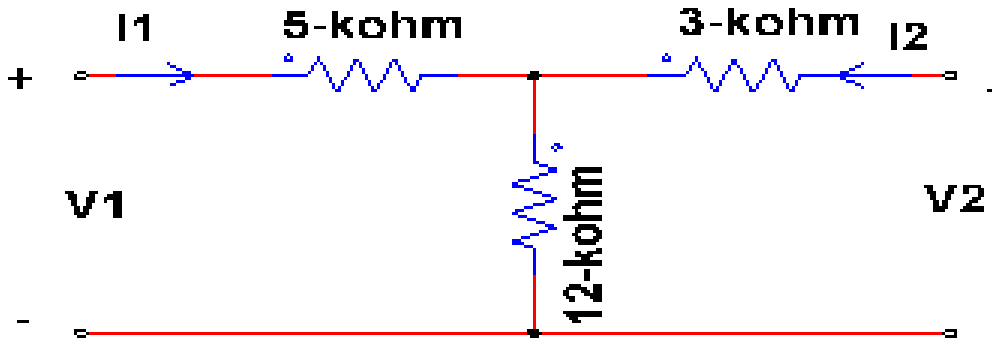
Determine the value of \(Z_{11}\) parameter of the given two port network.

Two-port network: a 5 kilohm resistor in series with port 1, a 12 kilohm resistor shunt across the middle, and a 3 kilohm resistor in series with port 2, with V1, I1 at the input and V2, I2 at the output

Exam Year(s)

DSSSB AE - 2023,

Answer: B

The z-parameter \(Z_{11} = V_1 / I_1\) with the output port open circuited (\(I_2 = 0\)).


With port 2 open, no current flows in the 3 kilohm resistor, so the input sees the 5 kilohm resistor in series with the 12 kilohm shunt resistor.


\[ Z_{11} = 5 + 12 = 17\ \text{k}\Omega \]


The 3 kilohm resistor does not enter because it carries no current. The value 15 kilohm adds the 12 and 3 and leaves out the 5, 16 kilohm and 12 kilohm do not match any combination of the series arms with the shunt. The answer is 17 kilohm, option B.

Please log in or register to report this question.

4.

If a two port network is passive, then we have, with the usual notation, the following relationship :

Exam Year(s)

RSMSSB JE - 2025, RSMSSB - 2025,

Answer: A

For a passive network, \(h_{12} = -h_{21}\).

A passive, linear, bilateral network is reciprocal. In terms of the other parameter sets reciprocity means \(z_{12} = z_{21}\), \(y_{12} = y_{21}\) and \(AD - BC = 1\). Converting the z-condition into hybrid parameters gives \(h_{12} = -h_{21}\), with a minus sign because \(h_{12}\) is a voltage ratio and \(h_{21}\) a current ratio defined in opposite senses.

\(h_{12} = h_{21}\) misses the sign. \(h_{11}h_{22} - h_{12}h_{21} = 1\) is the condition for a symmetrical network, not a reciprocal one, and \(h_{11} = h_{22}\) equates an impedance with an admittance.

Please log in or register to report this question.

5.

The driving point impedance Z(s) of a network has the pole-zero locations as shown in the following figure. If Z(o) = 3, then Z(s) is :

Pole-zero plot in the s-plane with crosses at -1 + j1 and -1 - j1 and a small mark above the point -3 on the real axis

Exam Year(s)

MH SET - 2018, SET Exam - 2018,

Answer: B

The impedance is \(Z(s) = \dfrac{2(s+3)}{s^{2}+2s+2}\).

The figure shows poles (crosses) at \(s = -1 \pm j1\), and the mark at \(-3\) on the real axis is the zero. So

\[ \begin{aligned} Z(s) &= \frac{K(s + 3)}{(s + 1 - j)(s + 1 + j)} \\ &= \frac{K(s + 3)}{s^{2} + 2s + 2} \end{aligned} \]

Setting \(s = 0\): \(Z(0) = 3K/2 = 3\), so \(K = 2\).

The denominator \(s^{2} + 2s + 3\) would put the poles at \(-1 \pm j\sqrt{2}\), not \(\pm j1\). The options with \(s - 3\) and \(s^{2} - 2s - \ldots\) place the zero and poles in the right half-plane, which is not what the plot shows.

Please log in or register to report this question.
6.

A two port network is a rectangular box that represents a network consisting of :

Exam Year(s)

MH SET - 2019, SET Exam - 2019,

Answer: B

A two port network consists of two pairs of terminals.

A port is a pair of terminals at which current enters at one terminal and leaves at the other. A two port network, drawn as a box, has an input port and an output port, that is, two pairs of terminals, and it is described by the relations between the voltages and currents at them through z, y, h or ABCD parameters.

'Two pairs of ports' would be four ports, an n-pairs description is a general n-port network, and two terminals make only a single port (a one-port network).

Please log in or register to report this question.

7.

Image impedances of port 1 and port 2 of symmetrical two-port network is :

Exam Year(s)

MH SET - 2020, SET Exam - 2020,

Answer: C

For a symmetrical two-port network the image impedances are equal.

The image impedances ZI1 and ZI2 are the pair of impedances such that terminating each port in its own image impedance makes the impedance seen at the other port equal to its image impedance. They are given by \(Z_{I1} = \sqrt{Z_{oc1}Z_{sc1}}\) and \(Z_{I2} = \sqrt{Z_{oc2}Z_{sc2}}\).

In a symmetrical network the two ports look the same from either side, so the open- and short-circuit impedances at port 1 equal those at port 2, and the two image impedances are equal; the common value is the characteristic impedance. They are not zero or infinite in general, and 'not equal' describes an asymmetrical network.

Please log in or register to report this question.

8.

For a reciprocal or bilateral two port network, which of the following is correct for the shown circuit ?

A T network. A 1 ohm series arm from terminal 1 and a 2 ohm series arm to terminal 2 meet at a node, joined by a 3 ohm shunt arm to the common line from terminal 1 prime to terminal 2 prime

Exam Year(s)

MH SET - 2023, SET Exam - 2023,

Answer: B

For a reciprocal network, \(Z_{12} = Z_{21}\).

A network built only of linear passive bilateral elements, such as this T of resistors, obeys the reciprocity theorem: the voltage at port 2 per unit current at port 1 equals the voltage at port 1 per unit current at port 2. For the T network the shared shunt arm gives both transfer impedances directly:

\[ Z_{12} = Z_{21} = 3\ \Omega \]

The other conditions do not hold here: \(Z_{11} = 1 + 3 = 4\ \Omega\) and \(Z_{22} = 2 + 3 = 5\ \Omega\), so the network is not symmetrical, and \(Z_{11} = Z_{12}\) or \(Z_{12} = Z_{22}\) are not conditions of reciprocity.

Please log in or register to report this question.

9.

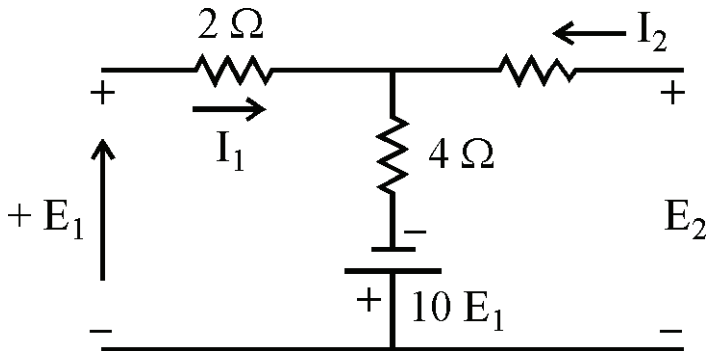
In the given network, \(Z_{11}\) is equal to

Two-port network: 2 ohm series resistor at the input, shunt branch of a 4 ohm resistor in series with a dependent source 10 E1 (plus at the bottom), and a series resistor at the output; E1, I1 at the input and E2, I2 at the output

Exam Year(s)

UGC NET - 2012,

Answer: B

The input impedance with the output open (\(I_2 = 0\)) is \(Z_{11} = E_1/I_1\), which is \(\frac{6}{11}\) ohm (option B). With the output open, the loop holds the 2 ohm and 4 ohm resistors and the dependent source, whose plus terminal is at the bottom.

\[ E_1 - 2I_1 - 4I_1 + 10E_1 = 0 \]

\[ 11E_1 = 6I_1 \]

\[ Z_{11} = \frac{6}{11}\ \Omega \]

The value \(-\frac{6}{11}\) (A) comes from taking the source with the opposite polarity, which would give \(1 - 10 = -9\) in the denominator, not 11. The other two values do not follow from the loop.

Please log in or register to report this question.

10.

If \(Z_{11} = 2\,\Omega\), \(Z_{12} = 1\,\Omega\), \(Z_{21} = 1\,\Omega\), \(Z_{22} = 3\,\Omega\). What is the determinant of admittance matrix ?

Exam Year(s)

UGC NET - 2012,

Answer: D

The determinant of the admittance matrix is 1/5, because the admittance matrix is the inverse of the impedance matrix and the determinant of an inverse is the reciprocal of the determinant. Here the impedance matrix is


\[ Z = \begin{bmatrix} 2 & 1 \\ 1 & 3 \end{bmatrix} \]
\[ \Delta_Z = (2)(3) - (1)(1) = 5 \]
\[ Y = Z^{-1} \]
\[ \Delta_Y = \frac{1}{\Delta_Z} = \frac{1}{5} \]

The value 5 is the determinant of the impedance matrix and not of the admittance matrix, which is the likely slip. The values 0 and 1 do not arise from these figures, since 0 would mean the matrix cannot be inverted. The answer is 1/5.

Please log in or register to report this question.

Loading…
Tags: Two Port Networks Questions and Answers || Two Port Networks MCQ Questions and Answers || Two Port Networks GK Questions and Answers || Two Port Networks GK MCQ Questions || Two Port Networks Multiple Choice Questions and Answers || Two Port Networks GK || GK on Two Port Networks || Network Analysis Questions and Answers || Network Analysis MCQ Questions and Answers || Network Analysis GK Questions and Answers || GK on Network Analysis