
Machine-translated by Google. Questions are authored in English.
Top

Radiation Exchange Between Surfaces Questions and Answers

1.

Two small parallel plane square surfaces, each measuring 4 mm × 4 mm are placed 0.5 m apart (centre to centre) with 30° angle between the radial distance and both the surface normals. The view factor between the two surfaces is

Exam Year(s)

GATE AG - 2012,

Answer: A

The view factor is \(1.53 \times 10^{-5}\).

For two small surfaces far apart compared with their size, the view factor reduces to the differential-area form:

\[ \begin{aligned} F_{12} &= \frac{A_{2}\cos\theta_{1}\cos\theta_{2}}{\pi r^{2}} \\ &= \frac{(16 \times 10^{-6})(0.866)(0.866)}{\pi (0.5)^{2}} \\ &= \frac{1.2 \times 10^{-5}}{0.7854} \\ &= 1.53 \times 10^{-5} \end{aligned} \]

Leaving out the cosines gives \(2.04 \times 10^{-5}\), and keeping only one cosine factor gives the distractor \(1.76 \times 10^{-5}\). The values of order \(10^{-3}\) are far too large for two 4 mm squares half a metre apart, which can intercept only a tiny fraction of each other's radiation.

Please log in or register to report this question.
2.

View factor of a large cylinder of 10 cm in radius and 60 cm in length from a coaxial smaller cylinder of 5 cm radius and the same length is 0.34. View factor of the larger cylinder of itself (concave inner surface) is 0.25. The view factor of the larger cylinder with respect to either annular end is

Exam Year(s)

GATE AG - 2016,

Answer: B

The view factor from the large cylinder to either annular end is 0.29.

Call the small cylinder 1 and the large cylinder's inner surface 2. The given 0.34 is \(F_{12}\), from the small cylinder to the large one. Reciprocity converts it, using the area ratio \(A_{1}/A_{2} = r_{1}/r_{2} = 5/10\) for equal lengths:

\[ \begin{aligned} F_{21} &= \frac{A_{1}}{A_{2}}F_{12} = 0.5 \times 0.34 = 0.17 \\ F_{21} + F_{22} + 2F_{2,\text{end}} &= 1 \\ 2F_{2,\text{end}} &= 1 - 0.17 - 0.25 = 0.58 \\ F_{2,\text{end}} &= 0.29 \end{aligned} \]

The summation rule over the enclosure, with two identical annular ends, gives the answer. 0.17 is \(F_{21}\) itself, and using 0.34 directly without reciprocity gives \((1 - 0.34 - 0.25)/2 \approx 0.21\), not offered. 0.33 and 0.42 match no consistent working.

Please log in or register to report this question.

3.

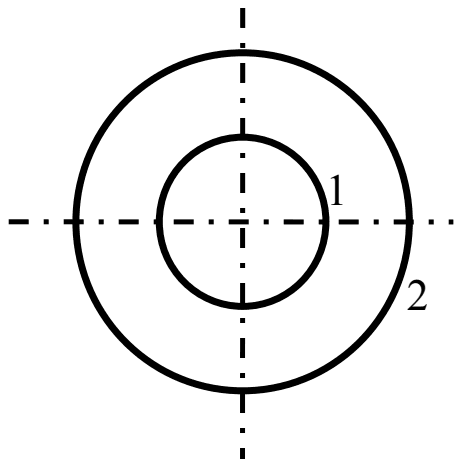
Consider two infinitely long thin concentric tubes of circular cross section as shown in the figure. If D1 and D2 are the diameters of the inner and outer tubes respectively, then the view factor F22 is given by

Cross section of two concentric circles: the inner tube labelled 1 and the outer tube labelled 2

Exam Year(s)

GATE ME - 2012,

Answer: D

The view factor is \(F_{22} = 1-\frac{D_{1}}{D_{2}}\).

The inner tube is convex, so it cannot see itself, \(F_{11}=0\), and everything it emits reaches the outer tube, \(F_{12}=1\). Reciprocity, per unit length, gives:

\[ \begin{aligned} A_{1}F_{12} &= A_{2}F_{21} \\ F_{21} &= \frac{\pi D_{1}}{\pi D_{2}} = \frac{D_{1}}{D_{2}} \end{aligned} \]

The summation rule for surface 2 then gives \(F_{22} = 1 - F_{21} = 1 - D_{1}/D_{2}\).

\(D_{1}/D_{2}\) is F21, not F22. Zero would be true only for a convex surface, but the inside of the outer tube is concave and sees part of itself. \(D_{2}/D_{1}-1\) is greater than 1 for a large outer tube, which no view factor can be.

Please log in or register to report this question.

4.

A cylindrical rod of length \(h\) and diameter \(d\) is placed inside a cubic enclosure of side length \(L\). \(S\) denotes the inner surface of the cube. The view-factor \(F_{S-S}\) is

Exam Year(s)

GATE ME - 2023,

Answer: D

The view factor is \(1 - \dfrac{(\pi dh + \pi d^{2}/2)}{6L^{2}}\).

Call the rod's whole surface r. Its area is the curved surface plus two end discs, and the cube's inner area is six faces:

\[ \begin{aligned} A_{r} &= \pi dh + 2 \times \frac{\pi d^{2}}{4} \\ &= \pi dh + \frac{\pi d^{2}}{2} \\ A_{S} &= 6L^{2} \end{aligned} \]

The rod is convex and fully enclosed, so everything leaving it reaches the cube: \(F_{r-S} = 1\). Reciprocity gives \(A_{S}F_{S-r} = A_{r}F_{r-S}\), so \(F_{S-r} = A_{r}/(6L^{2})\). By the summation rule, \(F_{S-S} + F_{S-r} = 1\), so

\[ F_{S-S} = 1 - \frac{\pi dh + \pi d^{2}/2}{6L^{2}} \]

0 would hold for a flat or convex surface, but the inside of a cube sees itself. 1 would be correct only with no rod inside. \(\dfrac{(\pi dh + \pi d^{2}/2)}{6L^{2}}\) is \(F_{S-r}\), the fraction that reaches the rod, not the fraction that returns to the cube.

Please log in or register to report this question.

5.

Calculate the shape factor for the sphere diameter 'd' inside a cubical box length, l =d

Exam Year(s)

RSMSSB JE - 2025, RSMSSB - 2025,

Answer: A

The answer is \(\pi/6\).

All radiation leaving the sphere (surface 1) reaches the box (surface 2), so \(F_{12} = 1\). The non-trivial shape factor is the one from the box to the sphere, found by reciprocity, \(A_{1}F_{12} = A_{2}F_{21}\):

\[ \begin{aligned} F_{21} &= \frac{A_{1}}{A_{2}} = \frac{\pi d^{2}}{6 l^{2}} \\ &= \frac{\pi}{6}\quad (l = d) \end{aligned} \]

Since \(F_{12} = 1\) is not offered, the key reads the question as asking for this factor. \(\pi/3\) would follow from taking only three faces of the cube, and \(4\pi/3\) and \(3\pi/2\) exceed one, which no shape factor can.

Please log in or register to report this question.

6.

Consider two infinitely long thin concentric tubes of circular cross section as shown in figre. If D1 and D2 are the diameters of the inner and outer tubes respectively, then the view factor F22 is given by:

Cross section of two concentric circles with dashed centre lines; the inner circle is marked 1 and the outer circle is marked 2

Exam Year(s)

RSMSSB JE - 2025, RSMSSB - 2025,

Answer: D

The view factor is \(F_{22} = 1 - \left(\frac{D_{1}}{D_{2}}\right)\).

All radiation leaving the inner tube reaches the outer tube, so \(F_{12} = 1\). By reciprocity, \(A_{2}F_{21} = A_{1}F_{12}\), and per unit length the areas are in the ratio of the diameters, so \(F_{21} = D_{1}/D_{2}\). Since the outer tube's inside surface is concave, it also sees itself, and the factors from surface 2 must add up to one:

\[ F_{22} = 1 - F_{21} = 1 - \frac{D_{1}}{D_{2}} \]

\(D_{1}/D_{2}\) alone is \(F_{21}\), not \(F_{22}\). Zero would be right only for a flat or convex surface, and \(D_{2}/D_{1} - 1\) can exceed one.

Please log in or register to report this question.

Loading…
Tags: Radiation Exchange Between Surfaces Questions and Answers || Radiation Exchange Between Surfaces MCQ Questions and Answers || Radiation Exchange Between Surfaces GK Questions and Answers || Radiation Exchange Between Surfaces GK MCQ Questions || Radiation Exchange Between Surfaces Multiple Choice Questions and Answers || Radiation Exchange Between Surfaces GK || GK on Radiation Exchange Between Surfaces || Heat Transfer Questions and Answers || Heat Transfer MCQ Questions and Answers || Heat Transfer GK Questions and Answers || GK on Heat Transfer