
Machine-translated by Google. Questions are authored in English.
Top

Band Theory of Solids Questions and Answers

1.

The energy dispersion for electrons in one dimensional lattice with lattice parameter \(a\) is given by \(E(k) = E_{0} - \frac{1}{2}W\cos ka\), where \(W\) and \(E_{0}\) are constants. The effective mass of the electron near the bottom of the band is

Exam Year(s)

GATE Physics - 2018,

Answer: A

The effective mass at the band bottom is \(\frac{2\hbar^{2}}{Wa^{2}}\).

The effective mass is set by the curvature of the band: \(m^{*} = \hbar^{2}/(d^{2}E/dk^{2})\). The band bottom is at \(k = 0\), where \(E = E_{0} - W/2\) is least.

\[ \begin{aligned} \frac{d^{2}E}{dk^{2}} &= \tfrac{1}{2}Wa^{2}\cos ka \to \tfrac{1}{2}Wa^{2} \\ m^{*} &= \frac{\hbar^{2}}{\tfrac{1}{2}Wa^{2}} = \frac{2\hbar^{2}}{Wa^{2}} \end{aligned} \]

Equivalently, near \(k = 0\), \(\cos ka \approx 1 - k^{2}a^{2}/2\), so \(E \approx E_{0} - W/2 + Wa^{2}k^{2}/4\), and matching to \(\hbar^{2}k^{2}/2m^{*}\) gives the same result. \(\hbar^{2}/Wa^{2}\) drops the factor \(\tfrac{1}{2}\) in the dispersion, and the smaller options misplace it further.

Please log in or register to report this question.
2.

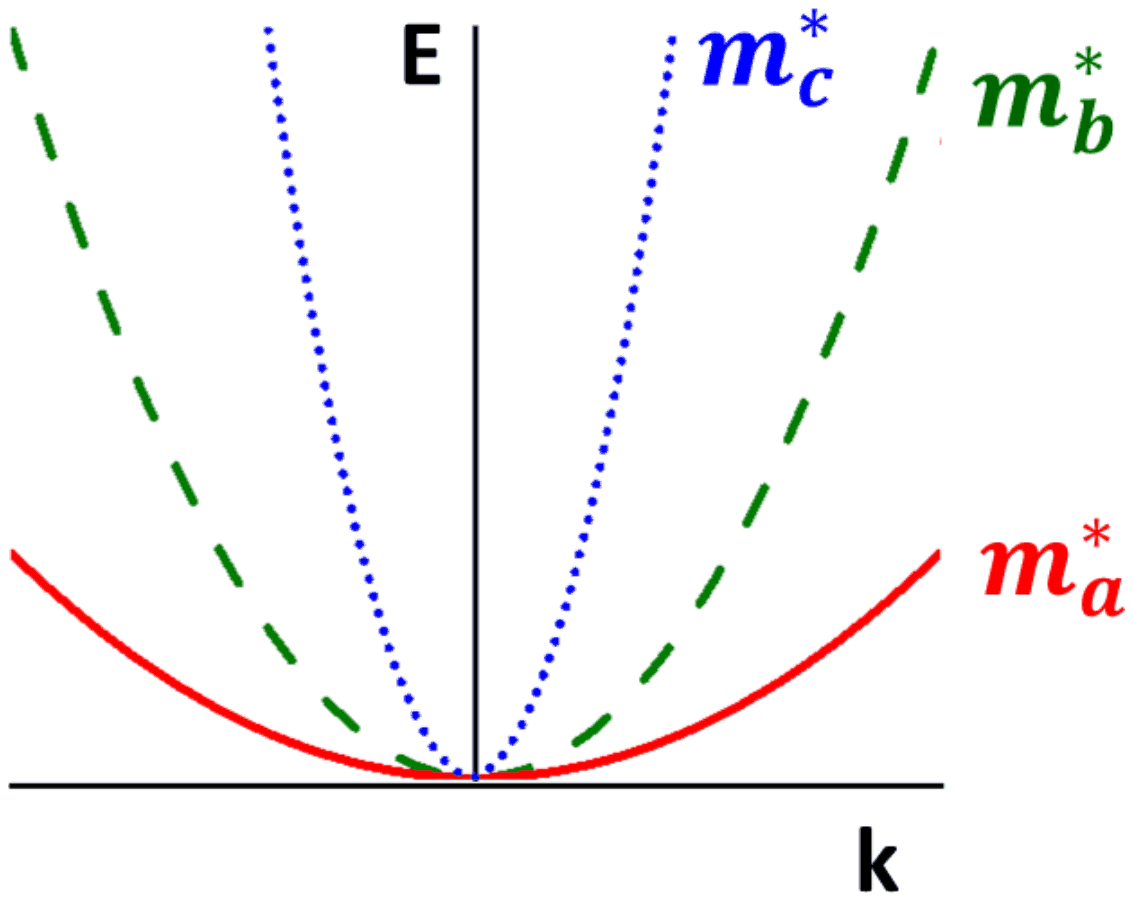
For nonrelativistic electrons in a solid, different energy dispersion relations (with effective masses \(m_{a}^{*}\), \(m_{b}^{*}\), and \(m_{c}^{*}\)) are schematically shown in the plots. Which one of the following options is CORRECT?

Three parabolas E against k with minimum at k = 0: the dotted mc curve is the narrowest, the dashed mb curve is wider, and the solid ma curve is the widest

Exam Year(s)

GATE Physics - 2023,

Answer: D

The correct order is \(m_{a}^{*} \gt m_{b}^{*} \gt m_{c}^{*}\).

For free-electron-like bands,

\[ \begin{aligned} E &= \frac{\hbar^{2}k^{2}}{2m^{*}} \\ \frac{1}{m^{*}} &= \frac{1}{\hbar^{2}}\frac{d^{2}E}{dk^{2}} \end{aligned} \]

so the effective mass is inversely proportional to the curvature of \(E(k)\). The \(m_{c}^{*}\) band is the narrowest, most sharply curved parabola, so its effective mass is the smallest; the \(m_{a}^{*}\) band is the flattest, so its mass is the largest; \(m_{b}^{*}\) lies between.

Equal masses would need identical parabolas, and the other two orders put a sharply curved band above a flatter one, which reverses the relation.

Please log in or register to report this question.

3.

In an allowed band of semiconductor the effective mass m* of the electron is infinite :

Exam Year(s)

MH SET - 2018, SET Exam - 2018,

Answer: C

The effective mass is infinite in the middle of the energy band.

The effective mass is set by the curvature of the band, \( \frac{1}{m^{*}} = \frac{1}{\hbar^{2}}\frac{d^{2}E}{dk^{2}} \). Near the bottom of a band \( E(k) \) curves upward and \( m^{*} \) is positive; near the top it curves downward and \( m^{*} \) is negative. In between there is an inflection point where the curvature is zero, so \( m^{*} \) becomes infinite: an applied force there produces no acceleration.

So it is finite (positive) at the bottom, finite (negative) at the top, and 'never' is wrong because every band has such an inflection point.

Please log in or register to report this question.

4.

The dispersion relation for a simple cubic crystal is given by :

\[ \begin{aligned} E(\vec{k}) = &E_{0} - 2\beta(\cos k_{x}a \\ &+ \cos k_{y}a + \cos k_{z}a), \end{aligned} \]

where β is constant having dimension of energy and α is lattice constant. The width of the energy band is :

Exam Year(s)

MH SET - 2023, SET Exam - 2023,

Answer: D

The band width is 12β.

Each cosine ranges from -1 to +1, so their sum ranges from -3 to +3:

\[ \begin{aligned} E_{min} &= E_{0} - 2\beta(3) = E_{0} - 6\beta \quad (\vec{k} = 0) \\ E_{max} &= E_{0} + 6\beta \quad (k_{x}, k_{y}, k_{z} = \pm\pi/a) \\ \Delta E &= 12\beta \end{aligned} \]

(The paper names the lattice constant α in the text but writes a in the formula.) This is the tight-binding band of a simple cubic lattice, whose width is 2zβ with z = 6 nearest neighbours. 4β is the width of a one-dimensional chain, 8β that of a square lattice, and 2β is a single hopping energy.

Please log in or register to report this question.

Answer: A

The correct statement is that the slope of E versus k is proportional to the group velocity.

The velocity of an electron wave packet in a band is the group velocity

\[ v_{g} = \frac{1}{\hbar}\frac{dE}{dk} \]

so the slope of the E-k curve is \(\hbar v_{g}\).

At the zone boundary \(|k| = \pi/a\) Bragg reflection produces standing waves and the slope is zero, not maximum. The curve is parabolic only near the band edges, where the effective mass approximation holds, not across the whole zone. The slope is also zero at k = 0, so it is not non-zero everywhere in the interval.

Please log in or register to report this question.

Answer: C

With no barrier, there are no forbidden energy regions.

In the Kronig-Penney model, the band gaps come from Bragg reflection by the periodic potential barriers. If the barrier strength is zero, the electron is free: \(E = \frac{\hbar^{2}k^{2}}{2m}\), a continuous parabola, and every energy is allowed.

So there is no periodic dependence of energy on \(k\) (beyond the trivial zone folding), energy is a continuous function of \(k\), and all energies are allowed, which rules out the other three statements.

Please log in or register to report this question.

Loading…
Tags: Band Theory of Solids Questions and Answers || Band Theory of Solids MCQ Questions and Answers || Band Theory of Solids GK Questions and Answers || Band Theory of Solids GK MCQ Questions || Band Theory of Solids Multiple Choice Questions and Answers || Band Theory of Solids GK || GK on Band Theory of Solids || Solid State Physics Questions and Answers || Solid State Physics MCQ Questions and Answers || Solid State Physics GK Questions and Answers || GK on Solid State Physics