
Machine-translated by Google. Questions are authored in English.
Top

Thermal Properties of Solids Questions and Answers

1.

At low temperatures (\(T\)), the specific heat of common metals is described by (with \(\alpha\) and \(\beta\) as constants)

Exam Year(s)

GATE Physics - 2018,

Answer: A

The low-temperature specific heat of a metal is \(\alpha T + \beta T^{3}\).

Two contributions add. The conduction electrons give a term linear in \(T\), because only the electrons within about \(k_{B}T\) of the Fermi level can be excited. The lattice vibrations give the Debye \(T^{3}\) law at temperatures well below the Debye temperature. At the lowest temperatures the linear electronic term dominates, and a plot of \(C/T\) against \(T^{2}\) is a straight line.

\(\beta T^{3}\) alone describes an insulator, with no free electrons. \(\exp(-\alpha/T)\) is the behaviour of a system with an energy gap, such as the Einstein model or a superconductor. There is no \(T^{5}\) term in the specific heat; a \(T^{5}\) law belongs to the electron-phonon resistivity.

Please log in or register to report this question.
2.

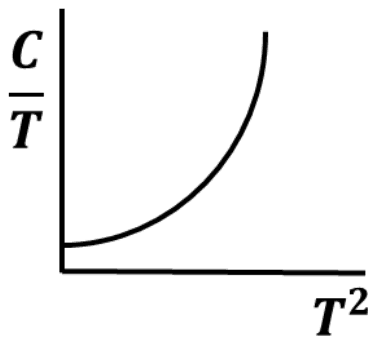
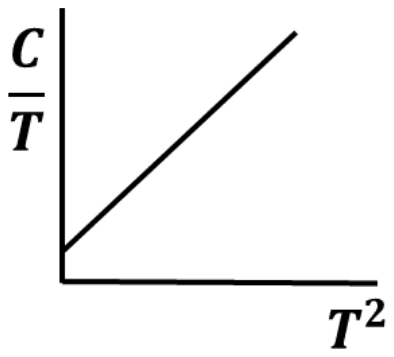
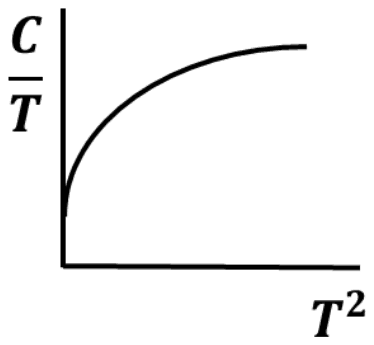
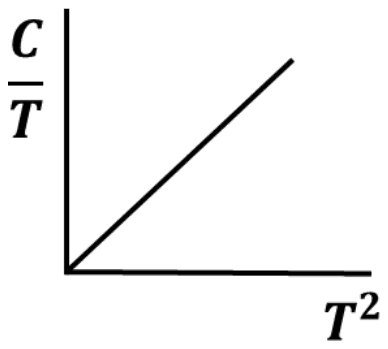
For a non-magnetic metal, which one of the following graphs best represents the behaviour of \(\frac{C}{T}\) vs. \(T^{2}\), where \(C\) is the heat capacity and \(T\) is the temperature?

Exam Year(s)

GATE Physics - 2023,

Answer: B

The plot is a straight line with a positive intercept, graph (B).

At low temperature the heat capacity of a non-magnetic metal is the sum of an electronic term, linear in \(T\), and the Debye phonon term, proportional to \(T^{3}\):

\[ \begin{aligned} C &= \gamma T + \beta T^{3} \\ \frac{C}{T} &= \gamma + \beta T^{2} \end{aligned} \]

Against \(T^{2}\) this is a straight line of slope \(\beta\) (from the phonons) cutting the axis at \(\gamma\) (from the conduction electrons). This is how the two contributions are separated experimentally.

A line through the origin (D) would describe an insulator with no electronic term. The two curved graphs do not follow from either term.

Please log in or register to report this question.
3.

For a metal \(C_{V} = \alpha T + \beta T^{3}\) at low temperatures. The entropy is :

Exam Year(s)

MH SET - 2018, SET Exam - 2018,

Answer: C

The entropy is \(\alpha T + \frac{\beta T^{3}}{3}\).

At constant volume \(dS = C_{V}\,dT/T\). Integrating from absolute zero, where S = 0 by the third law:

\[ \begin{aligned} S &= \int_{0}^{T}\frac{\alpha T' + \beta T'^{3}}{T'}\,dT' \\ &= \int_{0}^{T}(\alpha + \beta T'^{2})\,dT' \\ &= \alpha T + \frac{\beta T^{3}}{3} \end{aligned} \]

The \(\alpha T\) term is the electronic contribution and the \(T^{3}\) term the Debye lattice contribution. The options \(\alpha + 3\beta T^{2}\) and \(\alpha T + 3\beta T^{2}\) differentiate instead of integrating, and \(\alpha + \beta T^{3}/3\) does not vanish at T = 0.

Please log in or register to report this question.
4.

The Debye temperature of diamond is 2230 K. The molar heat capacity of diamond at 10 K is :

(R = 8.314 Jmol\(^{-1}\)K\(^{-1}\))

Exam Year(s)

MH SET - 2019, SET Exam - 2019,

Answer: B

The molar heat capacity is 0.175 Jkmol\(^{-1}\)K\(^{-1}\).

At 10 K, far below the Debye temperature, the Debye \(T^{3}\) law applies:

\[ \begin{aligned} C &= \frac{12\pi^{4}}{5}R\left(\frac{T}{\theta_{D}}\right)^{3} \\ &= 1944 \times \left(\frac{10}{2230}\right)^{3} \\ &= 1944 \times 9.02 \times 10^{-8} = 1.75 \times 10^{-4} \end{aligned} \]

in J mol\(^{-1}\) K\(^{-1}\), which is 0.175 J per kilomole per kelvin, the unit used in the options. The tiny value shows how completely the vibrations of stiff diamond are frozen out at low temperature; the other options do not follow from the \(T^{3}\) law with these numbers.

Please log in or register to report this question.
5.

Atomic weight and density of gold are 197 and 1.9 × 10⁴ kg/m3 respectively. If the velocity of sound in it is 2100 m/s, the Debye temperature for gold will be :

Exam Year(s)

MH SET - 2020, SET Exam - 2020,

Answer: B

The Debye temperature is about 240 K.

First the number of atoms per unit volume, then the Debye wave number \(k_{D} = (6\pi^{2}n)^{1/3}\), and \(\theta_{D} = \hbar v k_{D}/k_{B}\):

\[ \begin{aligned} n &= \frac{1.9 \times 10^{4} \times 6.02 \times 10^{23}}{0.197} \\ &= 5.8 \times 10^{28}\ \text{m}^{-3} \\ k_{D} &= (6\pi^{2}n)^{1/3} = 1.51 \times 10^{10}\ \text{m}^{-1} \\ \frac{\hbar v}{k_{B}} &= \frac{1.055 \times 10^{-34}}{1.38 \times 10^{-23}} \times 2100 \\ &= 1.60 \times 10^{-8}\ \text{K m} \\ \theta_{D} &= 1.60 \times 10^{-8} \times 1.51 \times 10^{10} \\ &\approx 242\ \text{K} \end{aligned} \]

The atomic weight 197 must be converted to 0.197 kg/mol. The other values do not follow from this sound speed; the tabulated Debye temperature of gold, about 165 K, is lower because a single sound speed overestimates it.

Please log in or register to report this question.

6.

Heat capacity \(C_{v}\) of a metal is measured as a function of temperature T in the low temperature region. Assume that the measured \(C_{v}\) is due to both electronic and lattice contributions, then the plot of (\(C_{v}\)/T) versus T is :

Exam Year(s)

MH SET - 2023, SET Exam - 2023,

Answer: B

The plot of \(C_{v}/T\) against T is quadratic in T.

At low temperatures the electronic heat capacity of a metal is linear in T (Sommerfeld) and the lattice heat capacity follows the Debye \(T^{3}\) law:

\[ \begin{aligned} C_{v} &= \gamma T + AT^{3} \\ \frac{C_{v}}{T} &= \gamma + AT^{2} \end{aligned} \]

So \(C_{v}/T\) is a quadratic function of T, a straight line when plotted against \(T^{2}\), with intercept \(\gamma\) and slope A. This is the standard way of separating the two contributions experimentally.

'Linear in T' would hold only if one plotted against \(T^{2}\); 'cubic' is the lattice term in \(C_{v}\) itself, before dividing by T, and nothing in it is inversely proportional to T.

Please log in or register to report this question.

7.

The ratio of the number of vacancies in equilibrium at 300 K in aluminium to that produced by rapid quenching at 800 K is (given that the enthalpy of formation of vacancy in Al is 68 kJ/mole and R = 8.314 kmol-1/K)

Exam Year(s)

MH SET - 2024, SET Exam - 2024,

Answer: A

The ratio is about 3.75 × 10⁻⁸ (option A, the only one of the right order).

The equilibrium vacancy fraction is \(n/N = \exp(-H_{v}/RT)\). Quenching freezes in the 800 K concentration, so the ratio is:

\[ \begin{aligned} \frac{n_{300}}{n_{800}} &= \exp\left[-\frac{H_{v}}{R}\left(\frac{1}{300} - \frac{1}{800}\right)\right] \\ \frac{H_{v}}{R} &= \frac{68000}{8.314} = 8179\ \text{K} \\ \text{ratio} &= e^{-8179 \times 0.002083} \\ &= e^{-17.04} \approx 4 \times 10^{-8} \end{aligned} \]

This works out at about 4.0 × 10⁻⁸; the keyed 3.75 × 10⁻⁸ is the only option of that order, the small difference coming from rounding in the constants. The options of order 10-10 would need an exponent near -22, which these data do not give.

Please log in or register to report this question.

Loading…
Tags: Thermal Properties of Solids Questions and Answers || Thermal Properties of Solids MCQ Questions and Answers || Thermal Properties of Solids GK Questions and Answers || Thermal Properties of Solids GK MCQ Questions || Thermal Properties of Solids Multiple Choice Questions and Answers || Thermal Properties of Solids GK || GK on Thermal Properties of Solids || Solid State Physics Questions and Answers || Solid State Physics MCQ Questions and Answers || Solid State Physics GK Questions and Answers || GK on Solid State Physics