Machine-translated by Google. Questions are authored in English.
Top

Hydrogen Atom Questions and Answers

1.

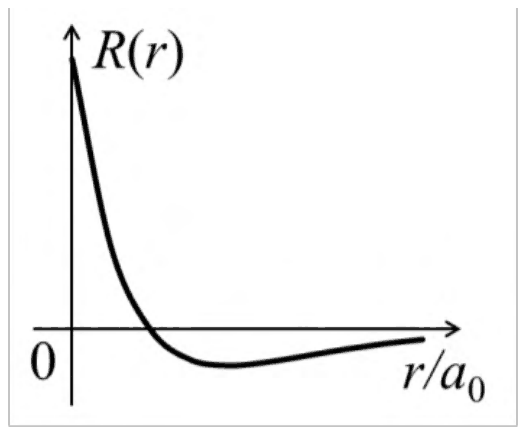
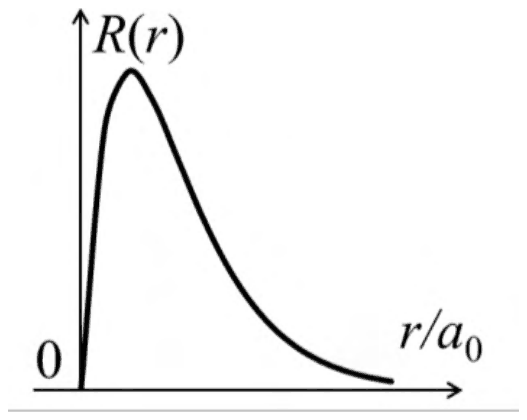
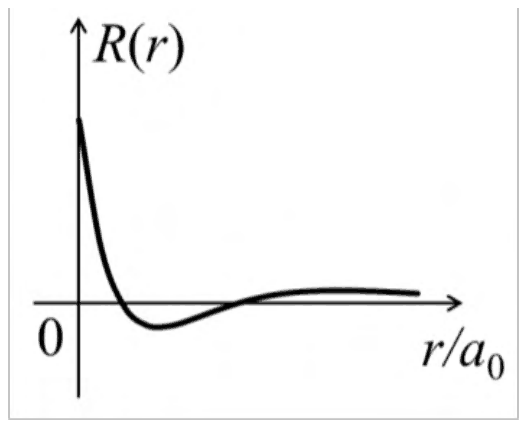
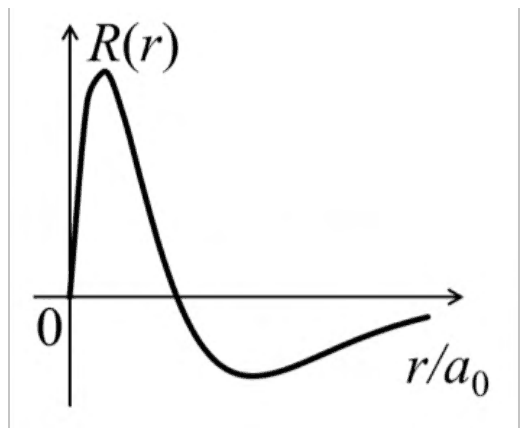
Which one of the following represents the \(3p\) radial wave function of hydrogen atom? (\(a_{0}\) is the Bohr radius)
Exam Year(s)

GATE Physics - 2018,

Answer: B

The 3p radial function is sketch (B).

A hydrogen radial function \(R_{nl}\) has \(n - l - 1\) radial nodes and behaves as \(r^{l}\) near the origin. For 3p, \(n = 3\) and \(l = 1\), so

\[ \begin{aligned} R_{31} &\propto \frac{r}{a_{0}}\left(1 - \frac{r}{6a_{0}}\right) \\ &\quad \times e^{-r/3a_{0}} \end{aligned} \]

It is zero at \(r = 0\), rises to a positive maximum, crosses zero once at \(r = 6a_{0}\), dips negative and decays to zero. Sketch (B) shows exactly this.

Sketches (A) and (C) are non-zero at the origin, which only s states (\(l = 0\)) do: (A), with two nodes, is the 3s function and (C), with one node, is 2s. Sketch (D) starts at zero but has no node, which is the 2p function.

Please log in or register to report this question.

2.

The intrinsic/permanent electric dipole moment in the ground state of hydrogen atom is (\(a_{0}\) is the Bohr radius)

Exam Year(s)

GATE Physics - 2018,

Answer: B

The permanent electric dipole moment of the hydrogen ground state is zero.

The ground state, 1s, is spherically symmetric and has definite (even) parity. The dipole moment is the expectation value of \(-e\vec{r}\), and \(\vec{r}\) is odd under parity, so

\[ \begin{aligned} \langle \vec{d} \rangle &= -e\int |\psi_{100}|^{2}\,\vec{r}\,d^{3}r \\ &= 0 \end{aligned} \]

because the integrand is odd. The electron cloud is centred on the proton.

Values such as \(3ea_{0}\) appear in the linear Stark effect of the degenerate \(n = 2\) level, where states of opposite parity mix and the atom behaves as if it had a permanent dipole of that size. They do not apply to the non-degenerate ground state, which only acquires an induced dipole (the quadratic Stark effect).

Please log in or register to report this question.

3.

The number of distinct (n, l, \(m_{l}\)) states of hydrogen atom with n = 3 is :

Exam Year(s)

MH SET - 2018, SET Exam - 2018,

Answer: B

There are 9 distinct states.

For a given n, l runs from 0 to n - 1 and, for each l, \(m_{l}\) runs from -l to +l, giving 2l + 1 values. For n = 3:

\[ \begin{aligned} l = 0:&\ 1, \quad l = 1:\ 3, \quad l = 2:\ 5 \\ \text{total} &= 1 + 3 + 5 = 9 = n^{2} \end{aligned} \]

Including spin would double this to 18, which is not asked. The option 5 counts only the l = 2 states, 3 counts only the values of l (or the l = 1 states), and 2 has no basis.

Please log in or register to report this question.

4.

The wave function for an electron in a hydrogen atom is given by

\[ \begin{aligned} \psi(\vec{r}) &= \psi_{200}(\vec{r}) + 2\psi_{211} \\ &\quad + 3\psi_{210} + \sqrt{2}\psi_{21-1} \end{aligned} \]

where \(\psi_{nlm_{l}}(\vec{r})\) is the wave function for an electron in the eigenstate \((nlm_{l})\). The expectation value of z-component of angular momentum, \(\langle L_{z} \rangle\) in the state \(\psi(\vec{r})\) is :

Exam Year(s)

MH SET - 2019, SET Exam - 2019,

Answer: B

\(\langle L_{z} \rangle\) is \(\hbar/8\).

The state is not normalised: the squared coefficients add to \(1 + 4 + 9 + 2 = 16\). Each component \(\psi_{nlm}\) has \(L_{z} = m\hbar\), so:

\[ \begin{aligned} \langle L_{z} \rangle &= \frac{1(0) + 4(1) + 9(0) + 2(-1)}{16}\hbar \\ &= \frac{2\hbar}{16} = \frac{\hbar}{8} \end{aligned} \]

The states with m = 0 contribute nothing. Forgetting the m = -1 term gives \(4\hbar/16\), and forgetting to divide by the norm gives \(2\hbar\); neither matches another option exactly, while the other options do not follow from the coefficients.

Please log in or register to report this question.

Loading…
Tags: Hydrogen Atom Questions and Answers || Hydrogen Atom MCQ Questions and Answers || Hydrogen Atom GK Questions and Answers || Hydrogen Atom GK MCQ Questions || Hydrogen Atom Multiple Choice Questions and Answers || Hydrogen Atom GK || GK on Hydrogen Atom || Quantum Mechanics Questions and Answers || Quantum Mechanics MCQ Questions and Answers || Quantum Mechanics GK Questions and Answers || GK on Quantum Mechanics