
Machine-translated by Google. Questions are authored in English.
Top

Operators and Observables Questions and Answers

1.

The eigenvalues of a Hermitian matrix are all

Exam Year(s)

GATE Physics - 2018,

Answer: A

The eigenvalues of a Hermitian matrix are all real.

If \(H = H^{\dagger}\) and \(Hv = \lambda v\), then

\[ \begin{aligned} v^{\dagger}Hv &= \lambda\, v^{\dagger}v \\ (v^{\dagger}Hv)^{*} &= v^{\dagger}H^{\dagger}v = v^{\dagger}Hv \end{aligned} \]

so \(v^{\dagger}Hv\) is real, and since \(v^{\dagger}v \gt 0\), \(\lambda\) is real. This is why observables in quantum mechanics are Hermitian operators.

Purely imaginary eigenvalues belong to anti-Hermitian matrices, and eigenvalues of modulus one to unitary matrices. Real and positive is too strong: \(\begin{bmatrix} 1 & 0 \\ 0 & -1 \end{bmatrix}\) is Hermitian with eigenvalue \(-1\). Positivity needs a positive-definite matrix.

Please log in or register to report this question.
2.

Among electric field (\(\vec{E}\)), magnetic field (\(\vec{B}\)), angular momentum (\(\vec{L}\)), and vector potential (\(\vec{A}\)), which is/are odd under parity (space inversion) operation?

Exam Year(s)

GATE Physics - 2018,

Answer: B

Under parity, \(\vec{E}\) and \(\vec{A}\) only are odd.

Parity sends \(\vec{r} \to -\vec{r}\). Polar (true) vectors change sign, while axial (pseudo) vectors, built as cross products of two polar vectors, do not.

  • \(\vec{E}\) is polar: it is the force per unit charge, and force reverses with \(\vec{r}\). Odd.
  • \(\vec{A}\) is polar: \(\vec{E} = -\nabla\phi - \partial\vec{A}/\partial t\), and \(\vec{E}\) is odd while \(\phi\) is a scalar, so \(\vec{A}\) must be odd too.
  • \(\vec{L} = \vec{r} \times \vec{p}\) is axial: both factors reverse, so \(\vec{L}\) does not. Even.
  • \(\vec{B} = \nabla \times \vec{A}\) is axial for the same reason. Even.

So options including \(\vec{B}\) or \(\vec{L}\), or leaving out \(\vec{A}\), are wrong.

Please log in or register to report this question.
3.

If \(H\) is the Hamiltonian for a free particle with mass \(m\), the commutator \([x, [x, H]]\) is

Exam Year(s)

GATE Physics - 2018,

Answer: B

The commutator is \(-\hbar^{2}/m\).

For a free particle \(H = p^{2}/2m\). Using \([x, p] = i\hbar\):

\[ \begin{aligned} [x, H] &= \frac{1}{2m}[x, p^{2}] = \frac{1}{2m}(2i\hbar p) = \frac{i\hbar p}{m} \\ [x, [x, H]] &= \frac{i\hbar}{m}[x, p] = \frac{i\hbar}{m}(i\hbar) = -\frac{\hbar^{2}}{m} \end{aligned} \]

The positive results miss the sign from \(i^{2} = -1\), and the results with \(2m\) forget that \([x, p^{2}] = 2i\hbar p\), whose factor 2 cancels the 2 in \(2m\).

Please log in or register to report this question.
Answer: C

The Hermitian operator is \(\frac{1}{i}\left(\frac{\partial}{\partial s} + \frac{1}{2s}\right)\).

In cylindrical coordinates the volume element contains the factor \(s\,ds\). For an operator \(\hat{A}\) to be Hermitian we need \(\int f^{*}(\hat{A}g)\,s\,ds = \int (\hat{A}f)^{*}g\,s\,ds\). Integrating \(\int f^{*}\frac{1}{i}\frac{\partial g}{\partial s}s\,ds\) by parts moves the derivative onto \(sf^{*}\), producing an extra term \(-\frac{1}{i}\int \frac{f^{*}g}{s}s\,ds\) from differentiating \(s\). Adding \(\frac{1}{2s}\) to the derivative splits this extra term evenly between the two sides, so the operator equals its adjoint.

\(\frac{1}{i}\partial_{s}\) alone leaves the extra term uncancelled. With \(\frac{1}{s}\) the correction is twice too large, and \(\partial_{s} + \frac{1}{s}\) without the factor \(1/i\) is anti-Hermitian in its derivative part.

Please log in or register to report this question.
5.

The wavefunction of a particle in one dimension is given by

\[ \psi(x) = \begin{cases} M, & -a \lt x \lt a \\ 0, & \text{otherwise.} \end{cases} \]

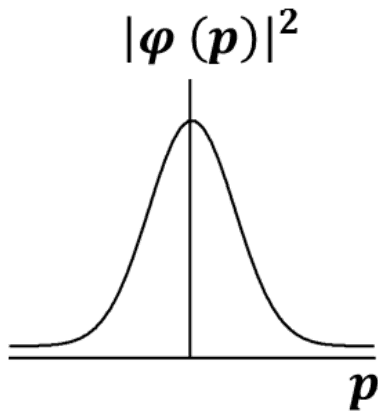
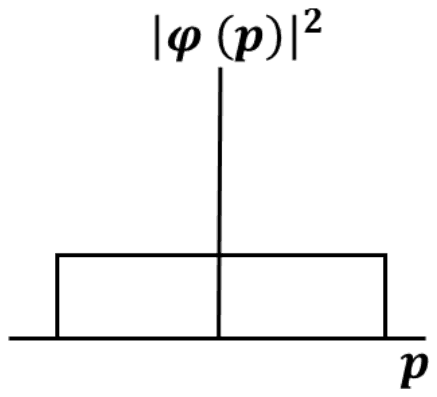
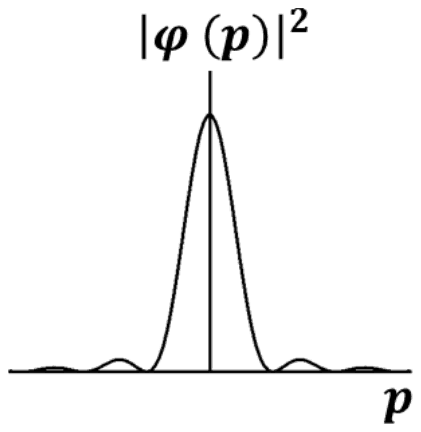
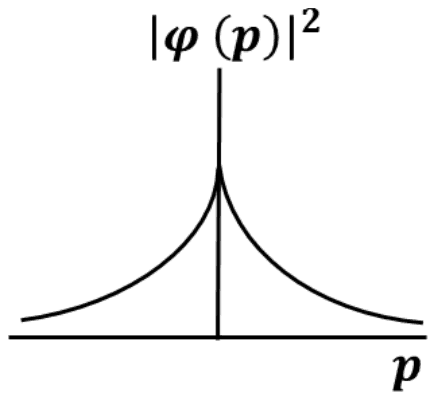
Here \(M\) and \(a\) are positive constants. If \(\varphi(p)\) is the corresponding momentum space wavefunction, which one of the following plots best represents \(|\varphi(p)|^{2}\)?

Exam Year(s)

GATE Physics - 2023,

Answer: C

The momentum distribution is a central peak with decaying side lobes, plot (C).

The momentum space wavefunction is the Fourier transform of the box function:

\[ \begin{aligned} \varphi(p) &= \frac{M}{\sqrt{2\pi\hbar}}\int_{-a}^{a} e^{-ipx/\hbar}\,dx \\ &= \frac{2M\hbar}{\sqrt{2\pi\hbar}}\,\frac{\sin(pa/\hbar)}{p} \end{aligned} \]

So \(|\varphi(p)|^{2} \propto \sin^{2}(pa/\hbar)/p^{2}\): a tall peak at \(p = 0\), zeros at \(p = n\pi\hbar/a\), and side lobes that shrink as \(1/p^{2}\).

A Gaussian (A) is the transform of a Gaussian, not of a box. A flat rectangle (B) would be the momentum distribution of a sinc-shaped wavefunction, the reverse transform. A cusp (D) is the transform of an exponential, such as \(e^{-|x|/a}\).

Please log in or register to report this question.

6.

Consider an operator \(\hat{A}\) which is not Hermitian. Find the possible values of \(c\) and \(d\) such that the operator \((c\,\hat{A} - d\,\hat{A}^{\dagger})\) is Hermitian.

Exam Year(s)

GATE Physics - 2026,

Answer: A

The operator is Hermitian for \(c = i\) and \(d = i\).

Take the adjoint, using \((c\hat{A})^{\dagger} = c^{*}\hat{A}^{\dagger}\):

\[ \begin{aligned} (i\hat{A} - i\hat{A}^{\dagger})^{\dagger} &= -i\hat{A}^{\dagger} + i\hat{A} \\ &= i\hat{A} - i\hat{A}^{\dagger} \end{aligned} \]

It equals itself, so it is Hermitian. In general the adjoint of \(c\hat{A} - d\hat{A}^{\dagger}\) is \(c^{*}\hat{A}^{\dagger} - d^{*}\hat{A}\), and matching terms needs \(d = -c^{*}\). For c = d = 1 this gives \(\hat{A} - \hat{A}^{\dagger}\), which is anti-Hermitian. For c = i, d = −i it gives \(i(\hat{A} + \hat{A}^{\dagger})\), also anti-Hermitian, and c = −1, d = i fails the condition since \(-c^{*} = 1 \neq i\).

Please log in or register to report this question.

7.

Given \(|v_{1}\rangle = \frac{1}{\sqrt{2}}\begin{pmatrix} 1 \\ i \end{pmatrix}\) and \(|v_{2}\rangle = \frac{1}{\sqrt{2}}\begin{pmatrix} 1 \\ -i \end{pmatrix}\), the tensor product \(|v_{1}\rangle \otimes |v_{2}\rangle\) is

Exam Year(s)

GATE Physics - 2026,

Answer: A

The tensor product is \(\frac{1}{2}(1, -i, i, 1)^{T}\), a column vector.

For column vectors \(a\) and \(b\), the tensor product is the column \((a_{1}b_{1}, a_{1}b_{2}, a_{2}b_{1}, a_{2}b_{2})^{T}\). With \(a = (1, i)\), \(b = (1, -i)\) and the prefactor \(\frac{1}{\sqrt{2}} \cdot \frac{1}{\sqrt{2}} = \frac{1}{2}\):

\[ \begin{aligned} a_{1}b_{1} &= 1, \quad a_{1}b_{2} = -i \\ a_{2}b_{1} &= i, \quad a_{2}b_{2} = (i)(-i) = 1 \end{aligned} \]

The option \((1, i, -i, 1)\) is \(|v_{2}\rangle \otimes |v_{1}\rangle\), the product taken in the other order. The two 2 by 2 matrices are outer products of the form \(|v\rangle\langle w|\), not the tensor product of two kets, which is a four-component column.

Please log in or register to report this question.

8.

Consider the normalized superposed state \(\psi = c_{0}\phi_{o} + c_{1}\phi_{1}\), where \(\phi_{0}\) and \(\phi_{1}\) are the ground and first excited states of a simple harmonic oscillator, respectively. \(c_{0}\) and \(c_{1}\) are imaginary superposition coefficients. Which of the following options is correct for the expectation value of \((\langle x \rangle + i \langle p \rangle)\)?

Exam Year(s)

IIT JAM - 2026,

Answer: B

The quantity \(\langle x \rangle + i\langle p \rangle\) is real.

Write the imaginary coefficients as \(c_0 = ia\) and \(c_1 = ib\) with \(a, b\) real. For the oscillator, \(\langle 0|x|1\rangle = x_{01}\) is real and \(\langle 0|p|1\rangle = i p_{01}\) is purely imaginary, with \(x_{01}, p_{01}\) real; diagonal elements of \(x\) and \(p\) vanish.

\[ \begin{aligned} \langle x \rangle &= c_0^{*}c_1 x_{01} + c_1^{*}c_0 x_{01} = 2ab\,x_{01} \\ \langle p \rangle &= ab(ip_{01}) + ab(-ip_{01}) = 0 \end{aligned} \]

So \(\langle x \rangle + i\langle p \rangle = 2ab\,x_{01}\), a real number, non-zero whenever both states are present. With purely imaginary coefficients the relative phase is zero, so the packet is displaced but momentarily at rest.

It is not zero in general, and since \(\langle p \rangle\) vanishes there is no imaginary part, which rules out the imaginary and complex options.

Please log in or register to report this question.

9.

Given \([x_{i}, p_{j}] = i\hbar\delta_{ij}\), i, j = 1, 2, 3, \([x_{1}, p_{1}^{3}]\) is :

Exam Year(s)

MH SET - 2018, SET Exam - 2018,

Answer: C

The commutator is \(3i\hbar p_{1}^{2}\).

Use the product rule \([A, BC] = [A, B]C + B[A, C]\) with \([x_{1}, p_{1}] = i\hbar\), a number that commutes with everything:

\[ \begin{aligned} [x_{1}, p_{1}^{3}] &= [x_{1}, p_{1}]p_{1}^{2} + p_{1}[x_{1}, p_{1}]p_{1} \\ &\quad + p_{1}^{2}[x_{1}, p_{1}] \\ &= 3i\hbar\, p_{1}^{2} \end{aligned} \]

In general \([x, p^{n}] = n i\hbar p^{n-1}\), which is \(i\hbar\, \partial(p^{n})/\partial p\). The option \((i\hbar)^{3}p_{1}\) multiplies the commutator three times instead of adding three terms, \(i\hbar^{2}p_{1}\) has the wrong power of p, and zero would apply only to different components such as \([x_{1}, p_{2}^{3}]\).

Please log in or register to report this question.

10.

Which of the following is not an eigenstate of linear momentum operator \(p_{x}\) ?

Exam Year(s)

MH SET - 2018, SET Exam - 2018,

Answer: D

The function that is not an eigenstate is A sin kx.

The momentum operator is \(\hat{p}_{x} = -i\hbar\, d/dx\). Acting on the exponentials:

\[ \begin{aligned} \hat{p}_{x}e^{\pm ikx} &= \pm\hbar k\, e^{\pm ikx} \\ \hat{p}_{x}e^{-x} &= i\hbar\, e^{-x} \end{aligned} \]

Each returns a constant multiple of itself, so each is formally an eigenfunction (the last with a complex eigenvalue, so it is not a physical momentum state, but it still satisfies the eigenvalue equation). For the sine,

\[ \hat{p}_{x}\sin kx = -i\hbar k\cos kx \]

which is not a multiple of \(\sin kx\). A sine is a superposition of \(e^{ikx}\) and \(e^{-ikx}\), momenta \(+\hbar k\) and \(-\hbar k\), so it has no single definite momentum.

Please log in or register to report this question.

Loading…
Tags: Operators and Observables Questions and Answers || Operators and Observables MCQ Questions and Answers || Operators and Observables GK Questions and Answers || Operators and Observables GK MCQ Questions || Operators and Observables Multiple Choice Questions and Answers || Operators and Observables GK || GK on Operators and Observables || Quantum Mechanics Questions and Answers || Quantum Mechanics MCQ Questions and Answers || Quantum Mechanics GK Questions and Answers || GK on Quantum Mechanics