
Machine-translated by Google. Questions are authored in English.
Top

Vorticity and Circulation Questions and Answers

1.

For an inviscid and barotropic ocean of constant depth (D), a water parcel with initial vorticity 2Ω is displaced from the equator to the north pole. Latitudinal variation of the parcel vorticity (ζ) is well represented by the curve
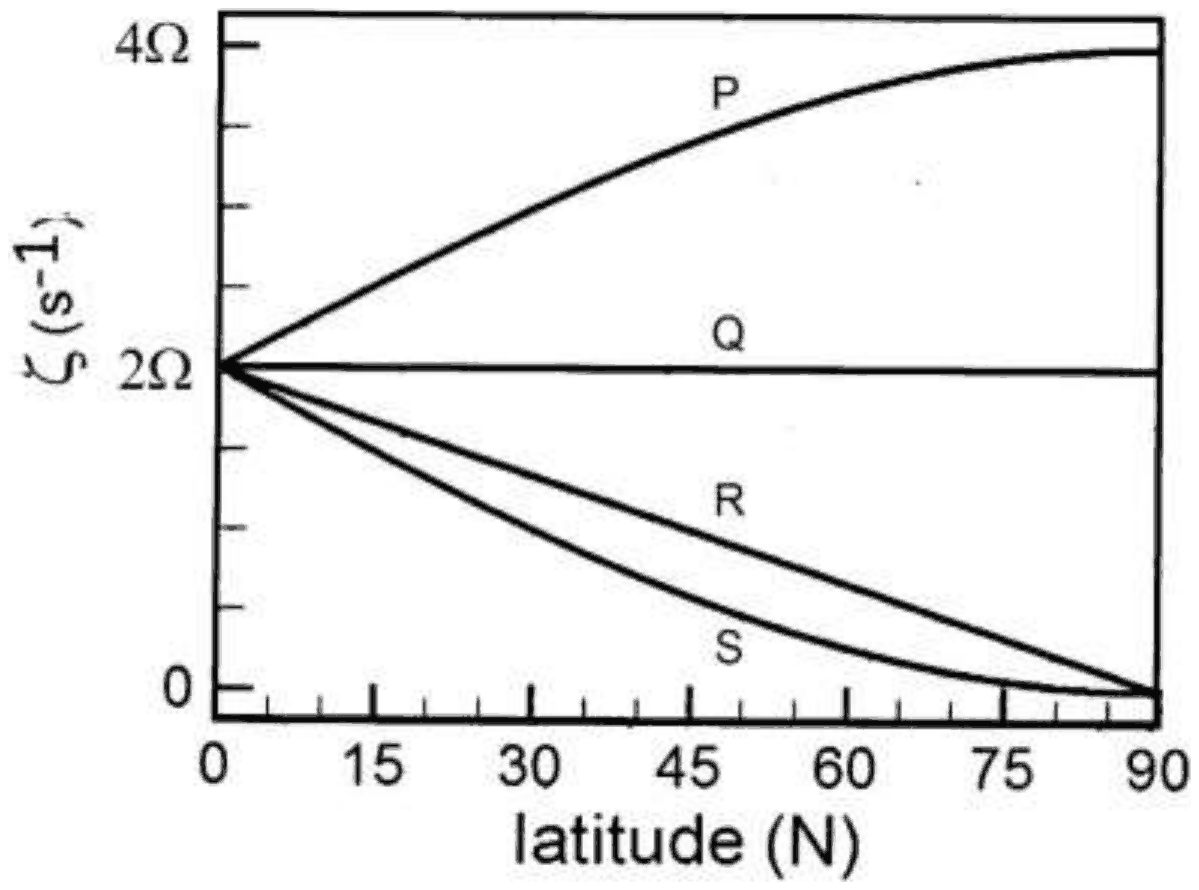
Vorticity zeta against latitude from 0 to 90 N, all curves starting at 2 Omega: P rises to 4 Omega, Q stays at 2 Omega, R falls linearly to 0 and S falls to 0 along a curve that bends below R and flattens near the pole

Exam Year(s)

GATE XE - 2018,

Answer: A

The curve is S.

For an inviscid barotropic ocean of constant depth, potential vorticity conservation reduces to conservation of absolute vorticity, \(\zeta + f\), where \(f = 2\Omega\sin\phi\). At the equator f = 0, so \(\zeta + f = 2\Omega\) throughout, and

\[ \zeta = 2\Omega(1 - \sin\phi) \]

This falls from \(2\Omega\) at the equator to 0 at the pole. It falls fastest near the equator, where \(\sin\phi\) grows quickly, and flattens near the pole, so it bends below the straight line: curve S.

R falls linearly with latitude, which would need \(\sin\phi\) to grow uniformly. Q keeps the relative vorticity constant, ignoring the change in f, and P adds f instead of subtracting it.

Please log in or register to report this question.

2.

A fluid is in solid body rotation in a cylindrical container of radius \(R\) rotating with an angular velocity \(\boldsymbol{\Omega} = (0, 0, \Omega)\). The circulation per unit area around a circular loop in the horizontal plane of radius \(r\) (\(r \lt R\)), whose center coincides with the axis of rotation is

Exam Year(s)

GATE XE - 2022,

Answer: A

The circulation per unit area is \(2\Omega\).

In solid body rotation the speed at radius r is \(v = \Omega r\). Around the circle of radius r:

\[ \begin{aligned} \Gamma &= \oint \mathbf{v}\cdot d\mathbf{l} = \Omega r \cdot 2\pi r = 2\pi\Omega r^{2} \\ \frac{\Gamma}{\pi r^{2}} &= 2\Omega \end{aligned} \]

This is the vorticity of solid body rotation, twice the angular velocity (Stokes' theorem). \(\Omega/2\) and \(\Omega/4\) divide instead of multiply, and \(\Omega^{2}\) has the wrong dimensions for a vorticity.

Please log in or register to report this question.

Answer: B

The vertical component of relative vorticity is \(Y = \frac{\delta v}{\delta x} - \frac{\delta u}{\delta y}\) (the paper writes the vorticity as Y).

Relative vorticity is the curl of the wind, and its vertical component, usually written \(\zeta\), is

\[ \zeta = \partial v/\partial x - \partial u/\partial y \]

where \(u\) and \(v\) are the eastward and northward wind components. It is positive for anticlockwise rotation in the northern hemisphere.

The sum of \(\partial u/\partial x\) and \(\partial v/\partial y\) is the horizontal divergence, not vorticity. The difference \(\partial u/\partial x - \partial v/\partial y\) is a stretching deformation, and the sum of second derivatives is not a vorticity expression.

Please log in or register to report this question.

4.

The angular velocity of the Earth is \(\Omega\), then the vorticity of the earth is :

Exam Year(s)

MH SET - 2019, SET Exam - 2019,

Answer: B

The vorticity of the Earth is 2 \(\Omega\).

A body rotating as a solid with angular velocity \(\Omega\) has velocity \(\mathbf{v} = \boldsymbol{\Omega} \times \mathbf{r}\), and its vorticity is

\[ \begin{aligned} \zeta &= \nabla \times (\Omega \times r) \\ &= 2\Omega \end{aligned} \]

So the planetary vorticity is twice the angular velocity, and its local vertical component is \(2\Omega\sin\phi\), the Coriolis parameter f.

Taking the vorticity equal to \(\Omega\) confuses vorticity with angular velocity, and the factors 3 and 1/2 have no basis in solid-body rotation.

Please log in or register to report this question.

Answer: A

Vorticity is the curl of the velocity, a vector whose vertical component is what matters for large-scale atmospheric flow. It measures the local rotation of a fluid element about its own axis, and it is a point quantity rather than an integral one. Divergence is the dot product of the gradient operator with the velocity, circulation is the line integral of velocity around a closed loop, and deformation describes the straining of an element without rotation. The four together provide a complete local description of how a fluid element is being distorted by the flow around it.

Please log in or register to report this question.

Answer: B

Because large-scale motion is nearly horizontal, the rotation that matters is about a vertical axis, so only the vertical component of the curl appears in the synoptic vorticity equation. The horizontal components describe rotation about horizontal axes, which is important in convective storms and in the tilting term but not in the leading order balance. Streamwise vorticity, the projection along the flow, is central to supercell dynamics and is a different combination again.

Please log in or register to report this question.

Answer: C

Relative vorticity is the curl of the wind as measured in the rotating frame, so it describes the rotation of the air relative to the ground beneath. Adding the planetary vorticity, which is the Coriolis parameter, gives the absolute vorticity, and dividing that by a measure of layer depth or stratification gives potential vorticity. Keeping the four straight is essential because each is conserved under different conditions and confusing them leads to wrong conclusions.

Please log in or register to report this question.

Answer: D

The planetary vorticity is the vertical component of twice the Earth's rotation vector, which is exactly \( f = 2\Omega\sin\phi \). It is therefore zero at the equator and about \( 1.45 \times 10^{-4} \) per second at the pole. Since typical relative vorticity in a synoptic system is around \( 10^{-5} \) per second, planetary vorticity usually dominates in mid-latitudes, which has important consequences for the conservation arguments that follow. Working one numerical case through both cases side by side fixes the distinction better than any rule of thumb.

Please log in or register to report this question.

Answer: A

Absolute vorticity is the vorticity seen from an inertial frame, which is the relative vorticity plus the planetary vorticity. It is the quantity conserved for frictionless barotropic flow without divergence, and it is what makes air moving poleward turn anticyclonically. The final option is a correct statement of the relationship between circulation and mean vorticity, but it defines mean vorticity rather than absolute vorticity specifically. The quantity that varies and the quantity that does not are worth naming before any substitution is attempted.

Please log in or register to report this question.

Answer: B

Anticlockwise rotation gives positive vorticity in the standard convention, and cyclonic means anticlockwise in the northern hemisphere, so cyclonic vorticity is positive there. In the southern hemisphere cyclonic means clockwise and therefore negative vorticity, which is why the word cyclonic is safer than any statement about sign. A circular flow certainly has vorticity, since the fluid elements themselves are rotating as they go round. Framing the question as which quantity the change acts upon makes the answer follow without calculation.

Please log in or register to report this question.

Loading…

Other Subjects

Tags: Vorticity and Circulation Questions and Answers || Vorticity and Circulation MCQ Questions and Answers || Vorticity and Circulation GK Questions and Answers || Vorticity and Circulation GK MCQ Questions || Vorticity and Circulation Multiple Choice Questions and Answers || Vorticity and Circulation GK || GK on Vorticity and Circulation || Atmospheric Dynamics Questions and Answers || Atmospheric Dynamics MCQ Questions and Answers || Atmospheric Dynamics GK Questions and Answers || GK on Atmospheric Dynamics