
Machine-translated by Google. Questions are authored in English.
Top

Cages and Metal Clusters Questions and Answers

1.

The structure type and shape of the polyhedral (skeletal) framework of the carborane, Me2C2B10H10, respectively, are

Exam Year(s)

GATE Chemistry - 2017,

Answer: B

The carborane is closo with an icosahedral framework.

Count the skeletal electron pairs with Wade's rules. Each B-H vertex contributes 2 skeletal electrons and each C-R vertex 3. For Me2C2B10H10, with 12 vertices:

\[ \begin{aligned} 10 \times 2 + 2 \times 3 &= 26\ \text{electrons} \\ &= 13\ \text{pairs} = n + 1 \end{aligned} \]

n + 1 pairs for n vertices is the closo count, a closed polyhedron with every vertex occupied, and the closed 12-vertex deltahedron is the icosahedron. This is the dimethyl derivative of the well-known icosahedral carborane C2B10H12.

A nido cluster would need n + 2 pairs. The dodecahedron (the 8-vertex deltahedron) is the closo shape for eight vertices, not twelve.

Please log in or register to report this question.
2.

The number of metal-metal bond(s), with σ, π, and δ character, present in [Mo2(CH3CO2)4] complex is(are), respectively,

Exam Year(s)

GATE Chemistry - 2022,

Answer: A

The answer is 1, 2, 1.

In [Mo2(CH3CO2)4] each Mo(II) is d4, so the Mo2 unit has eight metal d electrons. With the Mo-Mo axis as z, the d orbitals overlap to give one σ bond (dz2), two π bonds (dxz, dyz) and one δ bond (dxy). The configuration σ2π4δ2 fills all four bonding orbitals: a quadruple bond.

The eclipsed acetate bridges hold the two MoO4 units in the alignment the δ overlap needs. '1, 2, 0' describes a triple bond (as in a d3-d3 dimer), and the other options do not count two π components.

Please log in or register to report this question.

3.

The compound(s) having structure similar to that of B2H6 is/are

Exam Year(s)

GATE Chemistry - 2025,

Answer: C

The compound with a structure like B2H6 is Al2Cl6.

Diborane has two boron atoms joined by two bridging hydrogens, with the four terminal hydrogens in a plane at right angles to the B-H-B bridges; each boron is roughly tetrahedral. Al2Cl6 (the vapour-phase dimer of AlCl3) has exactly this arrangement: two edge-sharing AlCl4 tetrahedra with two bridging chlorines and four terminal chlorines (the bridges there are ordinary electron-pair bonds rather than three-centre bonds).

I2Cl6 is also chlorine-bridged but is completely planar, each iodine being square planar. Si2Cl6 is ethane-like, with a direct Si-Si bond. Cl2O6 is [ClO2]+[ClO4]- in the solid, with no bridged dimer of this type. Only one option fits, which is the whole key of this multiple-select question.

Please log in or register to report this question.

4.

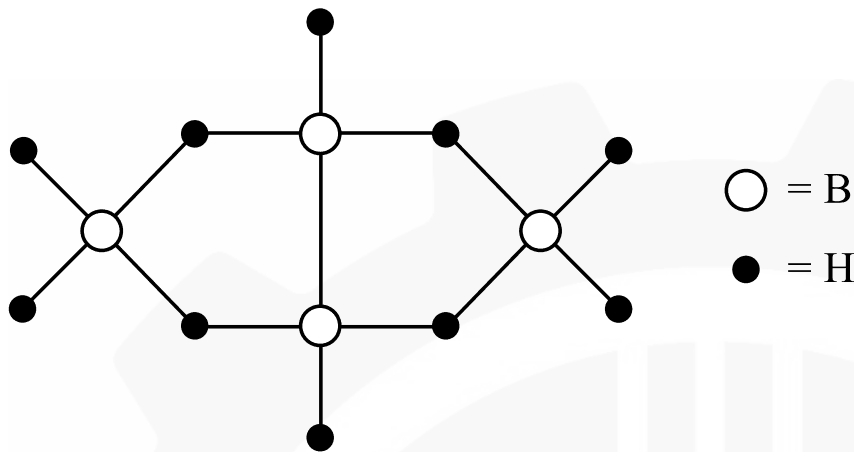
The structure of B4H10 is given below. Its styx number is

B4H10: two central borons joined by a B-B bond, each with one terminal H; two outer borons, each with two terminal H; each outer boron is linked to each central boron through a bridging H

Exam Year(s)

GATE Chemistry - 2026,

Answer: A

The styx number of B4H10 is 4012.

Lipscomb's code counts four kinds of bond: s = B-H-B bridges, t = three-centre B-B-B bonds, y = two-centre B-B bonds, x = extra terminal H beyond one per boron (BH2 groups). From the structure: 4 bridging hydrogens, no closed B-B-B bond, 1 B-B bond between the two central borons, and 2 BH2 groups (the outer borons), so s, t, y, x = 4, 0, 1, 2.

The balance equations for BpHp+q, here p = 4 and q = 6, confirm it:

\[ \begin{aligned} s + x &= q:\ 4 + 2 = 6 \\ s + t &= p:\ 4 + 0 = 4 \\ t + y &= p - q/2:\ 0 + 1 = 1 \end{aligned} \]

4102 swaps t and y, claiming a three-centre bond the arachno structure does not have. 2104 and 2014 count only two bridges, so they fail the balance \(s + t = p\), giving 2 + 1 = 3 and 2 + 0 = 2 instead of 4.

Please log in or register to report this question.

5.

The number of Metal-Metal bonds in [Re2Cl8]2- is/are :

Exam Year(s)

MH SET - 2018, SET Exam - 2018,

Answer: D

[Re2Cl8]2- has four metal-metal bonds between its two rhenium atoms: a quadruple bond.

Each Re(III) is d4, so the pair has eight d electrons for the Re-Re bond. Overlap of the d orbitals along the Re-Re axis gives one σ bond (dz²), two π bonds (dxz, dyz) and one δ bond (dxy), and the eight electrons fill exactly these four bonding orbitals: σ2π4δ2, a bond order of 4.

The δ bond is why the two ReCl4 units are eclipsed rather than staggered: rotating them would destroy the dxy overlap. Cotton's discovery of this ion (1964) established the quadruple bond. One, two or three bonds would leave bonding orbitals empty.

Please log in or register to report this question.

6.

According to Wade’s rules, the structures of B10C2H12 and B10H12(SEt2)2 are respectively :

Exam Year(s)

MH SET - 2021, SET Exam - 2021,

Answer: C

The two structures are closo and arachno.

Wade's rules count skeletal electron pairs: each B-H unit gives 2 electrons, each C-H unit 3, each extra hydrogen 1 and each two-electron ligand 2. For n cage atoms, n+1 pairs means closo, n+2 nido and n+3 arachno.

\[ \begin{aligned} \mathrm{B_{10}C_{2}H_{12}} &: 10(2) + 2(3) = 26\ e \\ &= 13\ \text{pairs} = n+1 \ (n=12) \end{aligned} \]

So the dicarbadodecaborane is a closo icosahedron. For B10H12(SEt2)2, the ten B-H units give 20 electrons, the two extra hydrogens 2 and the two SEt2 donors 4, a total of 26 electrons or 13 pairs for 10 cage atoms, which is n+3: arachno.

Options calling the carborane nido would need 14 pairs, and calling the ligand adduct nido ignores the two electron pairs the SEt2 groups add to the parent nido B10H14.

Please log in or register to report this question.

Loading…
Tags: Cages and Metal Clusters Questions and Answers