
Machine-translated by Google. Questions are authored in English.
Top

Transition Metals and Coordination Chemistry Questions and Answers

Direction for [ Question No: 1 To 1 ] :

Common Data for the next two questions:

[FeCl4]2- (I), [CoCl4]2- (II) and [NiCl4]2- (III) are paramagnetic tetrahedral complexes.

1.

The order of values of spin only magnetic moment is

Exam Year(s)

GATE Life Sciences - 2012,

Answer: D

The order of spin-only magnetic moments is I \(\gt\) II \(\gt\) III.

Chloride is a weak-field ligand and tetrahedral splitting is small, so all three complexes are high spin. Count the unpaired d electrons:

  • [FeCl4]2-: Fe2+, d6, 4 unpaired, \(\mu = \sqrt{24} = 4.90\) BM
  • [CoCl4]2-: Co2+, d7, 3 unpaired, \(\mu = \sqrt{15} = 3.87\) BM
  • [NiCl4]2-: Ni2+, d8, 2 unpaired, \(\mu = \sqrt{8} = 2.83\) BM

using \(\mu = \sqrt{n(n + 2)}\). The moment falls as electrons are added beyond d5, so every order putting III or II first is reversed.

Please log in or register to report this question.
2.

Paramagnetic transition metal ion is:

Exam Year(s)

DSSSB AE - 2023,

Answer: B

A transition metal ion is paramagnetic if it has unpaired d electrons. Count the d electrons of each ion.


\[ \begin{aligned} \mathrm{Ti^{4+}}: d^0,\quad \mathrm{V^{4+}}: d^1 \\ \mathrm{Zn^{2+}}: d^{10},\quad \mathrm{Cu^{+}}: d^{10} \end{aligned} \]


\(\mathrm{V^{4+}}\) (vanadium, atomic number 23, loses four electrons) has one electron in the 3d subshell, which is unpaired, so it is paramagnetic. \(\mathrm{Ti^{4+}}\) has an empty d subshell, and \(\mathrm{Zn^{2+}}\) and \(\mathrm{Cu^{+}}\) have filled d subshells, so they have no unpaired electrons and are diamagnetic. The answer is option B.

Please log in or register to report this question.
Answer: D

The order of hydration enthalpy (in magnitude) is Zn2+ > Mn2+ > Ca2+.

Hydration enthalpy grows in magnitude as the cation becomes smaller and its effective nuclear charge rises. All three ions are dipositive. Ca2+ is the largest (about 100 pm) and is hydrated least strongly. Mn2+ is smaller, and high-spin d5 gives it no crystal field stabilisation. Zn2+ is smaller again (about 74 pm) with a higher effective nuclear charge across the 3d series, so it is hydrated most strongly. The values are roughly -1580, -1840 and -2050 kJ mol-1 for Ca, Mn and Zn.

Any order placing Ca2+ above a 3d ion ignores its larger radius, and putting Mn2+ above Zn2+ ignores the contraction across the period.

Please log in or register to report this question.
4.

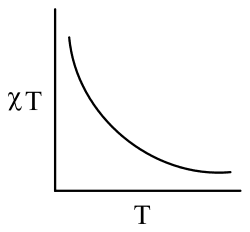
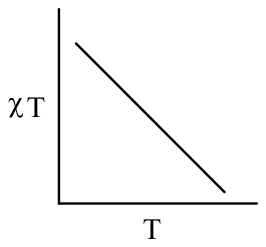
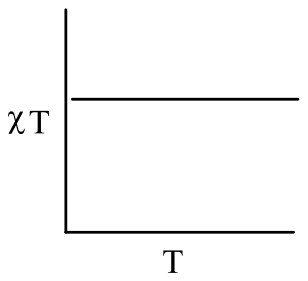
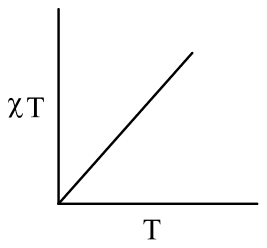
The plot of χT versus T (where χ is molar magnetic susceptibility and T is the temperature) for a paramagnetic complex which strictly follows Curie equation is

Exam Year(s)

GATE Chemistry - 2012,

Answer: C

The correct plot is the horizontal straight line (C).

The Curie law says the molar susceptibility of an ideal paramagnet is inversely proportional to temperature:

\[ \chi = \frac{C}{T} \quad \Rightarrow \quad \chi T = C \]

The product χT is therefore a constant, independent of T, and a plot of χT against T is a horizontal line. Its height is the Curie constant, which fixes the effective magnetic moment.

A falling curve such as A is what χ itself does against T. A falling or rising straight line (B or D) would mean χT varies with temperature, as it does with antiferromagnetic or ferromagnetic coupling or a Curie-Weiss term, which the question excludes.

Please log in or register to report this question.
5.

The IUPAC nomenclature of Na[PCl6] is

Exam Year(s)

GATE Chemistry - 2012,

Answer: B

The name is sodium hexachlorophosphate(V).

In Na[PCl6] the complex ion [PCl6]- is an anion. IUPAC names an anionic complex by adding the ending -ate to the central atom's name, giving phosphate, and gives the oxidation state in Roman numerals: six chlorides at -1 and an overall charge of -1 put phosphorus at +5. The cation is named first, so the full name is sodium hexachlorophosphate(V).

'Phosphine' is the name of PH3 and its derivatives, not of an anionic centre, and the ending '-ite' belongs to oxoanion names (phosphite), not to the nomenclature of complexes.

Please log in or register to report this question.

6.

Consider the following pairs of complexes

[CoF(NH3)5]2+ and [Cr(OH2)6]2+
[Co(NH3)5 (OH2)]3+ and [Cr(OH2)6]2+
[Co(NH3)6]3+ and [Cr(OH2)6]2+
[CoI(NH3)5]2+ and [Cr(OH2)6]2+

The electron transfer rate will be fastest in the pair

Exam Year(s)

GATE Chemistry - 2012,

Answer: D

The fastest electron transfer is between [CoI(NH3)5]2+ and [Cr(OH2)6]2+.

Cr2+(aq) is labile, and it reduces Co(III) pentaammine complexes by Taube's inner-sphere mechanism: the ligand X on cobalt bridges the two metals in Co-X-Cr, the electron passes through it, and X ends up on chromium. The rate depends on how well the bridge transmits the electron, and for these halide complexes the measured rate constants rise in the order F- < Cl- < Br- < I-: the large, polarisable iodide is the best bridge.

[Co(NH3)6]3+ has no lone pair available to bridge, so it can react only by the much slower outer-sphere route. Coordinated water is a poor bridge too, and fluoride, though it bonds strongly to Cr(III), transmits the electron less efficiently than iodide.

Please log in or register to report this question.

7.

If a mixture of NaCl, conc. H2SO4 and K2Cr2O7 is heated in a dry test tube, a red vapour (P) is formed. This vapour (P) dissolves in aqueous NaOH to form a yellow solution, which upon treatment with AgNO3 forms a red solid (Q). P and Q are, respectively

Exam Year(s)

GATE Chemistry - 2012,

Answer: D

P is CrO2Cl2 and Q is Ag2CrO4.

This is the chromyl chloride test for chloride. Heating a chloride with dichromate and concentrated sulfuric acid gives chromyl chloride, a volatile deep red-brown liquid whose vapour distils out:

\[ \begin{aligned} &\mathrm{K_{2}Cr_{2}O_{7} + 4NaCl + 6H_{2}SO_{4}} \\ &\rightarrow \mathrm{2CrO_{2}Cl_{2} + 2KHSO_{4}} \\ &\quad + \mathrm{4NaHSO_{4} + 3H_{2}O} \end{aligned} \]

In NaOH it hydrolyses to yellow sodium chromate, Na2CrO4. Silver nitrate then precipitates brick-red silver chromate, Ag2CrO4.

The yellow solution holds chromate, not dichromate, so Ag2Cr2O7 is wrong. Na2[CrOCl5] is not volatile and is not formed in this test.

Please log in or register to report this question.

8.

The ground states of high-spin octahedral and tetrahedral Co(II) complexes are, respectively

Exam Year(s)

GATE Chemistry - 2012,

Answer: B

The ground terms are 4T1g (octahedral) and 4A2 (tetrahedral).

Co(II) is d7, and the high-spin free ion has the ground term 4F (three unpaired electrons, quartet). In an octahedral field a d7 F term splits into T1g, T2g and A2g, with T1g lowest (t2g5eg2). In a tetrahedral field the splitting order is reversed, as for d3 in an octahedron, so A2 is lowest (e4t23); there is no g label without a centre of symmetry.

4T2g is an excited state of the octahedral ion. Any triplet (3T) term implies two unpaired electrons, which high-spin d7 does not have.

Please log in or register to report this question.

9.

The electronic ground state term for the chromium ion in [Cr(CN)6]4- is

Exam Year(s)

GATE Chemistry - 2017,

Answer: B

The ground state term is the triplet \(^{3}H\).

In [Cr(CN)6]4- chromium is Cr(II), a d4 ion. Cyanide is a strong-field ligand, so the complex is low spin: all four electrons go into the t2g set, t2g4, with two unpaired electrons, a spin triplet (S = 1).

On the d4 Tanabe-Sugano diagram, the high-spin ground state \(^{5}E_{g}\) comes from the free-ion \(^{5}D\) term, but beyond the spin-crossover point the ground state becomes \(^{3}T_{1g}\), which derives from \(^{3}H\), the lowest triplet term of the d4 configuration (largest L among the triplets, by Hund's rules).

\(^{5}D\) is the term of the weak-field, high-spin complex, which strong-field cyanide does not give. \(^{3}F\) and \(^{3}G\) are higher-lying triplet terms, not the parent of the ground state.

Please log in or register to report this question.

Answer: C

The wavelengths follow the order VO43- \(\lt\) CrO42- \(\lt\) MnO4-.

All three are d0 tetrahedral oxo-anions, and their intense colour (or its absence) comes from charge transfer from oxygen to the metal. The higher the metal's oxidation state and the more easily it is reduced, the lower the energy of this transfer and the longer its wavelength: V(V) \(\lt\) Cr(VI) \(\lt\) Mn(VII).

That matches the colours: vanadate is colourless (its band is in the ultraviolet), chromate is yellow (absorbing in the violet-blue), and permanganate is deep purple (absorbing green light, the longest wavelength of the three). The other orders put chromate or permanganate in the wrong place, for example making permanganate the shortest-wavelength absorber.

Please log in or register to report this question.

Loading…
Tags: Transition Metals and Coordination Chemistry Questions and Answers