
Machine-translated by Google. Questions are authored in English.
Top

Solid State Chemistry Questions and Answers

1.

For a face centered cubic lattice, the Miller indices for the first Bragg’s peak (smallest Bragg angle) are

Exam Year(s)

GATE Chemistry - 2012,

Answer: B

The first Bragg peak of a face-centred cubic lattice is the 1 1 1 reflection.

In an fcc lattice, reflections appear only when h, k and l are all odd or all even (zero counting as even); mixed indices are systematically absent. The Bragg angle rises with h2 + k2 + l2, since sin θ = (λ/2a)(h2 + k2 + l2)1/2. The allowed sets in order are 111 (3), 200 (4), 220 (8), and so on, so 111 comes first.

0 0 1 and 1 1 0 have mixed odd and even indices and are absent in fcc. 0 0 2 is allowed, but h2 + k2 + l2 = 4 places it after 111. (In a body-centred lattice, where h + k + l must be even, 110 would come first.)

Please log in or register to report this question.
2.

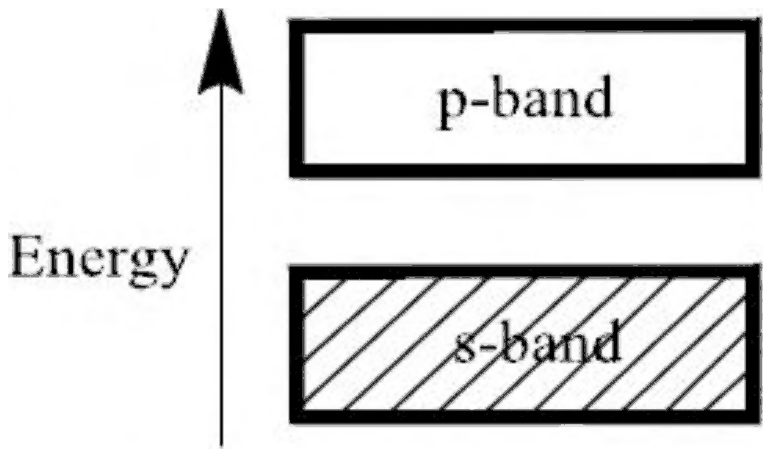
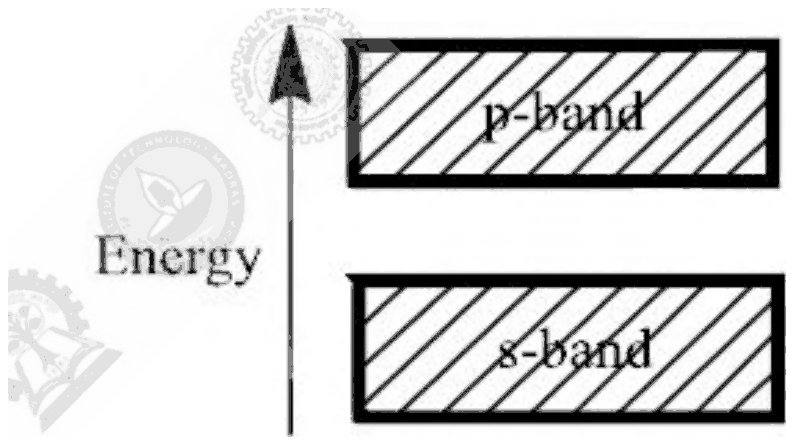
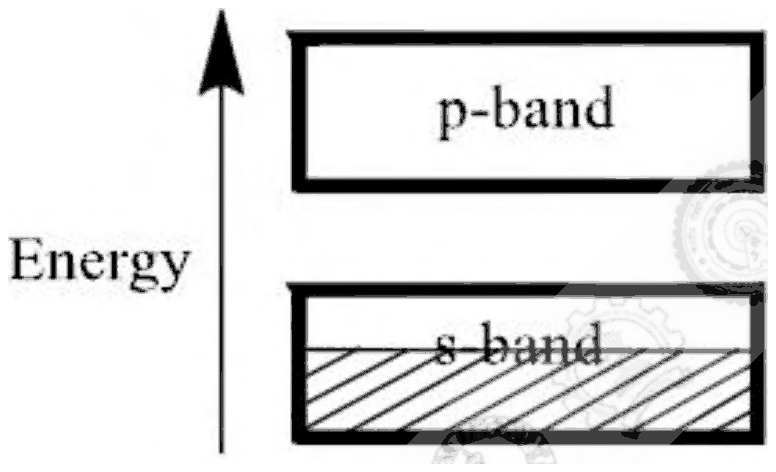
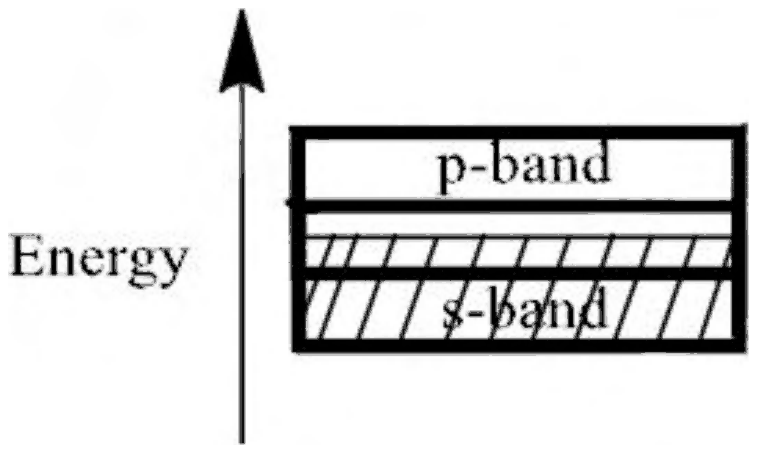
The energy band diagram for magnesium is

(The hatched and unhatched regions in the figure correspond to filled and unfilled regions of the band, respectively.)

Exam Year(s)

GATE Chemistry - 2017,

Answer: D

The band diagram for magnesium is (D), where the s-band and the p-band overlap and the combined band is only partly filled.

Magnesium has the configuration [Ne]3s2. If the 3s and 3p bands were separate, the two electrons per atom would exactly fill the s-band and leave the p-band empty, as in (A), and magnesium would be an insulator. Magnesium is a good metal because the 3s and 3p bands overlap: electrons spill into the bottom of the p-band, leaving both partly filled, with empty levels immediately above the highest filled ones.

(B) shows both bands full, which would need more electrons than magnesium has. (C) shows a half-filled, separate s-band, which describes sodium (3s1), not magnesium.

Please log in or register to report this question.
3.

P, F and I represent primitive, face-centered and body-centered lattices, respectively. The lattice types of NaCl and CsCl, respectively, are

Exam Year(s)

GATE Chemistry - 2017,

Answer: B

The lattice types are F and P.

NaCl has a face-centred cubic lattice: the Cl- ions form an fcc array, and each lattice point carries a basis of one Na+ and one Cl-, so the lattice type is F.

In CsCl, Cs+ sits at the body centre of a cube of Cl- ions. It looks body-centred, but the body-centre site holds a different ion from the corners, so it is not a lattice point equivalent to the corners. The lattice is simple cubic (P) with a two-ion basis.

Calling CsCl body-centred (I) is the common trap; a true I lattice needs identical atoms at the corners and the centre, as in metallic iron.

Please log in or register to report this question.
4.

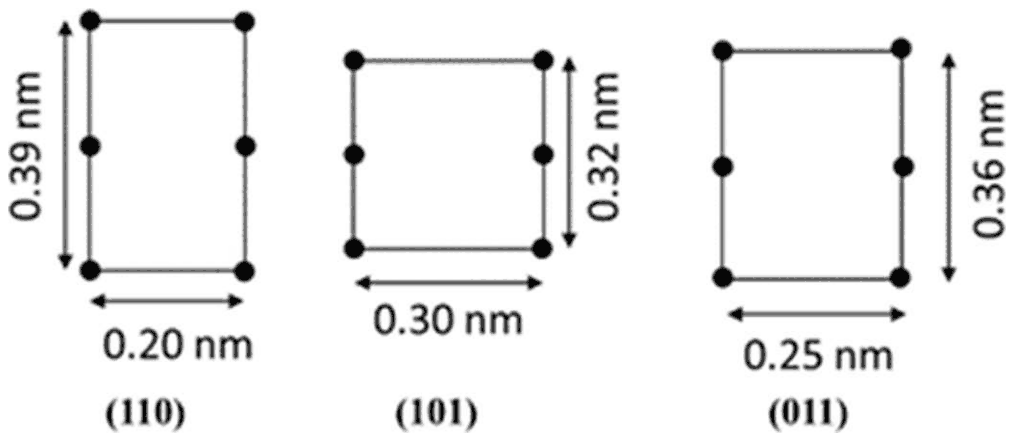
Three different crystallographic planes of a unit cell of a metal are given below (solid circles represent atom). The crystal system of the unit cell is

Three rectangles of atoms: plane (110) is 0.20 nm by 0.39 nm, plane (101) is 0.30 nm by 0.32 nm and plane (011) is 0.25 nm by 0.36 nm

Exam Year(s)

GATE Chemistry - 2022,

Answer: D

The unit cell is orthorhombic.

Each plane is a rectangle whose sides are one cell edge and one face diagonal. The (110) plane contains the edge c and the diagonal \(\sqrt{a^{2}+b^{2}}\); (101) contains b and \(\sqrt{a^{2}+c^{2}}\); (011) contains a and \(\sqrt{b^{2}+c^{2}}\). Taking the short sides as edges, \(c = 0.20\), \(b = 0.30\) and \(a = 0.25\) nm. The diagonals then check out:

\[ \begin{aligned} \sqrt{0.25^{2}+0.30^{2}} &= 0.39\ \text{nm} \\ \sqrt{0.25^{2}+0.20^{2}} &= 0.32\ \text{nm} \\ \sqrt{0.30^{2}+0.20^{2}} &= 0.36\ \text{nm} \end{aligned} \]

All three planes are rectangles, so the axes are mutually perpendicular, and the three edges are all different: \(a \ne b \ne c\) with all angles 90°, which defines the orthorhombic system. Tetragonal needs two equal edges, while monoclinic and triclinic need at least one non-right angle, which would make some of these sections parallelograms.

Please log in or register to report this question.
5.

The packing efficiency (in %) of spheres for a body-centered cubic (bcc) lattice is approximately

Exam Year(s)

GATE Chemistry - 2023,

Answer: B

The packing efficiency of a bcc lattice is about 68%.

A bcc cell of edge a holds 2 atoms, and they touch along the body diagonal, so \(4r = \sqrt{3}a\):

\[ \begin{aligned} f &= \frac{2 \times \tfrac{4}{3}\pi r^{3}}{a^{3}} = \frac{\sqrt{3}\pi}{8} \\ &\approx 0.680 \end{aligned} \]

74% is the value for the close-packed fcc (ccp) and hcp structures, and 52% is the simple cubic value (\(\pi/6\)). 60% matches no common lattice.

Please log in or register to report this question.
6.

The essential symmetry(ies) for a monoclinic crystal system is/are the presence of

Exam Year(s)

GATE Chemistry - 2025,

Answer: B

The essential symmetry is one \(C_2\) axis.

Each crystal system is defined by its minimum symmetry. A monoclinic crystal needs a single twofold axis (or, equivalently for the lattice, a single mirror plane perpendicular to it), which is why one of its three cell angles differs from 90 degrees.

One \(C_3\) axis is the essential symmetry of the trigonal (rhombohedral) system, one \(C_4\) axis of the tetragonal system, and one \(C_6\) axis of the hexagonal system. So of the four, only the \(C_2\) axis applies; this multiple-select question has that single correct choice.

Please log in or register to report this question.

7.

The number of crystal systems and the number of Bravais lattices are, respectively,

Exam Year(s)

IIT JAM - 2018,

Answer: D

There are 7 crystal systems and 14 Bravais lattices.

The seven crystal systems are cubic, tetragonal, orthorhombic, hexagonal, trigonal (rhombohedral), monoclinic and triclinic. Combining them with the possible centrings (primitive, body-centred, face-centred and base-centred) gives the 14 distinct Bravais lattices.

32 is the number of crystallographic point groups (crystal classes), which is the trap in the options pairing 32 with 7 or 14. '14 and 7' simply reverses the two numbers.

Please log in or register to report this question.

8.

Which of the following is the correct order of conductivity (in S m-1 )?

Exam Year(s)

KEAM - 2025,

Answer: A

The correct order is Fe < Na < Cu < Ag.

Approximate conductivities at 298 K (S m-1) are: iron \(1.0 \times 10^{7}\), sodium \(2.1 \times 10^{7}\), copper \(5.9 \times 10^{7}\) and silver \(6.2 \times 10^{7}\). Silver is the best metallic conductor and iron the poorest of the four.

Placing copper below sodium, or starting with sodium, misplaces the soft alkali metal, which conducts better than iron but worse than copper.

Please log in or register to report this question.

9.

A scientist attempts to replace a few carbon atoms in 1.0 g of diamond with boron atoms or nitrogen atoms in separate experiments. Which of the following is correct ?

Exam Year(s)

MH SET - 2019, SET Exam - 2019,

Answer: B

The correct statement is that with B doping the material will be a p-type semiconductor.

Each carbon in diamond forms four bonds. Boron has only three valence electrons, so a boron atom in a carbon site leaves one bond short of an electron, creating a hole. Holes are mobile positive charge carriers, so boron-doped diamond is a p-type semiconductor (natural blue diamonds owe their colour and conductivity to boron).

Nitrogen, with five valence electrons, donates an extra electron and gives n-type behaviour, so calling N-doped diamond p-type is wrong, as is calling B-doped diamond n-type. Substitutional doping does not require multiple bonds, so the statement that B cannot be incorporated is also false.

Please log in or register to report this question.

10.

Burgers vector is a measure of the lattice distortion due to the presence of :

Exam Year(s)

MH SET - 2019, SET Exam - 2019,

Answer: B

The Burgers vector measures the lattice distortion caused by a line defect.

Dislocations are one-dimensional (line) defects. The Burgers vector is found by drawing a closed circuit of lattice steps around the dislocation line and comparing it with the same circuit in a perfect crystal; the vector needed to close the circuit gives the magnitude and direction of the distortion. It is perpendicular to the line for an edge dislocation and parallel to it for a screw dislocation.

Point defects (vacancies, interstitials), surface defects (grain boundaries, stacking faults) and volume defects (voids, precipitates) are not characterised by a Burgers vector.

Please log in or register to report this question.

Loading…
Tags: Solid State Chemistry Questions and Answers