
Machine-translated by Google. Questions are authored in English.
Top

Basic Concepts of Polymers Questions and Answers

Answer: B

The blend is immiscible due to entropic constraints.

The free energy of mixing is \(\Delta G_{m} = \Delta H_{m} - T\Delta S_{m}\). For small molecules the combinatorial entropy of mixing is large and drives mixing, but for long chains it is tiny, because each chain contributes only one translational unit however many segments it has (in the Flory-Huggins expression the entropy terms are divided by the chain lengths). Even a small positive enthalpy of mixing between the similar but not identical PE and PP segments then outweighs it, and the polymers separate. The paper attributes this to the entropic constraint.

Being polyolefins with similar solubility parameters is not enough for high polymers, so both 'miscible' options are wrong.

Please log in or register to report this question.
12.

From the dynamic mechanical analysis of a polymer sample with a phase angle of 30°, the relationship between storage modulus (E') and loss modulus (E'') can be expressed as

Exam Year(s)

GATE XE - 2022,

Answer: A

The relation is E' = \(\sqrt{3}\) E''.

In dynamic mechanical analysis the loss tangent is the ratio of loss to storage modulus, \(\tan\delta = E''/E'\). With \(\delta = 30^{\circ}\):

\[ \begin{aligned} \frac{E''}{E'} &= \tan 30^{\circ} = \frac{1}{\sqrt{3}} \\ E' &= \sqrt{3}E'' \end{aligned} \]

\(E'' = \sqrt{3}E'\) is the case \(\delta = 60^{\circ}\). The two options with a factor 2 use \(\sin\) or \(\cos\) of 30° (0.5 and \(\sqrt{3}/2\)) instead of the tangent.

Please log in or register to report this question.

13.

Match the properties in Column A with their respective unit in Column B

Column AColumn B
P. Surface resistivity1. Ohm-cm
Q. Volume resistivity2. S cm-1
R. Coefficient of thermal expansion3. Ohm
S. Electrical conductivity4. K-1

Exam Year(s)

GATE XE - 2022,

Answer: C

The match is P-3; Q-1; R-4; S-2.

  • Surface resistivity is the resistance across a square of surface, so its unit is the ohm (often written ohm per square).
  • Volume resistivity is resistance times area over thickness: ohm-cm.
  • The coefficient of thermal expansion is a fractional change per kelvin: K-1.
  • Electrical conductivity is the reciprocal of resistivity: S cm-1.

The options pairing surface resistivity with ohm-cm or S cm-1, or the expansion coefficient with S cm-1, confuse these.

Please log in or register to report this question.

14.

Match the polymers with their characteristic infrared (IR) stretching frequency

PolymerIR stretch (cm-1)
P. Polyurethane1. ~2234
Q. Polyethylene2. ~1151
R. Polysulfone3. ~1720
S. Acrylonitrile-butadiene-styrene copolymer4. ~2914

Exam Year(s)

GATE XE - 2022,

Answer: B

The match is P-3; Q-4; R-2; S-1.

  • Polyurethane: the urethane C=O stretch, about 1720 cm-1.
  • Polyethylene: the CH2 C-H stretch, about 2914 cm-1.
  • Polysulfone: the symmetric O=S=O stretch, about 1150 cm-1.
  • ABS: the nitrile C≡N stretch from acrylonitrile, about 2234 cm-1.

The options giving polyethylene the 1720 or 1151 band, or the sulfone the 2234 band, mismatch the groups: polyethylene has only C-H and C-C bonds, and only ABS has a nitrile.

Please log in or register to report this question.

15.

A copper wire upon loading instantaneously increases in length to l, and then continues to elongate gradually. Upon unloading, the wire retracts to length l. According to the Maxwell model, which one of the options given correctly relates the total strain E, the applied stress S, the modulus G, the material’s resistance to flow \(\eta\), and the elapsed time t between loading and unloading?

Exam Year(s)

GATE XE - 2023,

Answer: C

The Maxwell model gives E = (S/G) + (S/\(\eta\))t.

The Maxwell model is a spring (modulus G) and a dashpot (viscosity \(\eta\)) in series. Under a constant stress S, both elements carry the full stress and their strains add. The spring stretches at once by S/G, the instantaneous elongation to l; the dashpot flows at a constant rate S/\(\eta\), so after time t it has added (S/\(\eta\))t, the gradual creep:

\[ E = \frac{S}{G} + \frac{S}{\eta}t \]

On unloading only the spring recovers, which is why the wire retracts by the elastic part and keeps the viscous flow. Subtracting the terms, multiplying them or dividing them has no basis: strains of elements in series simply add.

Please log in or register to report this question.

16.

Among the options given, identify the correct match between the polymers and their glass transition temperatures (\(T_{g}\)).

PolymerGlass transition temperature (°C)
PHigh density polyethylene1\(\gt 200\)
QPoly(vinyl carbazole)2145 to 155
RPolymethyl methacrylate3-100 to -80
SPolycarbonate490 to 100

Exam Year(s)

GATE XE - 2023,

Answer: B

The correct match is P-3; Q-1; R-4; S-2.

  • High density polyethylene: a flexible chain with no side groups, so \(T_{g}\) is far below room temperature, around -100 to -80°C (3).
  • Poly(vinyl carbazole): the very bulky, rigid carbazole side group stiffens the chain enough to push \(T_{g}\) above 200°C (1).
  • PMMA: an amorphous glassy plastic at room temperature, with \(T_{g}\) usually quoted near 100°C, which is the 90 to 100°C band (4).
  • Polycarbonate: rigid aromatic rings in the backbone give \(T_{g}\) near 145 to 150°C (2).

The other options misplace these; any option putting HDPE above room temperature, or PMMA above 200°C, can be ruled out at once.

Please log in or register to report this question.

17.

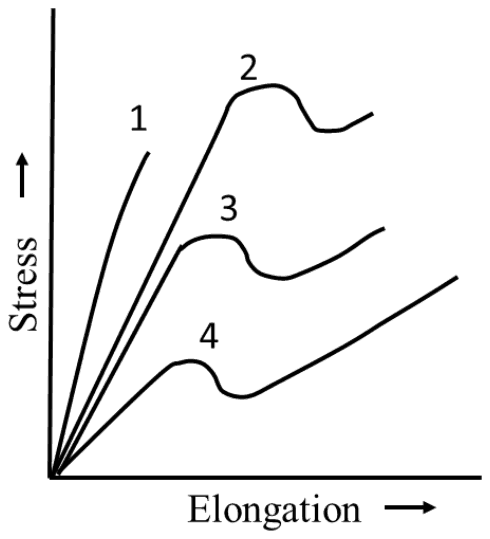
Stress versus elongation profiles for different polymeric materials are shown in the figure. Choose the combination that best describes these profiles.

Four stress-elongation curves from the origin: 1 steepest, breaking early; 2 steep, yielding at the highest stress, then dropping; 3 yielding lower, dropping, then rising; 4 lowest slope, small yield bump, longest rise

Exam Year(s)

GATE XE - 2023,

Answer: C

The keyed combination is 1-Polystyrene; 2-Nylon fibers; 3-Polyethylene; 4-Vulcanized rubber.

Curve 1 has the steepest initial slope and ends abruptly at a small elongation with no yield: a hard, brittle glassy polymer. Polystyrene is the brittle material in the list, and it is the only reading that fits curve 1. That alone settles the answer, since only one option labels curve 1 polystyrene.

The rest follows the same pattern of decreasing stiffness. Nylon fibres (2), oriented and partly crystalline, are stiff and strong and yield at the highest stress. Polyethylene (3) yields at a lower stress and then cold-draws, the stress falling and then rising as the neck propagates. Vulcanized rubber (4) has the lowest modulus and the largest elongation.

The other options give curve 1 to nylon, polyethylene or rubber, none of which breaks in that stiff, brittle way at so small an elongation.

Please log in or register to report this question.

18.

Melting phenomenon in a semi-crystalline polymer is a ________ order phase transition.

Exam Year(s)

GATE XE - 2024,

Answer: B

Melting is a first order phase transition.

At the melting point the crystalline regions absorb latent heat, and volume, enthalpy and entropy change discontinuously. Discontinuities in the first derivatives of the Gibbs free energy define a first-order transition in Ehrenfest's scheme.

The glass transition, by contrast, shows only a change in slope of volume and enthalpy (a step in heat capacity and expansion coefficient) and is often described as pseudo-second-order. Zeroth and third order do not describe melting.

Please log in or register to report this question.

19.

The 'die swell' phenomenon exhibited by a polymer melt is due to

Exam Year(s)

GATE XE - 2024,

Answer: D

Die swell is due to elastic recovery.

A polymer melt is viscoelastic. In the die, the chains are stretched and oriented by shear and elongation, storing elastic energy. When the extrudate leaves the die, the constraint is removed and the chains recover part of that deformation, so the extrudate swells to a larger cross-section than the die (the Barus effect).

Purely viscous deformation is not recoverable and would give no swell, plastic deformation is permanent, and although the melt is both viscous and elastic, the swelling itself comes from the elastic recovery.

Please log in or register to report this question.

20.

Match the following properties with their respective units.

PropertyUnit
P.Notched Izod impact strength1.Pa s
Q.Flexural strength2.J m-1
R.Dielectric strength3.MPa
S.Complex viscosity4.kV cm-1

Exam Year(s)

GATE XE - 2024,

Answer: C

The correct matching is P-2; Q-3; R-4; S-1.

  1. Notched Izod impact strength is the energy absorbed per unit notch width, in J m-1 (P-2).
  2. Flexural strength is a stress, in MPa (Q-3).
  3. Dielectric strength is the breakdown voltage per unit thickness, in kV cm-1 (R-4).
  4. Complex viscosity, from oscillatory rheometry, is a viscosity, in Pa s (S-1).

The other options give impact strength the unit of viscosity or stress, or swap the units of flexural and dielectric strength.

Please log in or register to report this question.

Loading…

Other Subjects

Tags: Basic Concepts of Polymers Questions and Answers || Basic Concepts of Polymers MCQ Questions and Answers || Basic Concepts of Polymers GK Questions and Answers || Basic Concepts of Polymers GK MCQ Questions || Basic Concepts of Polymers Multiple Choice Questions and Answers || Basic Concepts of Polymers GK || GK on Basic Concepts of Polymers || Polymer Chemistry Questions and Answers || Polymer Chemistry MCQ Questions and Answers || Polymer Chemistry GK Questions and Answers || GK on Polymer Chemistry