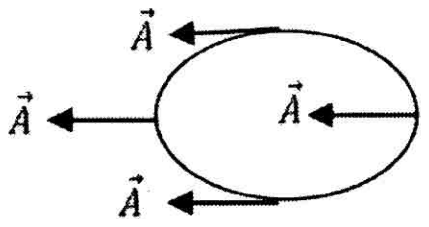
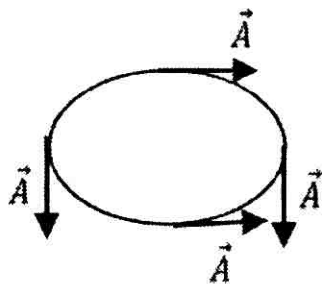
An interstellar object has speed \(v\) at the point of its shortest distance \(R\) from a star of much larger mass \(M\). Given \(v^{2} = 2GM/R\), the trajectory of the object is
GATE Physics - 2018,
Answer: C
The trajectory is a parabola.
The total energy per unit mass at closest approach is
\[ \begin{aligned} \varepsilon &= \frac{v^{2}}{2} - \frac{GM}{R} \\ &= \frac{GM}{R} - \frac{GM}{R} = 0 \end{aligned} \]
The sign of the energy fixes the conic: negative for bound orbits (circle or ellipse), zero for a parabola, positive for a hyperbola. Here \(v\) is exactly the escape speed \(\sqrt{2GM/R}\), so the energy is zero and the path is a parabola.
A circular orbit would need \(v^{2} = GM/R\), and any speed between that and escape speed gives an ellipse. A hyperbola needs \(v^{2} \gt 2GM/R\).
Please log in or register to report this question.