
Machine-translated by Google. Questions are authored in English.
Top

Ocean Atmosphere Interaction Questions and Answers

41.

What is the approximate value of annual-mean pH of seawater at the surface in the northern Indian Ocean?

Exam Year(s)

GATE XE - 2026,

Answer: C

The surface pH is about 8.0.

Seawater is mildly alkaline because it is strongly buffered by the carbonate system (dissolved CO2, bicarbonate and carbonate). Open-ocean surface water has a pH of about 8.0 to 8.1, and the northern Indian Ocean is close to that, a little lower than before industrial times because of ocean acidification.

4.5 and 5.0 are acidic values typical of rain or acidic lakes, and 11.0 is far more alkaline than any natural seawater.

Please log in or register to report this question.
42.

In a two-layered fluid system, temperature and salinity values are given for cases P, Q and R. Which of the following options indicates that the process of ‘salt fingering’ is likely to occur?

LayerCase: PCase: QCase: R
Upper (1)T1 = 30 °C, S1 = 35 psuT1 = 30 °C, S1 = 35 psuT1 = 30 °C, S1 = 35 psu
Lower (2)T2 = 31 °C, S2 = 35.5 psuT2 = 29 °C, S2 = 34 psuT2 = 29.5 °C, S2 = 36 psu

Exam Year(s)

GATE XE - 2026,

Answer: B

Salt fingering is likely in only Q.

Salt fingering occurs when warm, salty water lies over cooler, fresher water. The column is stable overall, because the temperature effect wins, but heat diffuses about a hundred times faster than salt, so a parcel of upper water pushed down loses its heat while keeping its salt, becomes denser than its surroundings and keeps sinking in thin 'fingers'.

  • Case Q: the upper layer (30 °C, 35 psu) is warmer and saltier than the lower (29 °C, 34 psu): salt fingering.
  • Case P: the upper layer is cooler and fresher than the lower, the opposite arrangement, which gives diffusive layering instead.
  • Case R: the upper layer is warmer and fresher; both temperature and salinity make it stable, so no double-diffusive instability occurs.

Please log in or register to report this question.
43.

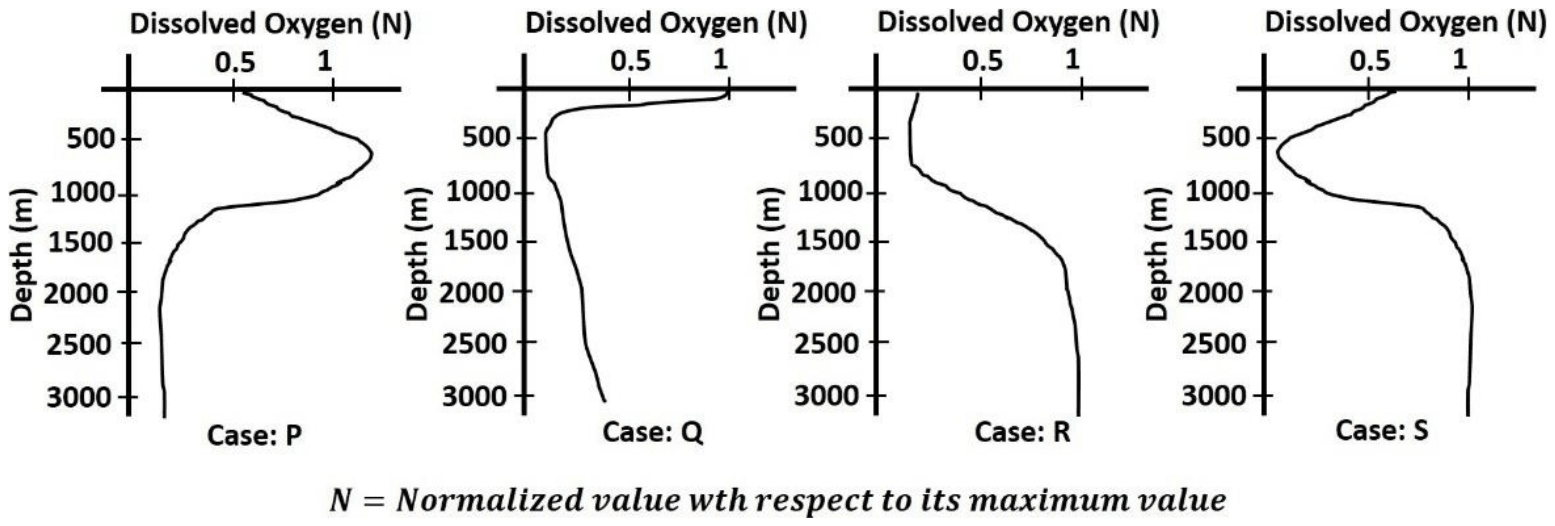
From the given cases (P, Q, R and S), which represents the annual mean profile of dissolved oxygen in the Bay of Bengal?

Four normalised dissolved oxygen profiles to 3000 m. P peaks near 700 m. Q is 1 at the surface, falls almost to zero within 200 m and recovers slowly to 0.4. R is low near the surface and rises to 1 below 1500 m. S has a minimum near 700 m and rises to 1 below 1500 m

Exam Year(s)

GATE XE - 2026,

Answer: B

The Bay of Bengal profile is Q.

The Bay of Bengal has a high oxygen concentration only in the thin, well-mixed surface layer. Just below, from roughly 100 m to about 1000 m, lies a strong oxygen minimum zone, because organic matter sinking from the productive surface and river inputs is decomposed while the strongly stratified, sluggishly ventilated water below is not replenished. Concentrations then recover only slowly towards depth.

Profile Q shows exactly this: a surface maximum, a sharp drop to near zero within the upper few hundred metres, and a slow rise below. P has a subsurface maximum, R lacks the surface maximum, and S places the minimum too deep and recovers to the maximum value at depth, unlike the Bay of Bengal.

Please log in or register to report this question.

Answer: C

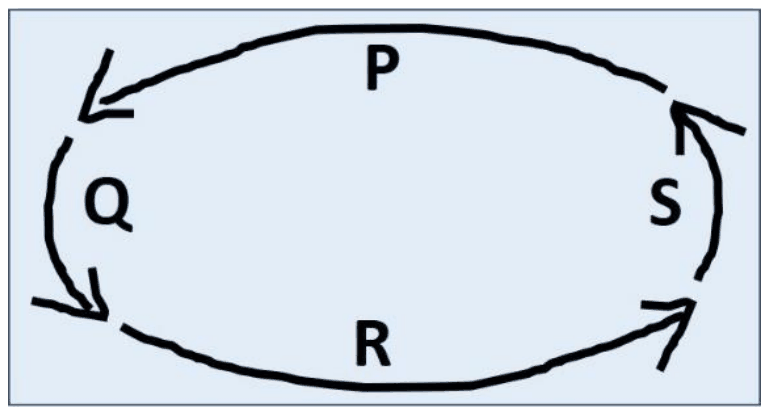
The sequence is South Equatorial Current, Madagascar Current, South Indian Ocean Current and West Australian Current.

Subtropical gyres in the Southern Hemisphere turn anticlockwise. In the southern Indian Ocean:

  • P, flowing west on the northern side, is the South Equatorial Current, driven by the south-east trades.
  • Q, flowing south on the western side, is the Madagascar Current (feeding the Agulhas Current), the western boundary current.
  • R, flowing east on the southern side, is the South Indian Ocean Current, driven by the westerlies.
  • S, flowing north on the eastern side, is the West Australian Current.

The other options put the West Australian Current on the western side or the South Indian Ocean Current on the west or east, contradicting the geography.

Please log in or register to report this question.

Loading…

Other Subjects

Tags: Ocean Atmosphere Interaction Questions and Answers || Ocean Atmosphere Interaction MCQ Questions and Answers || Ocean Atmosphere Interaction GK Questions and Answers || Ocean Atmosphere Interaction GK MCQ Questions || Ocean Atmosphere Interaction Multiple Choice Questions and Answers || Ocean Atmosphere Interaction GK || GK on Ocean Atmosphere Interaction || Climatology Questions and Answers || Climatology MCQ Questions and Answers || Climatology GK Questions and Answers || GK on Climatology