
Machine-translated by Google. Questions are authored in English.
Top

Turbulent Flow and Pipe Losses Questions and Answers

Direction for [ Question No: 1 To 1 ] :

In the pipe network shown in the figure, all pipes have the same cross-section and can be assumed to have the same friction factor. The pipes connecting points \(W\), \(N\), and \(S\) with point \(J\) have an equal length \(L\). The pipe connecting points \(J\) and \(E\) has a length \(10L\). The pressures at the ends \(N\), \(E\), and \(S\) are equal. The flow rate in the pipe connecting \(W\) and \(J\) is \(Q\). Assume that the fluid flow is steady, incompressible, and the pressure losses at the pipe entrance and junction are negligible. Consider the following statements:

1.

I : The flow rate in pipe connecting \(J\) and \(E\) is \(Q/21\).
II: The pressure difference between \(J\) and \(N\) is equal to the pressure difference between \(J\) and \(E\).

Which one of the following options is CORRECT?

Pipes W, N, S each of length L meet at J; pipe J to E is 10L; Q enters at W

Exam Year(s)

GATE ME - 2024,

Answer: B

The correct option is I is False and II is True.

Statement II: the pressures at N, E and S are equal and all three pipes start at J, so the pressure drop from J to each end is the same. II is true.

Statement I: with the same friction factor and cross-section, the Darcy-Weisbach loss in each pipe is \(\Delta p \propto L\,Q^{2}\). Equal pressure drops therefore require

\[ \begin{aligned} L\,q_{N}^{2} &= 10L\,q_{E}^{2} \Rightarrow q_{E} = \frac{q_{N}}{\sqrt{10}} \\ Q &= q_{N} + q_{S} + q_{E} = q_{E}(2\sqrt{10} + 1) \\ q_{E} &= \frac{Q}{7.32} \end{aligned} \]

So the flow to E is about Q/7.3, not Q/21. The value Q/21 is what a loss proportional to Q (laminar flow) would give, \(q_{E} = q_{N}/10\) and \(Q = 2.1q_{N}\), but a constant friction factor makes the loss vary with \(Q^{2}\). That rules out the options with I true.

Please log in or register to report this question.
2.

In a rectangular channel of width 4 m and depth 2 m, water is running full. The bed slope is 1 in 3600. Find the velocity of the flow of water if Chezy's constant C = 60.

Exam Year(s)

DSSSB JE - 2023,

Answer: A

The channel is running full, so the area is 4 x 2 = 8 m\(^2\) and the wetted perimeter is 4 + 2 + 2 = 8 m (the free surface is not part of it). The hydraulic mean depth is \(m = A/P = 8/8 = 1\) m. By Chezy's formula:

\[ \begin{aligned} V = C\sqrt{mS} \\ &= 60\sqrt{1 \times \tfrac{1}{3600}} \\ &= 60 \times \tfrac{1}{60} = 1\ \text{m/s} \end{aligned} \]

The velocities of 2, 3 and 4 m/s would result from using too large a hydraulic mean depth, for example taking the whole perimeter as only the bed width.

Please log in or register to report this question.

3.

A 4 m wide by 2 m deep rectangular channel is flowing fully. The bed slope of the channel is 1 in 2500. If Chezy's constant is 50, what is the discharge through the channel?

Exam Year(s)

DSSSB JE - 2023,

Answer: D

Running full, the cross-sectional area is \(4 \times 2 = 8\) m\(^2\) and the wetted perimeter is \(4 + 2 + 2 = 8\) m, so the hydraulic mean depth is \(m = 1\) m. Chezy's formula gives the velocity

\[ \begin{aligned} V = C\sqrt{mS} = 50\sqrt{\tfrac{1}{2500}} \\ &= 1\ \text{m/s} \\ Q = AV = 8 \times 1 = 8\ \text{m}^3/\text{s} \end{aligned} \]

The options 6, 10 and 12 m\(^3\)/s come from a wrong area or a wrong velocity, such as using the whole perimeter of 12 m.

Please log in or register to report this question.

4.

Which of the following is/are associated with turbulent flow? i) Flow of liquid is orderly. ii) Flow of liquid is zigzag and random.

Exam Year(s)

DSSSB TGT - 2023,

Answer: B

Only statement ii goes with turbulent flow. In turbulent flow the liquid moves in a zigzag, random way, with eddies and mixing. Orderly flow, in which layers of the liquid slide smoothly past one another, is laminar flow, so statement i describes laminar flow and not turbulent flow. The options that include statement i are therefore wrong. The usual way to tell the two apart is that laminar flow is smooth and orderly, while turbulent flow is irregular, with eddies, which is the picture in statement ii.

Please log in or register to report this question.

5.

Consider steady flow of an incompressible fluid through two long and straight pipes of diameters \(d_{1}\) and \(d_{2}\) arranged in series. Both pipes are of equal length and the flow is turbulent in both pipes. The friction factor for turbulent flow though pipes is of the form, \(f = K(\text{Re})^{-n}\), where K and n are known positive constants and Re is the Reynolds number. Neglecting minor losses, the ratio of the frictional pressure drop in pipe 1 to that in pipe 2, \(\left(\frac{\Delta P_{1}}{\Delta P_{2}}\right)\), is given by

Exam Year(s)

GATE ME - 2017,

Answer: A

The ratio is \(\left(\frac{d_{2}}{d_{1}}\right)^{(5-n)}\).

The Darcy-Weisbach equation gives \(\Delta P = f\frac{L}{d}\frac{\rho V^{2}}{2}\). With the same flow rate in both pipes, \(V \propto 1/d^{2}\) and \(Re \propto Vd \propto 1/d\), so \(f \propto Re^{-n} \propto d^{n}\):

\[ \begin{aligned} \Delta P &\propto d^{n} \cdot \frac{1}{d} \cdot \frac{1}{d^{4}} = d^{\,n-5} \\ \frac{\Delta P_{1}}{\Delta P_{2}} &= \left(\frac{d_{1}}{d_{2}}\right)^{n-5} = \left(\frac{d_{2}}{d_{1}}\right)^{5-n} \end{aligned} \]

The exponent 5 alone is the constant-friction-factor result, (5 + n) has the Reynolds-number effect in the wrong direction, and (3 - n) mishandles the velocity dependence.

Please log in or register to report this question.

6.

Oil flows through a 200 mm diameter horizontal cast iron pipe (friction factor, f = 0.0225) of length 500 m. The volumetric flow rate is 0.2 m3/s. The head loss (in m) due to friction is (assume g = 9.81 m/s2)

Exam Year(s)

GATE ME - 2012,

Answer: A

The head loss is about 116.18 m.

Find the velocity, then apply the Darcy-Weisbach equation:

\[ \begin{aligned} A &= \tfrac{\pi}{4}(0.2)^{2} = 0.031416\ \text{m}^{2} \\ v &= \frac{0.2}{0.031416} = 6.366\ \text{m/s} \end{aligned} \]

\[ \begin{aligned} h_{f} &= \frac{fLv^{2}}{2gD} \\ &= \frac{0.0225 \times 500 \times 6.366^{2}}{2 \times 9.81 \times 0.2} \\ &= \frac{455.9}{3.924} = 116.2\ \text{m} \end{aligned} \]

232.36 is twice the correct value, the result of dropping the 2 in 2g. 0.116 is the right digits with the decimal point moved three places, and 18.22 does not come from the Darcy-Weisbach equation with these data.

Please log in or register to report this question.

7.

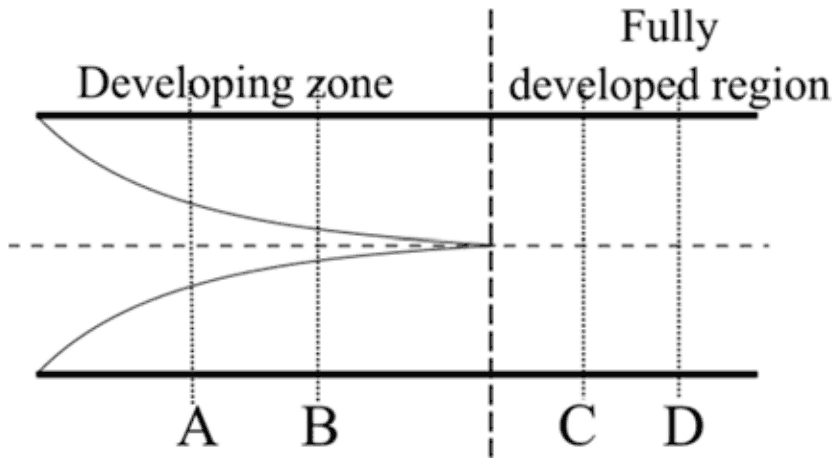
The figure shows the developing zone and the fully developed region in a pipe flow where the steady flow takes place from left to right. The wall shear stress in the sections A, B, C, and D are given by \(\tau_{A}, \tau_{B}, \tau_{C}\), and \(\tau_{D}\), respectively. Select the correct statement.

A pipe with boundary layers growing from the inlet until they meet; sections A and B lie in the developing zone, A upstream of B, and C and D in the fully developed region

Exam Year(s)

GATE XE - 2022,

Answer: A

The correct statement is \(\tau_{A} \gt \tau_{B}\).

At the pipe entrance the boundary layer is very thin, so the velocity gradient at the wall, and with it the wall shear stress \(\tau = \mu (du/dy)_{wall}\), is large. As the boundary layer thickens along the developing zone the wall gradient falls, so the shear stress decreases with distance: section A, upstream of B, has the larger value.

Once the flow is fully developed the velocity profile no longer changes along the pipe, so the wall shear stress is constant: \(\tau_{C} = \tau_{D}\), which rules out \(\tau_{C} \gt \tau_{D}\). The fully developed value is the lowest along the pipe, so \(\tau_{C} \gt \tau_{B}\) is also wrong, as is \(\tau_{B} \gt \tau_{A}\).

Please log in or register to report this question.

8.

The hydraulic diameter for a circular pipe of radius \(R\) is

Exam Year(s)

GATE XE - 2024,

Answer: C

The hydraulic diameter is 2R.

Hydraulic diameter is defined as four times the flow area divided by the wetted perimeter:

\[ D_h = \frac{4A}{P} = \frac{4\pi R^{2}}{2\pi R} = 2R \]

For a full circular pipe it is simply the pipe diameter, which is why the definition carries the factor 4. 0.5R is the hydraulic radius \(A/P\), R is the pipe radius, and 4R double-counts the factor of 2.

Please log in or register to report this question.

9.

A liquid flows under steady and incompressible flow conditions from station 1 to station 4 through pipe sections P, Q, R, and S as shown in figure. Consider, \(d\), \(V\), and \(h\) represent the diameter, velocity, and head loss, respectively, in each pipe section with subscripts ‘P’, ‘Q’, ‘R’, and ‘S’. \(\Delta h\) represents the head difference between the inlet (station 1) and outlet (station 4). All the pipe sections are placed on the same horizontal plane for which the figure shows the top view.

[The top view shows pipe P from station 1 to station 2, then a wider pipe Q from station 2 to station 3, after which the flow divides into two parallel branches, R and S, that rejoin at station 4 before the outlet.]

Which one of the following options is correct for the given flow loop?

Exam Year(s)

GATE XE - 2025,

Answer: C

The correct pair is \(\Delta h = h_{P} + h_{Q} + h_{R}\) and \(V_{P}d_{P}^{2} = V_{Q}d_{Q}^{2} = V_{R}d_{R}^{2} + V_{S}d_{S}^{2}\).

P and Q are in series, so their head losses add and they carry the same flow. R and S are in parallel between stations 3 and 4, so each has the same head loss, \(h_{R} = h_{S}\), and the loss across the pair is counted once. Hence \(\Delta h = h_{P} + h_{Q} + h_{R}\).

The flow rate \(Q = \frac{\pi}{4}d^{2}V\) is the same in P and Q, and it divides between R and S, so \(V_{P}d_{P}^{2} = V_{Q}d_{Q}^{2} = V_{R}d_{R}^{2} + V_{S}d_{S}^{2}\).

Adding \(h_{S}\) as well double-counts the parallel branch, and writing \(V_{R}d_{R}^{2} = V_{S}d_{S}^{2}\) equal to the total flow treats the parallel branches as if each carried all of it.

Please log in or register to report this question.

10.

Consider two different cases of water flowing through a smooth pipe of 50 cm diameter. The mass flow rates for the two cases are (i) 0.25 kg.s-1, and (ii) 0.8 kg.s-1. Assume the density and dynamic viscosity of water as 1000 kg.m-3 and 10-3 Pa.s, respectively. Which one of the following options is correct?

Exam Year(s)

GATE XE - 2026,

Answer: A

The flow is laminar for both (i), and (ii).

For a circular pipe the Reynolds number can be written directly in terms of the mass flow rate:

\[ Re = \frac{\rho VD}{\mu} = \frac{4\dot{m}}{\pi D\mu} \]

\[ \begin{aligned} Re_{i} &= \frac{4(0.25)}{\pi(0.5)(10^{-3})} \approx 637 \\ Re_{ii} &= \frac{4(0.8)}{\pi(0.5)(10^{-3})} \approx 2037 \end{aligned} \]

Both are below the usual transition value of about 2300 for pipe flow, so both flows are laminar. The large 50 cm diameter keeps the velocity, and so the Reynolds number, low. The options calling either case turbulent overestimate Re.

Please log in or register to report this question.

Loading…
Tags: Turbulent Flow and Pipe Losses Questions and Answers || Turbulent Flow and Pipe Losses MCQ Questions and Answers || Turbulent Flow and Pipe Losses GK Questions and Answers || Turbulent Flow and Pipe Losses GK MCQ Questions || Turbulent Flow and Pipe Losses Multiple Choice Questions and Answers || Turbulent Flow and Pipe Losses GK || GK on Turbulent Flow and Pipe Losses || Fluid Mechanics Questions and Answers || Fluid Mechanics MCQ Questions and Answers || Fluid Mechanics GK Questions and Answers || GK on Fluid Mechanics