
Machine-translated by Google. Questions are authored in English.
Top

Flow Measurement Devices Questions and Answers

1.

Which principle does a venturimeter primarily utilize to measure fluid flow?

Exam Year(s)

DSSSB - 2023,

Answer: B

A venturimeter works on Bernoulli's principle. In the converging section the velocity rises and the pressure falls, and the drop in pressure between the inlet and throat, measured by a manometer, gives the discharge. Newton's third law, Pascal's principle and Archimedes' principle are not used for measuring the flow in this way.

Please log in or register to report this question.
2.

If a pitot tube is placed in a fluid flow and indicates a stagnation pressure equal to the static pressure, what can be inferred about the fluid velocity at that location?

Exam Year(s)

DSSSB - 2023,

Answer: A

If the stagnation pressure indicated by a pitot tube equals the static pressure, then the dynamic pressure \(\frac{1}{2}\rho v^{2}\) is zero, so the velocity of the fluid is zero at that location. The stagnation pressure is the sum of the static pressure and the dynamic pressure, and the dynamic pressure is zero only when the velocity is zero. A maximum or an average velocity would give a positive dynamic pressure, and equal readings are not an error in the tube.

Please log in or register to report this question.
3.

A vortex flowmeter works on the principle that the Strouhal number of 0.2 is a constant over a wide range of flow rates. If the bluff-body diameter in the flowmeter is 20 mm and the piezo-electric transducer registers the vortex shedding frequency to be 10 Hz, then the velocity of the flow would be measured as

Exam Year(s)

GATE AE - 2012,

Answer: B

The flow velocity is 1 m/s.

The Strouhal number relates shedding frequency \(f\), body diameter \(d\) and velocity \(V\):

\[ \begin{aligned} St &= \frac{fd}{V} \\ V &= \frac{fd}{St} = \frac{10 \times 0.020}{0.2} \\ &= 1\ \text{m/s} \end{aligned} \]

The other options differ from it by factors of ten, the usual result of a unit slip with the diameter or the frequency. Keeping \(d\) in metres and \(f\) in hertz gives 1 m/s.

Please log in or register to report this question.

4.

The pressure drop through a well-designed constriction is to be used for measuring the velocity of flow through a circular pipe. If the pressure drop from a 0.1 m diameter section to a 0.05 m diameter section of the pipe is 7.5 kPa, the velocity in m s-1 in the 0.1 m diameter section of the pipe is ____________.

(Take density of liquid = 1000 kg m-3)

Exam Year(s)

GATE AG - 2022,

Answer: B

The velocity in the 0.1 m section is 1.0 m/s.

The constriction acts as a venturi meter. Continuity links the two velocities: the diameter halves, so the area falls to a quarter and \(V_{2} = 4V_{1}\). Bernoulli’s equation between the two sections then gives

\[ \begin{aligned} \Delta p &= \tfrac{1}{2}\rho(V_{2}^{2} - V_{1}^{2}) = \tfrac{1}{2}\rho(16 - 1)V_{1}^{2} \\ 7500 &= 500 \times 15 V_{1}^{2} \\ V_{1} &= 1.0\ \text{m/s} \end{aligned} \]

The throat velocity is 4.0 m/s. A value of 0.5 or 1.5 would give pressure drops of 1.9 kPa or 16.9 kPa, and 2.0 m/s would need 30 kPa.

Please log in or register to report this question.

5.

Match the devices in Column I with the characteristics in Column II.

Column IColumn II
P. orifice meter1. high head loss and low cost
Q. venturi meter2. high head loss and high cost
3. low head loss and high cost
4. low head loss and low cost

Exam Year(s)

GATE XE - 2012,

Answer: D

The match is P - 1; Q - 3.

An orifice meter is just a thin plate with a hole clamped between flanges, so it is cheap to make and install. But the jet contracts sharply (the vena contracta) and then expands abruptly, so much of the pressure drop is never recovered: high head loss, low cost.

A venturi meter has a smooth converging section, a throat and a long gradual diffuser that recovers most of the pressure, so its permanent head loss is low; but it is long and precisely machined, so it is expensive. Options pairing the orifice with high cost or the venturi with low cost or high loss reverse these features.

Please log in or register to report this question.

6.

The velocity of an air stream is 20 m/s. The densities of mercury and air are 13600 kg/m3 and 1.2 kg/m3, respectively. The gravitational acceleration may be taken as 10 m/s2. When a Pitot-static tube is placed in the stream, assuming the flow to be incompressible and frictionless, the difference between the stagnation and static pressure in the flow field (in mm Hg) would approximately be

Exam Year(s)

GATE XE - 2012,

Answer: B

The pressure difference is about 1.76 mm Hg.

A Pitot-static tube reads the dynamic pressure, the difference between stagnation and static pressure:

\[ \begin{aligned} \Delta p &= \tfrac{1}{2}\rho_{air}V^{2} = \tfrac{1}{2}(1.2)(20)^{2} = 240\ \text{Pa} \\ h &= \frac{\Delta p}{\rho_{Hg}g} = \frac{240}{13600 \times 10} \\ &= 1.76 \times 10^{-3}\ \text{m} = 1.76\ \text{mm} \end{aligned} \]

1760 is the same column expressed in micrometres, a units slip. 0.57 is the reciprocal of 1.76, and \(0.57 \times 10^{-5}\) compounds that with a wrong power of ten.

Please log in or register to report this question.

7.

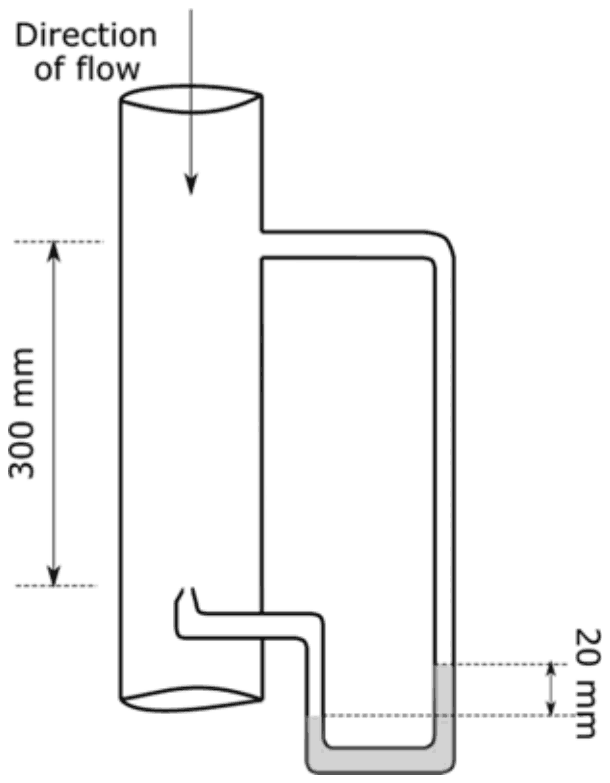
Consider an inviscid flow through a smooth pipe which has a pitot-static tube arrangement as shown. Find the centre-line velocity in the pipe.

Consider that the density of the fluid is 1000 kg/m3, acceleration due to gravity is 10 m/s2, and the specific gravity of the manometric fluid is 11.

A vertical pipe with flow downward; a pitot tube on the centre-line faces the flow and a static tap 300 mm above it, both connected to a U-tube manometer showing a 20 mm difference

Exam Year(s)

GATE XE - 2022,

Answer: A

The centre-line velocity is 2 m/s.

The pitot tube reads the stagnation pressure and the static tap the static pressure. In the manometer the difference in piezometric head shows up as the 20 mm deflection of the manometric fluid; the 300 mm vertical spacing between the two openings is accounted for by the fluid columns in the connecting lines and does not appear in the result. So

\[ \begin{aligned} \frac{1}{2}\rho V^{2} &= (\rho_{m} - \rho) g h \\ &= (11000 - 1000)(10)(0.02) = 2000\ \text{Pa} \\ V &= \sqrt{\frac{2 \times 2000}{1000}} = 2\ \text{m/s} \end{aligned} \]

Using the full manometric density 11000 instead of the difference gives about 2.1 m/s, and 3, 5 and 7 m/s do not follow from a 20 mm reading with these densities.

Please log in or register to report this question.

8.

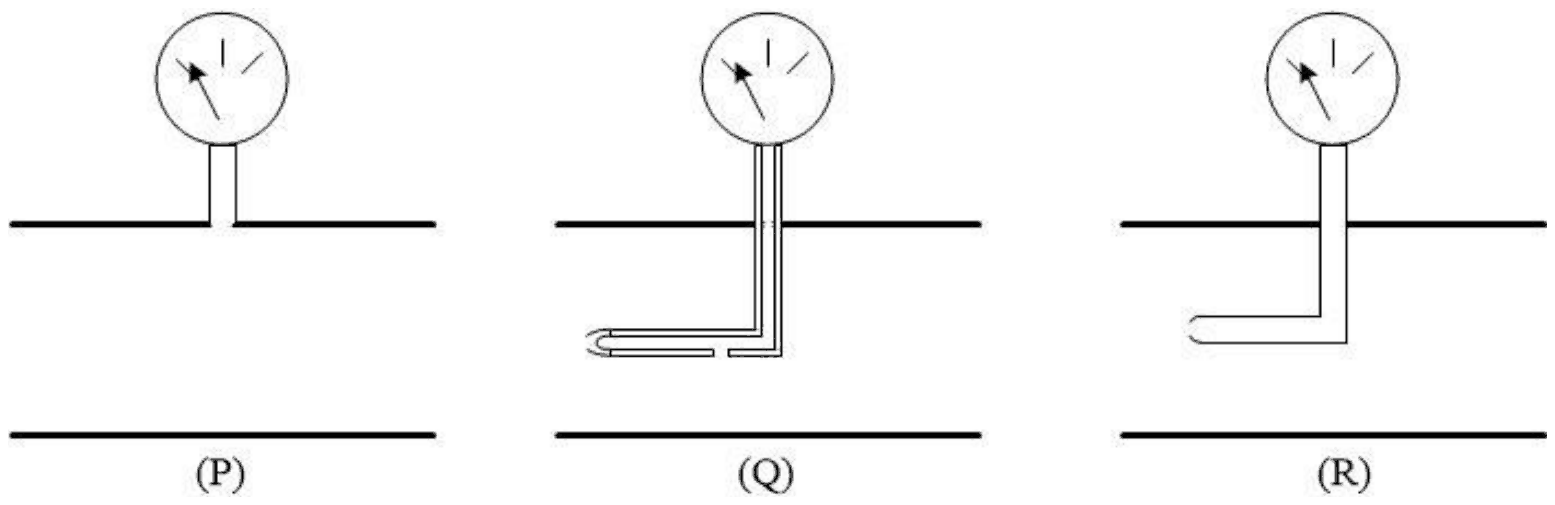
Match the following measuring instruments with the appropriate figures.

I - Pitot probe
II - Pitot-static probe
III - Piezometer

Three pressure gauges on a pipe: P connected to a tapping flush with the pipe wall; Q connected to an L-shaped double tube in the flow with an open nose and side openings; R connected to a single L-shaped tube whose open end faces along the pipe

Exam Year(s)

GATE XE - 2023,

Answer: B

The correct match is I - R; II - Q; III - P.

  • Pitot probe (R): a single L-shaped tube whose open end faces the oncoming flow. The fluid is brought to rest at the opening, so the gauge reads the stagnation (total) pressure.
  • Pitot-static probe (Q): two concentric tubes. The inner one is open at the nose and senses stagnation pressure; the outer one has holes in its side wall, parallel to the flow, which sense static pressure. Their difference gives the dynamic pressure and hence the velocity.
  • Piezometer (P): a tapping flush with the pipe wall, which disturbs nothing and reads the static pressure only.

The options pairing P with either probe give a wall tapping the job of a probe that has to sit in the stream, and those calling Q a simple Pitot probe ignore its second, static-pressure tube.

Please log in or register to report this question.

9.

If Cv , Cc , Cd and Cr are the hydraulic coefficients of an orifice , then :

Where, Cv= coefficient of velocity
Cc = Coefficient of contraction
Cd = coefficient of discharge
Cr = coefficient of retention

Exam Year(s)

RSMSSB JE - 2025, RSMSSB JE Agriculture - 2025, RSMSSB - 2025,

Answer: B

The correct relation is \(C_d = C_c \times C_v\).

Actual discharge is the actual area of the jet at the vena contracta times the actual velocity there. The area is \(C_c\) times the orifice area and the velocity \(C_v\) times the theoretical velocity, so

\[ \begin{aligned} Q_{act} &= (C_c a)(C_v \sqrt{2gH}) \\ C_d &= \frac{Q_{act}}{a\sqrt{2gH}} = C_c C_v \end{aligned} \]

The coefficients multiply, so a sum as in the first option is wrong, and \(C_c = C_v/C_d\) inverts the relation (it should be \(C_c = C_d/C_v\)). The relation offered for \(C_r\) is not a standard result.

Please log in or register to report this question.

10.

Consider a fluid flow through an orifice of area 0.8 m2 with an actual discharge of 800 lit/s. If the velocity of flow through the orifice is 2m/s, then the coefficient of discharge is:

Exam Year(s)

RSMSSB JE - 2025, RSMSSB JE Agriculture - 2025, RSMSSB - 2025,

Answer: B

The coefficient of discharge is 0.50.

The coefficient of discharge is the actual discharge divided by the discharge the area and velocity would give. Convert 800 lit/s to 0.8 m3/s first.

\[ \begin{aligned} C_d &= \frac{Q}{aV} = \frac{0.8}{0.8 \times 2} \\ &= 0.50 \end{aligned} \]

0.68, 0.71 and 0.56 are values near the usual range of \(C_d\) for orifices (about 0.6 to 0.65), but they do not follow from these data.

Please log in or register to report this question.

Loading…
Tags: Flow Measurement Devices Questions and Answers || Flow Measurement Devices MCQ Questions and Answers || Flow Measurement Devices GK Questions and Answers || Flow Measurement Devices GK MCQ Questions || Flow Measurement Devices Multiple Choice Questions and Answers || Flow Measurement Devices GK || GK on Flow Measurement Devices || Fluid Mechanics Questions and Answers || Fluid Mechanics MCQ Questions and Answers || Fluid Mechanics GK Questions and Answers || GK on Fluid Mechanics