
Machine-translated by Google. Questions are authored in English.
Top

Feedback Amplifiers Questions and Answers

101.

An amplifier has \( 60 \ \mathrm{dB} \) of loop gain at \( 1 \ \mathrm{kHz} \) and a dominant pole at \( 10 \ \mathrm{Hz} \). Its loop gain at \( 10 \ \mathrm{kHz} \) is about

Answer: A

Above the dominant pole the gain falls twenty decibels per decade:

\[ 60 - 20 = 40 \ \mathrm{dB} \]

giving about 40 dB, so the distortion correction has fallen by a factor of ten over one decade of frequency. That is why distortion measurements are quoted at several frequencies rather than one, and why a figure at a kilohertz says little about behaviour at twenty.

Please log in or register to report this question.
Answer: B

Because the loop gain falls with frequency, the same amplifier corrects far less at twenty kilohertz than at one, so a single figure would flatter it. Device linearity is roughly constant, load variation is a separate matter that also deserves specifying, and the equipment is adequate. A specification that varies by a factor of ten across the intended band has to be quoted across that band, and a single headline figure should always prompt the question of where it was measured.

Please log in or register to report this question.
103.

Consider the following statements about an internally compensated operational amplifier.

1. Its dominant pole is placed at a few hertz

2. It is stable at any closed-loop gain down to unity

3. Its distortion correction is constant across the audio band

Which of the statements given above is or are correct?

Answer: C

The first two are correct and the third is not: the loop gain falls twenty decibels per decade above the dominant pole, so the correction at twenty kilohertz is some sixty times less than at twenty hertz. The first two statements are two views of the same design choice, and the third is the price it charges at the top of the band. A device stable everywhere is necessarily one whose loop gain has been given away at high frequency, and the distortion figure shows it.

Please log in or register to report this question.

104.

Consider the following pairs of limit and its cause.

Slew rate - Fixed charging current into the compensation capacitor

Clipping - The supply rails

Small-signal bandwidth - The dominant pole and the closed-loop gain

Rising distortion with frequency - Falling device linearity

How many of the pairs given above are correctly matched?

Answer: D

The first three are correctly paired and the fourth is not, so three match. Distortion rises with frequency because the loop gain falls, not because the devices themselves become less linear. Three independent limits on one amplifier, each with its own cause and its own remedy, and attributing a symptom to the wrong one leads to buying a faster amplifier when a larger supply was wanted or the reverse.

Please log in or register to report this question.

105.

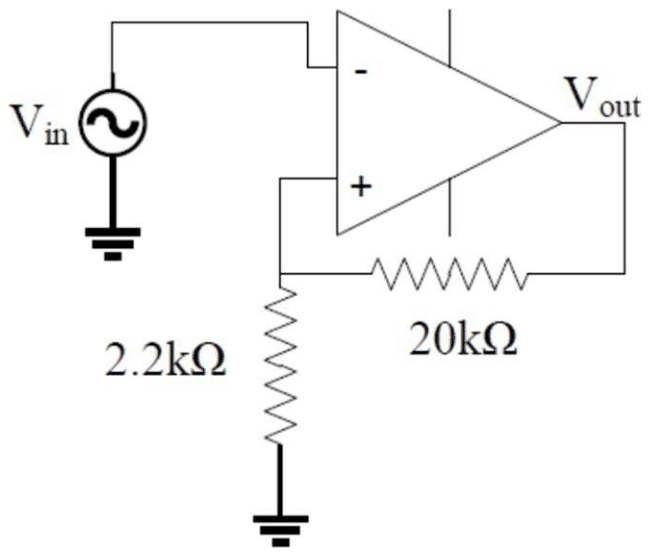
For the Op-Amp circuit shown below, choose the correct output waveform corresponding to the input \(V_{in} = 1.5\sin 20\pi t\) (in Volts). The saturation voltage for this circuit is \(V_{sat} = \pm 10\) V.

Op-amp with Vin at the inverting input; the output is fed back through 20 kilohm to the non-inverting input, which goes to ground through 2.2 kilohm

Exam Year(s)

GATE Physics - 2022,

Answer: A

The output is (A), a square wave switching between +10 V and −10 V.

The input goes to the inverting terminal and the output is fed back to the non-inverting terminal through the 20 kΩ/2.2 kΩ divider. That is positive feedback, so the circuit is an inverting Schmitt trigger: the output sits at +10 V or −10 V. The switching thresholds are the fed-back fraction of the output:

\[ \begin{aligned} V_{T} &= \pm 10 \times \frac{2.2}{2.2 + 20} \\ &\approx \pm 0.99\ \text{V} \end{aligned} \]

The 1.5 V peak input crosses both thresholds every cycle, so the output flips between the two saturation levels at the input frequency (10 Hz), producing a square wave.

A constant +10 V would mean the input never reached the threshold, which it does. A sine of amplitude 10 would need linear negative feedback, and 0 V would need no gain at all.

Please log in or register to report this question.

Answer: A

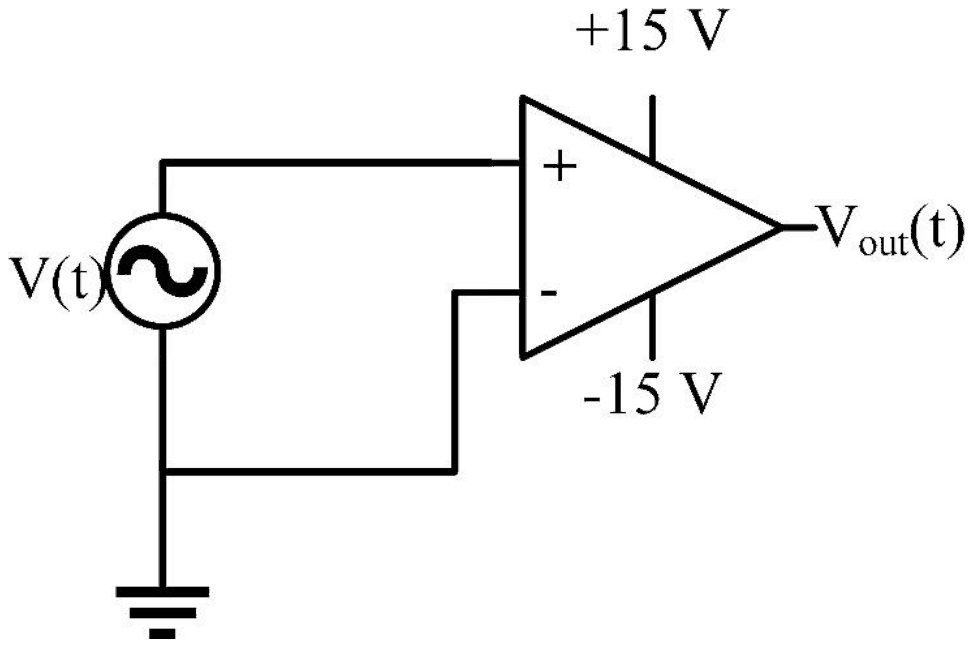
\(V_{out}\) is a square wave of 30 V peak-to-peak with a period of 1 ms.

With no feedback, an ideal op-amp has infinite open-loop gain, so it acts as a comparator: the output sits at the positive rail, +15 V, whenever the non-inverting input is above the inverting input (here, ground), and at −15 V whenever it is below. The sine input crosses zero twice per cycle, so the output switches between +15 V and −15 V, a square wave of 30 V peak-to-peak.

The input \(2\sin(2000\pi t)\) has \(\omega = 2000\pi\), so f = 1000 Hz and the period is 1 ms; the square wave has the same period. A 4 V peak-to-peak output would mean unity gain (a follower), which needs negative feedback, and a 30 V sine wave would need a finite gain of 7.5.

Please log in or register to report this question.

107.

An amplifier having open loop gain of 100 is provided with a negative feedback having feedback factor of 0.02. The gain of the amplifier after feedback will be :

Exam Year(s)

MH SET - 2019, SET Exam - 2019,

Answer: B

The gain with feedback is 33.33.

With negative feedback, the closed-loop gain is:

\[ \begin{aligned} A_{f} &= \frac{A}{1 + A\beta} \\ &= \frac{100}{1 + 100 \times 0.02} \\ &= \frac{100}{3} \approx 33.33 \end{aligned} \]

Negative feedback trades gain for stability and bandwidth, so the gain falls by the factor \(1 + A\beta = 3\). The value 50.00 is \(1/\beta\), the approximation that holds only when \(A\beta \gg 1\); here \(A\beta = 2\), so it does not apply. The other values do not follow from the formula.

Please log in or register to report this question.

108.

Gain bandwidth product of an amplifier after inclusion of negative feedback :

Exam Year(s)

MH SET - 2020, SET Exam - 2020,

Answer: C

The gain-bandwidth product remains constant.

For an amplifier with a single dominant pole, negative feedback reduces the gain by the factor (1 + Aβ) and increases the bandwidth by the same factor. The product of the two is therefore unchanged: an op-amp with a gain-bandwidth product of 1 MHz gives a bandwidth of 100 kHz at a gain of 10 and 10 kHz at a gain of 100.

So the product neither decreases nor increases, and it certainly does not become zero; feedback only trades gain for bandwidth.

Please log in or register to report this question.

109.

Match the pairs between List I and List II :

List IList II
(a) Negative feedback(1) Comparator with controlled hysteresis
(b) Bipolar junction transistor(2) Increased stability
(c) Operational amplifier(3) Current controlled current amplifier
(d) Schmitt Trigger(4) High open loop gain

Codes : (a) (b) (c) (d)

Exam Year(s)

MH SET - 2020, SET Exam - 2020,

Answer: C

The correct code is (2) (3) (4) (1).

  • (a) Negative feedback gives increased stability of gain against changes in the device.
  • (b) A bipolar junction transistor is a current controlled current amplifier: the collector current is controlled by the base current.
  • (c) An operational amplifier is marked by its very high open loop gain.
  • (d) A Schmitt trigger is a comparator with controlled hysteresis.

Option A swaps the op-amp and Schmitt trigger, and options B and D misplace negative feedback and the BJT.

Please log in or register to report this question.

110.

Identify the correct sequence of the following with increasing value of gain :

(i) Amplifier without feedback
(ii) Amplifier with positive feedback
(iii) Oscillator
(iv) Amplifier with negative feedback

Codes :

Exam Year(s)

MH SET - 2021, SET Exam - 2021,

Answer: C

In increasing order of gain the sequence is (iv), (i), (ii), (iii).

Negative feedback reduces gain to \(A/(1 + A\beta)\), so the amplifier with negative feedback has the least gain. The amplifier without feedback has its open-loop gain A. Positive feedback increases gain to \(A/(1 - A\beta)\), larger than A while Aβ is less than 1. An oscillator is the limit where Aβ = 1, so the gain becomes infinite and the circuit produces an output with no input.

The other codes misplace at least one of these, for example by putting the oscillator before the amplifiers or starting from the amplifier without feedback.

Please log in or register to report this question.

Loading…
Tags: Feedback Amplifiers Questions and Answers || Feedback Amplifiers MCQ Questions and Answers || Feedback Amplifiers GK Questions and Answers || Feedback Amplifiers GK MCQ Questions || Feedback Amplifiers Multiple Choice Questions and Answers || Feedback Amplifiers GK || GK on Feedback Amplifiers || Analog Electronics Questions and Answers || Analog Electronics MCQ Questions and Answers || Analog Electronics GK Questions and Answers || GK on Analog Electronics