
Machine-translated by Google. Questions are authored in English.
Top

Frequency Response of Amplifiers Questions and Answers

101.

A cable of \( 100 \ \mathrm{pF} \) loads a stage whose output impedance is \( 2 \ \mathrm{k\Omega} \). The break is at about

Answer: A

The output impedance works into the cable capacitance:

\[ \begin{aligned} f &= \frac{1}{2\pi (2000)(100 \times 10^{-12})} \\ &\approx 800 \ \mathrm{kHz} \end{aligned} \]

so about 800 kHz. Driving the same cable from sixty ohms would move the break to twenty-six megahertz, which is why a follower or a line driver is fitted whenever a cable has to be driven. The cable is the same; the difference is entirely in what drives it.

Please log in or register to report this question.
Answer: B

The gain-bandwidth product states what is available to trade, so the bandwidth at any chosen gain follows from one division. Midband gain alone says nothing about speed, the lower break concerns the other end entirely, and the phase at the break is fixed at forty-five degrees for a single pole and so carries no information. A figure of merit that combines two specifications into a conserved quantity is worth more than either alone, and it is why data sheets lead with it.

Please log in or register to report this question.
103.

Which of the following is not a way to widen a stage's bandwidth?

Increasing the collector load resistance

Adding a cascode device

Lowering the source impedance

Reducing the load capacitance

Answer: C

Increasing the collector load raises the gain and lowers the break in the same proportion, so the bandwidth falls. The other three all attack a factor in one of the limiting time constants without raising the gain. Because gain and bandwidth trade at a roughly constant product, any change that raises the gain has to be checked for what it costs at the band edge, and this one costs exactly what it gains.

Please log in or register to report this question.
104.

The flat region of a response, where coupling capacitors are effectively shorts and shunt capacitances effectively opens, is the ______ region.

Answer: D

This is the midband region, and its usefulness is precisely that both sets of capacitances can be ignored there, leaving a calculation in resistors alone. Transition refers to the device's unity-gain frequency, and saturation and the ohmic region are operating regions rather than parts of a response. Every small-signal gain figure quoted for a stage is implicitly a midband figure, which is worth remembering when a measurement at the band edge fails to match.

Please log in or register to report this question.
105.

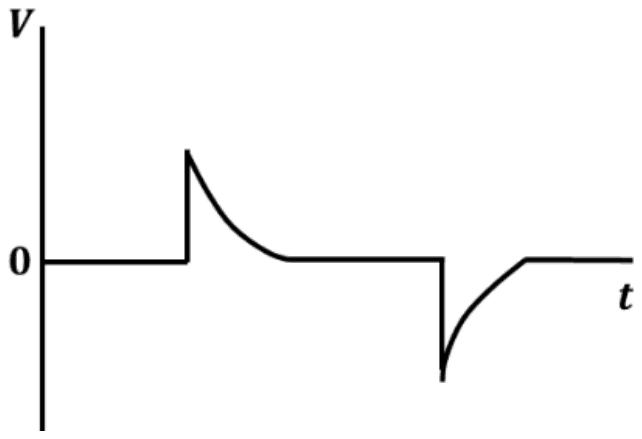
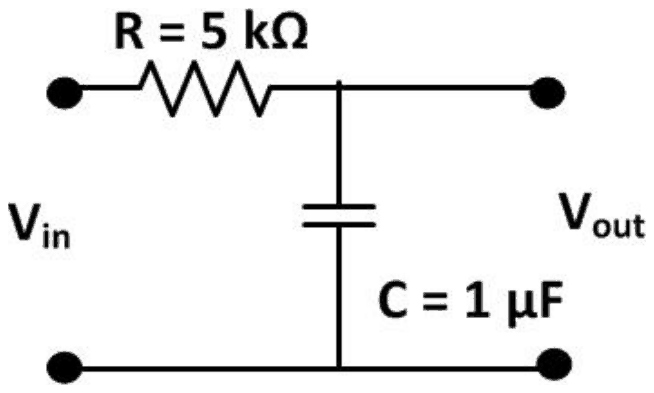
An input voltage in the form of a square wave of frequency 1 kHz is given to a circuit, which results in the output shown schematically below. Which one of the following options is the CORRECT representation of the circuit?

Output voltage against time: zero, a sharp positive spike that decays back to zero, then a sharp negative spike that decays back to zero

Exam Year(s)

GATE Physics - 2023,

Answer: A

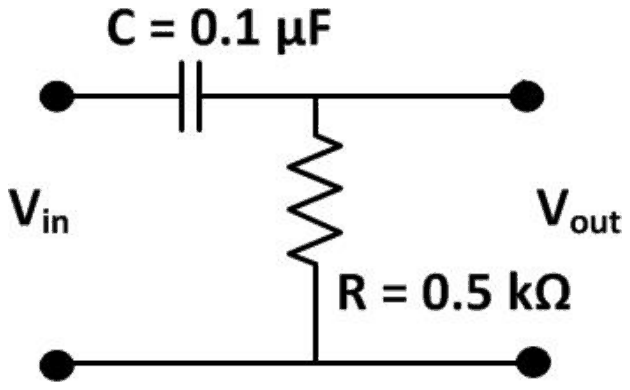
The circuit is (A): a series 0.1 μF capacitor with a shunt 0.5 kΩ resistor, a differentiator with a short time constant.

The output is a sharp spike at each edge of the square wave that dies away to zero long before the next edge. That is the response of a high-pass RC circuit (capacitor in series, output across the resistor) whose time constant is much shorter than the half period.

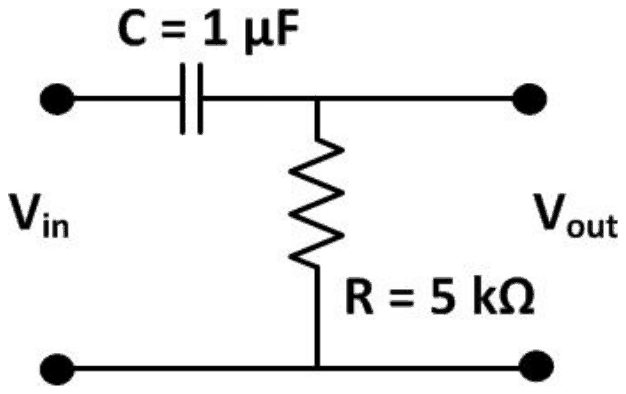
\[ \begin{aligned} \tau_{A} &= 0.5\ \text{k}\Omega \times 0.1\ \mu\text{F} = 50\ \mu\text{s} \\ T/2 &= 0.5\ \text{ms} \end{aligned} \]

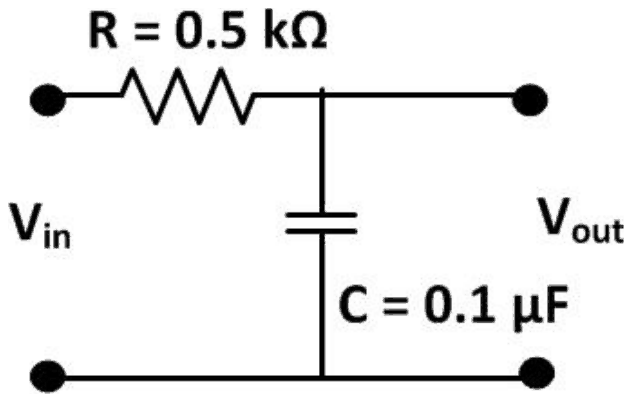
With \(\tau \ll T/2\) each spike decays fully, as drawn. Circuit (B) has the same layout but \(\tau = 5\) ms, ten times the half period, so its output would barely decay and look like a slightly tilted square wave. Circuits (C) and (D) take the output across the capacitor; these low-pass integrators give smoothed or ramp-like versions of the square wave, not spikes.

Please log in or register to report this question.
Loading…
Tags: Frequency Response of Amplifiers Questions and Answers || Frequency Response of Amplifiers MCQ Questions and Answers || Frequency Response of Amplifiers GK Questions and Answers || Frequency Response of Amplifiers GK MCQ Questions || Frequency Response of Amplifiers Multiple Choice Questions and Answers || Frequency Response of Amplifiers GK || GK on Frequency Response of Amplifiers || Analog Electronics Questions and Answers || Analog Electronics MCQ Questions and Answers || Analog Electronics GK Questions and Answers || GK on Analog Electronics