
Machine-translated by Google. Questions are authored in English.
Top

Magnetic Forces and Materials Questions and Answers

81.

An infinitely long cylinder of radius \(R\) carries a frozen-in magnetization \(\vec{M} = ke^{-s}\hat{z}\), where \(k\) is a constant and \(s\) is the distance from the axis of cylinder. The magnetic permeability of free space is \(\mu_{0}\). There is no free current present anywhere. The magnetic flux density \((\vec{B})\) inside the cylinder is

Exam Year(s)

GATE Physics - 2024,

Answer: C

The flux density inside is \(\mu_{0}ke^{-s}\hat{z}\).

With no free current, ∮ H · dl = 0. Take a rectangular loop with one side inside the cylinder parallel to the axis and the other far outside. For an infinitely long cylinder with axial magnetization, H outside is zero and H inside is parallel to the axis, so H must be zero inside as well. Then

\[ \begin{aligned} \vec{B} &= \mu_{0}(\vec{H} + \vec{M}) \\ &= \mu_{0}\vec{M} = \mu_{0}ke^{-s}\hat{z} \end{aligned} \]

Zero would ignore the magnetization entirely. μ0ke-R uses the value of M at the surface everywhere, and the extra factor R/s has no source in this geometry: B simply follows M point by point.

Please log in or register to report this question.
82.

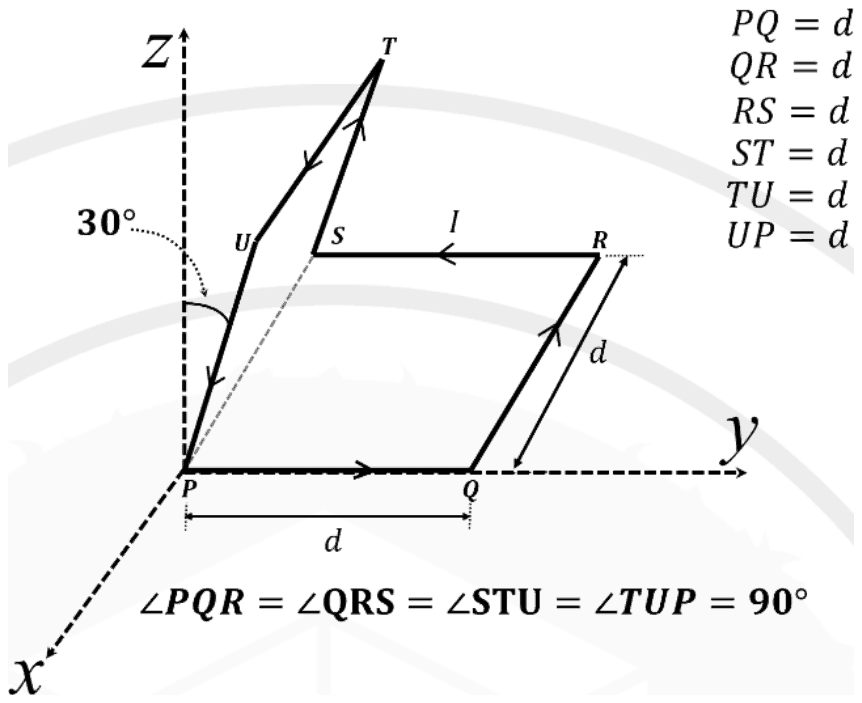
The wire loop shown in the figure carries a steady current \(I\). Each straight section of the loop has length \(d\). A part of the loop lies in \(xy\) plane and the other part is tilted at 30° with respect to the \(xz\) plane. The magnitude of the magnetic dipole moment of the loop (in appropriate units) is

Loop PQRSTUP of six sides of length d: square PQRS in the xy plane with P at the origin and PQ along y, and square PSTU hinged on PS and tilted 30 degrees from the xz plane

Exam Year(s)

GATE Physics - 2025,

Answer: D

The magnitude of the dipole moment is \(Id^{2}\).

Add and subtract the side PS (from S to P): the loop P-Q-R-S-T-U-P is then the sum of two square loops, PQRS in the \(xy\) plane and PSTU in the tilted plane, each of area \(d^{2}\), with the shared side cancelling.

PQRS, traversed P to Q (along \(+y\)) then Q to R (along \(-x\)), has moment \(Id^{2}\hat{z}\). PSTU contains PS (along \(-x\)) and PU, which leans 30° from the \(z\)-axis towards \(+y\); its moment is perpendicular to its plane:

\[ \begin{aligned} \vec{m}_{2} &= Id^{2}(\cos 30^{\circ}\hat{y} - \sin 30^{\circ}\hat{z}) \\ \vec{m} &= Id^{2}\left(\tfrac{\sqrt{3}}{2}\hat{y} + \tfrac{1}{2}\hat{z}\right) \\ |\vec{m}| &= Id^{2} \end{aligned} \]

Adding the two squares' moments as if they were perpendicular gives \(\sqrt{2}Id^{2}\), and as if parallel \(2Id^{2}\); they are in fact 120° apart, so the resultant has the magnitude of either one.

Please log in or register to report this question.

83.

Given below are two statements : one is labelled as Assertion (A) and the other is labelled as Reason (R).

Assertion (A) : A material for which \(X_{m} \gt 0\) and \(\mu_{r} \ge 1\) is said to be paramagnetic.
(Here \(X_{m}\) is magnetic susceptibility and \(\mu_{r}\) is relative permeability)
Reason (R) : A material for which \(X_{m} \gg 0,\ \mu_{r} \gg 1\) is said to be ferromagnetic.

In the light of the above statements, choose the most appropriate answer from the options given below.

Exam Year(s)

RSMSSB JE - 2025, RSMSSB - 2025,

Answer: C

(A) is false but (R) is true.

(R) is true. A ferromagnetic material has a very large positive susceptibility and a very large relative permeability, so \(X_{m} \gg 0\) and \(\mu_{r} \gg 1\) is the usual description of one.

(A) is false. A paramagnetic material has a small positive susceptibility, of the order of \(10^{-5}\) to \(10^{-3}\), so that \(\mu_{r} = 1 + X_{m}\) is only just above 1. The condition given in the Assertion, \(X_{m} \gt 0\) and \(\mu_{r} \ge 1\), has no upper limit and is met by ferromagnetic materials as well, so it does not define a paramagnetic one. A diamagnetic material, by contrast, has \(X_{m} \lt 0\) and \(\mu_{r} \lt 1\).

So option B (A true, R false) and options A and D (A true) fail on the Assertion, and the Board keyed option C. A student who reads (A) loosely, as the textbook line that paramagnets have positive susceptibility, is led to option A or D; the missing size limit is what makes the Assertion wrong.

Please log in or register to report this question.

84.

A point charge ‘q’ having mass ‘m’ follows a circular trajectory of radius ‘R’ under the action of magnetic field \(\vec{B}\). The magnitude of the angular momentum of the particle is :

Exam Year(s)

MH SET - 2018, SET Exam - 2018,

Answer: D

The angular momentum is \(BqR^{2}\).

The magnetic force provides the centripetal force for circular motion:

\[ \begin{aligned} qvB &= \frac{mv^{2}}{R} \\ mv &= qBR \end{aligned} \]

The angular momentum about the centre of the circle is

\[ L = mvR = qBR \cdot R = BqR^{2} \]

It is not zero, because the particle moves in a circle about that centre. The options with \(q^{2}\) or with an extra m have the wrong dimensions; the mass cancels when mv is replaced by qBR.

Please log in or register to report this question.

85.

A unit charge q moving with initial velocity \((\overline{v} = v_{x}\hat{i})\) is subjected to external electric field \((\overline{E} = E_{y}\hat{j})\). The number of degrees of freedom is :

Exam Year(s)

MH SET - 2019, SET Exam - 2019,

Answer: B

The motion has 2 degrees of freedom.

The charge starts with velocity along \(\hat{i}\) and the only force, \(q\overline{E}\), acts along \(\hat{j}\). Nothing ever gives it a velocity component along \(\hat{k}\), so the motion stays in the x-y plane: it moves uniformly in x and accelerates in y, tracing a parabola.

Two independent coordinates, x and y, are needed to describe it, so the number of degrees of freedom is 2. A free particle in space would have 3, motion along a line 1, and zero would mean no motion at all.

Please log in or register to report this question.

86.

There is a space region where \(\overline{E} = E_{0}\hat{z}\) and \(\overline{B} = B_{0}\hat{x}\) are both present. A charged particle with velocity \(\left(\frac{E_{0}}{B_{0}}\right)\hat{y}\) enters this region. The trajectory of the particle in this region is a :

Exam Year(s)

MH SET - 2019, SET Exam - 2019,

Answer: A

The trajectory is a Straight line.

The Lorentz force on the particle is \(q(\overline{E} + \overline{v} \times \overline{B})\). With \(\overline{v} = (E_{0}/B_{0})\hat{y}\) and \(\overline{B} = B_{0}\hat{x}\):

\[ \begin{aligned} \overline{v} \times \overline{B} &= \frac{E_{0}}{B_{0}}B_{0}(\hat{y} \times \hat{x}) \\ &= -E_{0}\hat{z} \end{aligned} \]

This exactly cancels \(\overline{E} = E_{0}\hat{z}\), so the net force is zero and the particle moves undeflected in a straight line. This is the principle of the velocity selector. A particle with any other speed would follow a cycloid-type path; circles and helices need a magnetic field alone.

Please log in or register to report this question.

87.

A charged particle is released from rest in a region where both uniform constant electric field and uniform constant magnetic field are present. If these fields are perpendicular to each other, then the trajectory of the particle is a ........ .

Exam Year(s)

MH SET - 2020, SET Exam - 2020,

Answer: C

The trajectory is a cycloid.

The electric field starts the particle moving from rest, and the magnetic force \(q\bar{v} \times \bar{B}\) then bends its path. The motion is the sum of a uniform drift with velocity \(\bar{v}_{d} = \frac{\bar{E} \times \bar{B}}{B^{2}}\) and a circular motion at the cyclotron frequency. Because the particle starts at rest, the circular speed equals the drift speed, so the path is that of a point on the rim of a rolling wheel: a cycloid, which momentarily stops at each cusp.

A straight line would need no magnetic force, a circle would need no electric field, and a helix needs an initial velocity component along B.

Please log in or register to report this question.

88.

The SI unit of magnetic dipole moment is ........ .

Exam Year(s)

MH SET - 2020, SET Exam - 2020,

Answer: D

The SI unit is C m\(^{2}\)/s.

The magnetic dipole moment of a current loop is \(m = IA\), current times area, so its unit is the ampere square metre. Since one ampere is one coulomb per second:

\[ \begin{aligned} \text{A m}^{2} &= \frac{\text{C}}{\text{s}}\,\text{m}^{2} \\ &= \text{C m}^{2}/\text{s} \end{aligned} \]

The coulomb metre (C m) is the unit of the electric dipole moment, a common confusion. C m\(^{2}\) and C m/s lack the correct combination of area and time.

Please log in or register to report this question.

89.

A magnetic dipole of dipole moment (\(\vec{m}\)) is placed in a non-uniform magnetic field \(\vec{B}\). If the position vector of the dipole is \(\vec{r}\) , the torque acting on the dipole about the origin is :

Exam Year(s)

MH SET - 2024, SET Exam - 2024,

Answer: B

The torque is \(\vec{m} \times \vec{B} + \vec{r} \times \vec{\nabla}(\vec{m} \cdot \vec{B})\).

In a non-uniform field the dipole feels two things: a torque about its own centre, \(\vec{m} \times \vec{B}\), and a net force \(\vec{F} = \vec{\nabla}(\vec{m} \cdot \vec{B})\). About the origin, that force adds a moment \(\vec{r} \times \vec{F}\). The total torque about the origin is the sum.

\(\vec{m} \times \vec{B}\) alone is the torque in a uniform field or about the dipole's own centre. \(\vec{r} \times \vec{\nabla}(\vec{m} \cdot \vec{B})\) alone omits the intrinsic torque, and \(\vec{r} \times (\vec{m} \times \vec{B})\) has no physical meaning as a torque here.

Please log in or register to report this question.

90.

The induced surface current density \(\vec{K}\) on a conducting sphere, in a uniform background magnetic field, is \(\vec{K} = \left(\frac{3}{2}\right)\frac{(\vec{B} \times \hat{n})}{\mu_{0}}\). Where \(\hat{n}\) is the outward normal on the surface of the sphere. Now consider a current I flows in a long, straight wire placed along the z-axis. A conducting sphere of radius R is placed at a distance d from the wire (\(R \ll d\)). The induced surface current density on the sphere is proportional to ..........

Exam Year(s)

MH SET - 2025, SET Exam - 2025,

Answer: C

The induced surface current density is proportional to \(I/d\).

The given result says \(K = \frac{3}{2}(\vec{B}\times\hat{n})/\mu_{0}\), so \(K\) is proportional to the field the sphere sits in. Since \(R \ll d\), the field of the wire is essentially uniform across the sphere and equal to its value at distance \(d\):

\[ \begin{aligned} B &= \frac{\mu_{0}I}{2\pi d} \\ K &\sim \frac{3}{2}\cdot\frac{I}{2\pi d} \propto \frac{I}{d} \end{aligned} \]

The radius \(R\) does not appear in the formula for \(K\), so \(I/R\) and \(I/R^{2}\) are wrong; \(1/d^{2}\) would be the fall-off of a dipole-like field, not of a long straight wire, whose field falls as \(1/d\).

Please log in or register to report this question.

Loading…
Tags: Magnetic Forces and Materials Questions and Answers || Magnetic Forces and Materials MCQ Questions and Answers || Magnetic Forces and Materials GK Questions and Answers || Magnetic Forces and Materials GK MCQ Questions || Magnetic Forces and Materials Multiple Choice Questions and Answers || Magnetic Forces and Materials GK || GK on Magnetic Forces and Materials || Electromagnetic Field Theory Questions and Answers || Electromagnetic Field Theory MCQ Questions and Answers || Electromagnetic Field Theory GK Questions and Answers || GK on Electromagnetic Field Theory