
Machine-translated by Google. Questions are authored in English.
Top

Work Energy and Power Questions and Answers

1.

Suppose a person fires a bullet of mass 100.0 g with a speed of 100 m/s on a target of plywood of thickness 20 cm. The bullet emerges from the target with only 20% of its initial kinetic energy. Then the emergent speed of the bullet is:

Exam Year(s)

DSSSB JE - 2023,

Answer: B

The kinetic energy is proportional to the square of the speed. If the bullet keeps 20 percent of its kinetic energy, then \(v^2 = 0.2 \times 100^2 = 2000\), so

\[ v = \sqrt{2000} = 44.72\ \text{m/s} \]

The mass and the thickness of the plywood are not needed. A common slip is to take 20 percent of the speed, giving 20 m/s, or to use 0.2 times the energy without the square root; none of the other options, 34.70, 38.78 and 40.74 m/s, corresponds to any fraction of the energy that the question gives.

Please log in or register to report this question.
2.

Ram has a mass of 60 kg and he runs up from the ground floor to the first floor of his college through stairs of 40 steps with each step of 40 cm height in 20.0 s. The power supplied by him is ______ (take g = 10 m/s\(^2\)).

Exam Year(s)

DSSSB JE - 2023,

Answer: B

The work done is against gravity over the total height climbed. The height is 40 steps x 0.40 m = 16 m, so the work is \(mgh = 60 \times 10 \times 16 = 9600\) J. The power is the work divided by the time:

\[ P = \frac{9600}{20} = 480\ \text{W} \]

The value 240 W would come from halving the height, and 720 W and 960 W from using the wrong time or a height of 24 m or 32 m; the data give exactly 16 m and 20 s.

Please log in or register to report this question.

3.

A circular solid disc of uniform thickness 20 mm, radius 200 mm and mass 20 kg, is used as a flywheel. If it rotates at 600 rpm, the kinetic energy of the flywheel, in Joules is

Exam Year(s)

GATE ME - 2012,

Answer: B

The kinetic energy is about 790 J.

A solid disc has \(I = \tfrac{1}{2}mr^{2}\):

\[ \begin{aligned} I &= \tfrac{1}{2}(20)(0.2)^{2} = 0.4\ \text{kg m}^{2} \\ \omega &= \frac{2\pi(600)}{60} = 62.83\ \text{rad/s} \\ KE &= \tfrac{1}{2}(0.4)(62.83)^{2} = 789.6\ \text{J} \end{aligned} \]

1580 J uses \(I = mr^{2}\), the value for a thin ring, and 3160 J also drops the half in the kinetic energy formula. 395 J is half the correct value. The thickness given is not needed once the mass is known.

Please log in or register to report this question.

4.

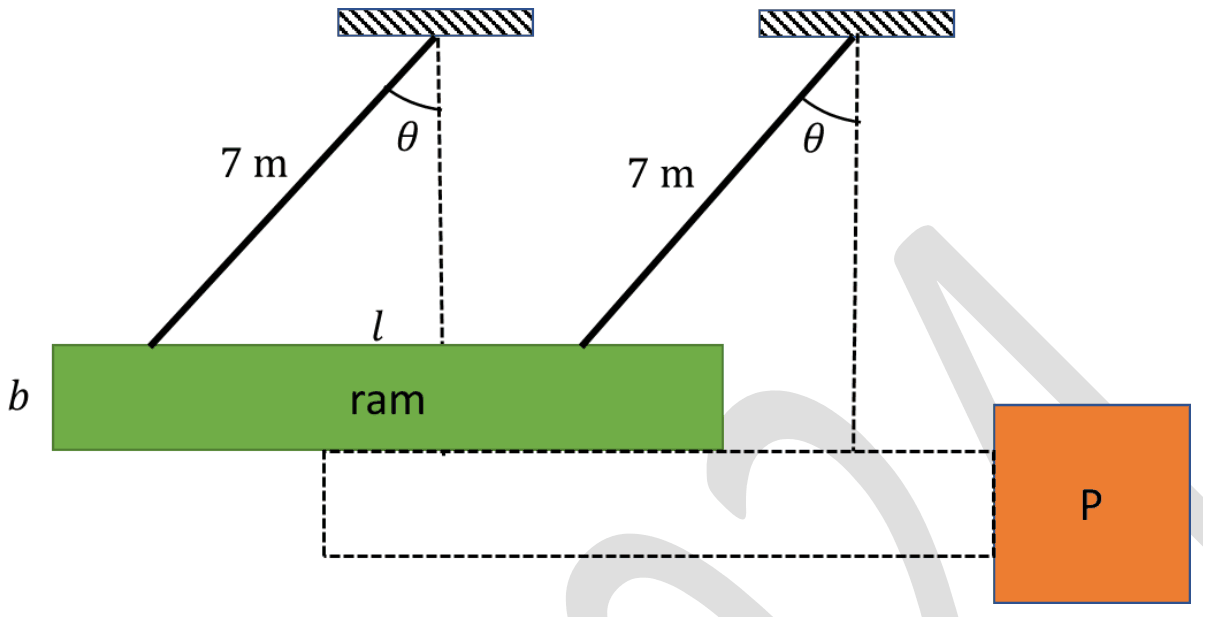
A ram in the form of a rectangular body of size \(l = 9\) m and \(b = 2\) m is suspended by two parallel ropes of lengths 7 m. Assume the center-of-mass of the body is at its geometric center and \(g = 9.81\) m/s2. For striking the object P with a horizontal velocity of 5 m/s, what is the angle \(\theta\) with the vertical from which the ram should be released from rest?

Ram on two 7 m ropes at angle theta to the vertical; dashed ram at the bottom of the swing strikes P

Exam Year(s)

GATE ME - 2024,

Answer: C

The ram should be released from 35.1°.

Because the two ropes are equal and parallel, the ram does not rotate: it moves in curvilinear translation, every point travelling on a circle of radius 7 m. Its size (9 m by 2 m) therefore does not enter. When released from angle \(\theta\), its centre of mass falls by \(7(1 - \cos\theta)\), and energy conservation gives the speed at the bottom:

\[ \begin{aligned} v^{2} &= 2gL(1 - \cos\theta) \\ 1 - \cos\theta &= \frac{25}{2 \times 9.81 \times 7} = 0.1820 \\ \cos\theta &= 0.8180 \Rightarrow \theta = 35.1^{\circ} \end{aligned} \]

The larger angles would give striking speeds well above 5 m/s; for example 67.1° corresponds to about 9.2 m/s.

Please log in or register to report this question.

Loading…
Tags: Work Energy and Power Questions and Answers || Work Energy and Power MCQ Questions and Answers || Work Energy and Power GK Questions and Answers || Work Energy and Power GK MCQ Questions || Work Energy and Power Multiple Choice Questions and Answers || Work Energy and Power GK || GK on Work Energy and Power || Engineering Mechanics Questions and Answers || Engineering Mechanics MCQ Questions and Answers || Engineering Mechanics GK Questions and Answers || GK on Engineering Mechanics